
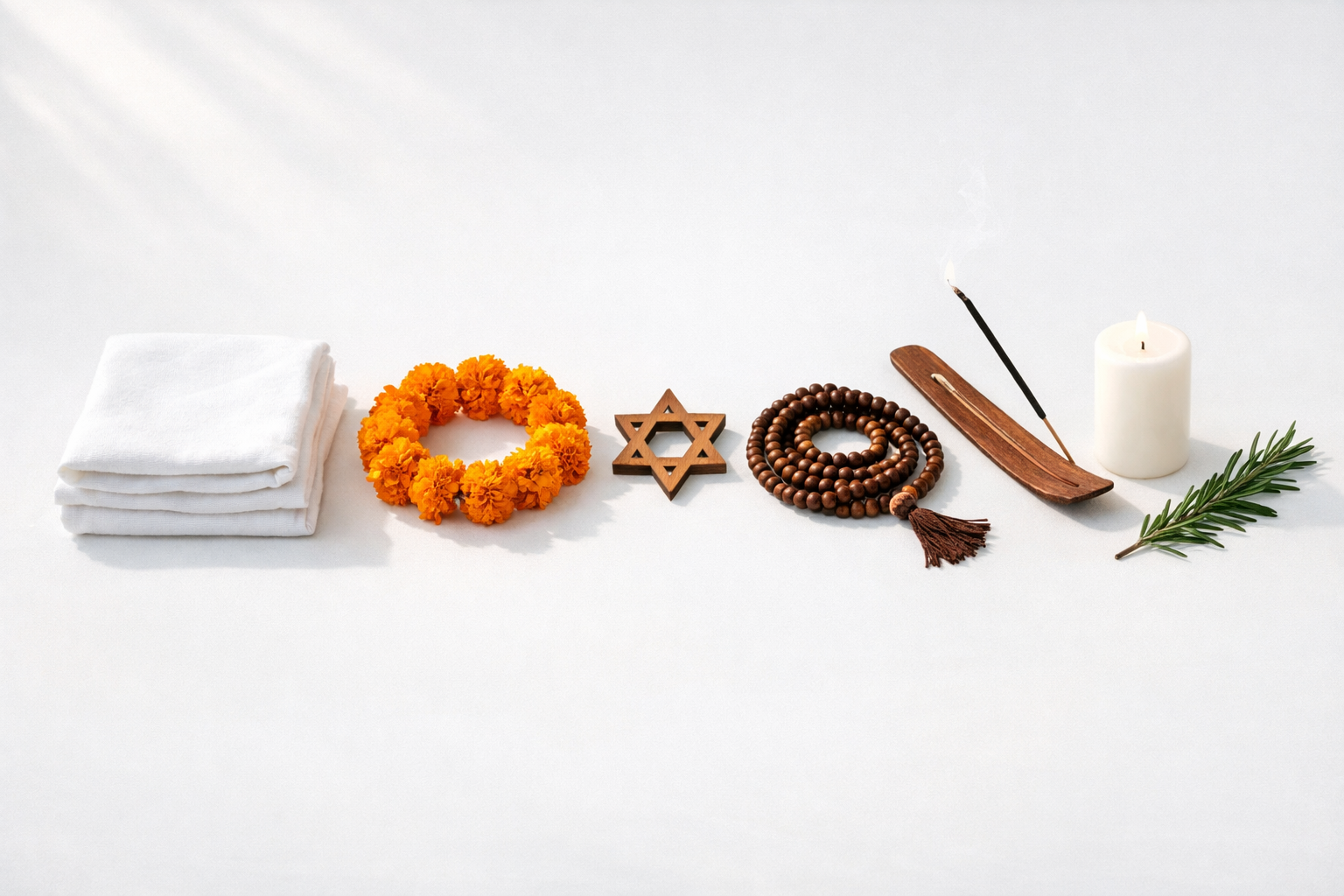
The UK and Ireland are more culturally diverse than at any point in their history. At some stage - likely sooner than you expect - you will serve a family whose traditions, requirements, and expectations are unfamiliar to you. Getting it wrong is a failure of care at the moment when care matters most.
This guide is a starting point, not an encyclopaedia. No community can be fully captured in a few hundred words, and individual families within any tradition will vary enormously. But having a working foundation - knowing the key requirements, common sensitivities, and where to ask for help - is the difference between serving a family well and making their worst day worse.
Muslim Funerals
Core Requirements
Islam requires burial, not cremation. Cremation is not permitted in Islamic tradition, and suggesting it to a Muslim family would be a serious misstep. Burial should happen as quickly as possible - ideally within 24 hours of death, though UK and Irish regulatory requirements (registration, coroner involvement if applicable) may extend this. Speed is not a preference; it is a religious obligation, and families will feel genuine distress at unnecessary delay.
The deceased undergoes ritual washing (ghusl), performed by same-gender members of the community. This is not a task for the funeral director. Your role is to facilitate it - providing a suitable, clean, private space with running water. After washing, the body is wrapped in a white shroud (kafan). Many Islamic traditions prefer burial without a coffin, though UK and Irish regulations generally require one. A simple, unadorned wooden coffin is appropriate.
What Directors Need to Know
Embalming is generally not permitted unless required by law (e.g., repatriation). Do not embalm without explicit family consent. Janazah (funeral) prayers are typically held at the mosque or at the graveside, not at your premises. The grave should face Mecca (qibla direction) - Muslim burial sections at cemeteries are already oriented correctly, but confirm this if arranging burial at a cemetery without a dedicated section.
Your most important practical task is facilitating speed. Contact the registrar immediately. Confirm cemetery availability. Coordinate with the mosque and the family’s imam. If a coroner is involved, communicate the family’s religious urgency - most coroners understand and will prioritise where possible.
Key contact
Build a relationship with your nearest mosque before you need one. A conversation over tea is far better preparation than a frantic phone call during an arrangement.
Hindu Funerals
Core Requirements
Cremation is the norm in Hindu tradition - it is considered essential for the release of the soul (atman) from the body. Traditionally, the eldest son or closest male relative lights the funeral pyre. In a crematorium setting, this translates to that person pressing the button to start the cremation or being present as the coffin enters the cremator. Many families will request the right to witness the committal, and this matters deeply.
Before cremation, prayers (often led by a Hindu priest or pandit) are common. An open casket viewing is typical, and the family may wish to wash and dress the body themselves, placing garlands of flowers around the deceased. Specific garments are customary - often white for older people who have died, though this varies by region and family.
What Directors Need to Know
Prompt cremation is important - not with the same urgency as Muslim burial, but families will want to move without unnecessary delay. Coordinate with the crematorium to allow family witnessing of the committal; most crematoria accommodate this, but it requires advance arrangement. Garlands, incense, and offerings of food or flowers at the coffin are common - ensure your facilities and the crematorium can accommodate these without triggering fire alarms or breaching regulations.
Some families will want to collect ashes promptly for scattering in a river - the Ganges is traditional, but UK-based families often scatter in local rivers or arrange for ashes to be taken to India. Discuss ash collection timelines early.
Sikh Funerals
Core Requirements
Cremation is the preferred method in Sikh tradition. The practices share significant overlap with Hindu funerals, though the theological framework differs. Ardas (a formal Sikh prayer) is recited before cremation, and hymns from the Guru Granth Sahib may be read. Open casket viewing is common, with the body washed and dressed by the family.
A practising Sikh will be dressed in the five articles of faith (the five Ks): kesh (uncut hair, covered by a turban), kangha (wooden comb), kara (steel bracelet), kachera (specific undergarment), and kirpan (small ceremonial blade). These articles must not be removed from the body. Removing them - even with good intentions during preparation - would cause serious distress and offence.
What Directors Need to Know
The practical considerations mirror Hindu funerals closely: prompt cremation, family witnessing of committal, accommodation of prayers and hymns. The critical additional point is the five Ks. Brief your staff clearly: these items stay with the deceased through washing, dressing, viewing, and cremation. No exceptions.
Contact your local gurdwara to understand their specific community’s expectations. Sikh communities in the UK and Ireland are well-established, and gurdwaras are generally very willing to guide funeral directors who approach with genuine respect.
Jewish Funerals
Core Requirements
Jewish tradition strongly prefers burial, though some Reform and Liberal communities permit cremation. As with Muslim funerals, burial should happen as quickly as possible - traditionally before the next sunset, though Shabbat (Friday evening to Saturday evening) and Jewish holidays pause proceedings. Speed is a religious duty, not a cultural preference.
Ritual washing of the body (tahara) is performed by the Chevra Kadisha - a Jewish burial society. This is their role, not yours. The body is dressed in simple white shrouds (tachrichim) and placed in a plain, unadorned wooden coffin. Elaborate coffins, metal handles, silk linings - all contrary to Jewish tradition, which emphasises equality in death. Flowers are not customary and should not be suggested.
What Directors Need to Know
Coordinate with the Chevra Kadisha, not against them. They will perform tahara, dress the body, and often stay with the deceased (a Shomer, or guardian, may sit with the body continuously until burial as a sign of respect). Your role is to provide the space, manage logistics, and facilitate their work. Attempting to take over tasks that belong to the Chevra Kadisha will create friction and erode trust.
Embalming is not permitted under Jewish law. Open casket viewing is uncommon in Orthodox communities, though practices vary among Reform and Liberal families. After burial, the family observes shiva - a seven-day mourning period at home. Your involvement largely ends at the graveside, but understanding shiva helps you communicate timelines and next steps with sensitivity.
Jewish communities in most UK and Irish cities have established Chevra Kadisha groups. Make contact proactively. They will tell you exactly what they need from you.
Chinese and East Asian Funerals
Core Requirements
Practices within Chinese, Vietnamese, Korean, Japanese, and other East Asian communities vary more than in almost any other group covered here. Regional origin, generation, degree of religious observance (Buddhist, Taoist, Christian, secular), and individual family preference all shape what a funeral looks like. Any generalisation risks being wrong for the specific family in front of you.
That said, some common elements appear frequently in Chinese funerals in the UK and Ireland. White is the colour of mourning - not black. Red, associated with celebration and luck, is generally avoided. Joss paper (spirit money) and incense may be burned as offerings. Food offerings may be placed near the coffin. Some families observe specific feng shui considerations for burial orientation and timing. Odd numbers are associated with mourning; even numbers with celebration - this can affect flower arrangements, gift quantities, and service structure.
What Directors Need to Know
Ask the family. More than with any other community on this list, assumptions are likely to be wrong. A third-generation British-Chinese family may have entirely different expectations from a recently arrived family from Hong Kong or mainland China. Some will want a traditional Buddhist ceremony; others will want a secular service with Chinese cultural elements; others will want a standard Western funeral with no cultural adaptations at all.
Offer to accommodate - don’t impose. If incense and joss paper are important, work with the crematorium or venue to find a way to include them safely. If specific colours matter, adjust your arrangements accordingly. Your willingness to ask and adapt matters more than any specific cultural knowledge.
Connecting with local Chinese community associations or Buddhist temples can provide guidance when you need it.
Traveller and Roma Funerals
Core Requirements
Irish Traveller and Roma communities in the UK and Ireland often hold large funerals with significant attendance - sometimes hundreds of mourners. Open casket viewing is common, often over several days, and the presentation of the deceased matters enormously. Expectations for the coffin, hearse, and overall appearance of the funeral may be higher and more specific than with other families. Elaborate coffins, decorated hearses, and large floral tributes are frequently requested.
For UK-based Irish Traveller families, repatriation of the deceased to Ireland for burial is common. Repatriation logistics - embalming requirements, airline coordination, documentation - add complexity but are a standard part of serving these families.
What Directors Need to Know
Treat every Traveller and Roma family with the same professionalism and respect you would offer any other family. This should go without saying, but the reality is that these communities have experienced discrimination from service providers, including funeral directors. Cultural assumptions, stereotypes, and prejudgements are unacceptable. If a family wants an elaborate funeral and can pay for it, serve them. If they want something simpler, serve them. Same as anyone else.
Large attendance creates practical considerations: car parking, road access, chapel capacity, health and safety at the graveside. Plan for these proactively rather than being caught off guard. Communicate clearly about what your facilities can accommodate and what alternatives exist for very large gatherings.
Respect is the foundation. Everything else follows from it.
The Overarching Principle
Every section above could be longer. Every tradition contains more nuance, more regional variation, more individual difference than any guide can capture. A Muslim family from Somalia will have different cultural expectations from a Muslim family from Pakistan, even where the core religious requirements are identical. A secular Jewish family may want none of the practices described above.
When in doubt, ask. Families far prefer hearing “I want to make sure I get this right - can you walk me through what’s important to your family?” than watching a director make assumptions and get them wrong.
Asking is a form of respect. Cultural competency does not mean memorising every tradition. It means approaching every family with humility, genuine curiosity, and a willingness to learn.
The worst thing you can do is guess. The second worst is treat a cultural or religious requirement as an inconvenience. If same-day burial matters to a family, move heaven and earth to make it happen. If the five Ks must stay on, make sure every member of your team knows. If a family wants to wash the body themselves, provide the space and step back.
Meeting families where they are - not where your standard procedures assume they should be - is what good funeral service looks like, regardless of the tradition.
Building Your Cultural Competency: A Practical Checklist
Contacts to Establish Before You Need Them
| Community | Key Contact | What to Discuss |
|---|---|---|
| Muslim | Local mosque / imam | Ghusl facilities, burial speed, cemetery sections |
| Hindu | Local Hindu temple / pandit | Cremation witnessing, prayer arrangements |
| Sikh | Local gurdwara / granthi | Five Ks protocol, Ardas arrangements |
| Jewish | Chevra Kadisha / synagogue | Tahara process, Shomer arrangements, coffin requirements |
| Chinese/East Asian | Community association / Buddhist temple | Variation within community, common local practices |
| Traveller/Roma | Community liaison (local council) | Facility capacity, repatriation contacts |
Before Every Arrangement With an Unfamiliar Tradition
- Ask the family to describe what matters most to them
- Confirm religious requirements vs. cultural preferences (they may differ)
- Identify who in the community you should coordinate with (imam, priest, Chevra Kadisha, etc.)
- Check your facilities can accommodate specific needs (washing space, witnessing, incense, large attendance)
- Brief all staff on requirements - one person’s ignorance can undo the whole team’s effort
- Confirm crematorium or cemetery can meet specific requirements (orientation, timing, witnessing)
- Follow up after the funeral - ask what you could do better next time
Ongoing Development
- Attend NAFD or local association training on multicultural funeral service
- Read faith community guidance documents (most are freely available online)
- Visit local places of worship - not when you need something, but to build genuine relationships
- Review Cruse Bereavement Care resources on bereavement across cultures
- Debrief with your team after serving families from unfamiliar traditions - what went well, what would you change
No single blog post makes you culturally competent. Relationships, experience, and a genuine commitment to learning do. Start with the contacts. Start with the questions. The families will teach you the rest.