
Two adult children sit across the table from you. Their mother died thirty-six hours ago. Neither of them has arranged a funeral before. They've barely slept. One of them takes a breath and says: "We don't really know what we want. What would you recommend?"
This is the moment. Not the hearse booking, not the coffin selection, not the crematorium slot - this question, right here, is where the funeral arrangement conversation is won or lost. What you say next, and how you say it, will determine whether this family leaves your office feeling guided or sold to.
The Weight of That Question
When a family asks what would you recommend, they're handing you something significant: their trust. Fifty-three per cent of people don't know their loved one's funeral wishes. They haven't had that conversation at home. They have no reference point for what a funeral should look like, what it should cost, or what choices are even available. They're relying entirely on you.
That power dynamic is real, even when directors don't think of it that way. And it's why the structure of the arrangement meeting matters more than most directors give it credit for.
Two Versions of the Same Conversation
Let's stay in the room. The family is waiting. Here's how the next five minutes can unfold - two ways.
Version One: Top-Down
The director opens an arrangement folder and begins.
So, what we'd normally do is a full service at the church. We'd have a hearse and a following limousine for the family, a viewing the evening before at our chapel of rest, and then the committal at the crematorium afterwards. For the coffin, I'll show you what we have - this is our oak range, solid timber, very popular...
The family nods. They don't interrupt. They don't know enough to interrupt. Fifteen minutes later, they've agreed to a service that costs £4,200. They drive home and one of them says to the other: "Was that what Mum would have wanted? I don't even know."
Nothing unethical happened. The director was professional, experienced, thorough. But the conversation started with the most expensive configuration and worked down. The family never felt they had permission to choose differently.
Version Two: Family-First
The director puts the folder to one side for a moment.
Before we talk about any of the details - tell me about your mum. What was she like? What mattered to her?
The daughter smiles for the first time since she walked in. "She was no-fuss. Hated a spectacle. She'd have been mortified by anything too grand."
That's really helpful. So let's build something that feels right for her. There's a real range of options, and there's no wrong answer - we can keep it simple or add things that feel meaningful. What matters most to you both?
Same director. Same price list. Same options available. Completely different experience for the family.
Key takeaway
The difference between Version One and Version Two is who leads the conversation - the director's assumptions, or the family's values - not what's on the price list.
The Upselling Trap No One Intends to Set
Here's the thing directors rarely hear said out loud: almost no one intends to upsell. The upselling trap is a matter of structure rather than greed.
When your arrangement conversation is built around presenting options from the top down, leading with the premium coffin, describing the full traditional service before mentioning simpler alternatives, the architecture of the conversation does the upselling for you. The family doesn't know what's standard and what's optional. They don't know that a viewing is a choice, not a requirement. They don't know that a limousine is nice but not necessary. So they agree to what's presented, because disagreeing feels like they're cutting corners on someone they loved.
The perception matters as much as the intent. A family who feels upsold won't tell you in the room. They'll tell their sister-in-law over tea the following week. And that's a referral that never arrives.
The Language That Changes Everything
What matters here is a shift in orientation - from presenting options to guiding a decision. Scripts won't get you there; they sound scripted, and families can tell.
Some phrases close space down:
- "Most families choose..." - creates social pressure. The family hears: if we don't choose this, we're doing it wrong.
- "The standard package includes..." - implies that anything different is a deviation from the norm.
- "We'd recommend..." - positions the director as a salesperson with a preferred outcome.
Other phrases open space up:
- "You could also consider..." - presents an option without pushing toward it.
- "Some families find it helpful to..." - normalises a range of choices without ranking them.
- "There's no wrong answer here." - reduces anxiety. Simple, but families remember hearing it.
- "What feels right for your family?" - returns the decision to where it belongs.
None of these phrases are complicated. Most experienced directors already use some version of them. The difference is consistency - using them deliberately, throughout the conversation, not just at the start.
Worth remembering
A family who feels guided will leave a five-star review without being asked. A family who feels sold to will tell their neighbours - and that's a referral that never arrives.
When the Family Asks About Cost
Back in the room. The coffin has been chosen - a simple elm veneer, lined, dignified. The family has opted for a service at the crematorium rather than the church. No limousine. A single arrangement of flowers. Now comes the question that makes some directors tense up:
So... how much will this cost?
The instinct is to soften it. To apologise for the number, or to rush past it, or to immediately justify every line item. Don't.
State the figure clearly. Break it down. Explain what each element covers - your professional fees, the crematorium charges, the doctor's fees, the coffin, the flowers. Families don't resent the cost when they understand what they're paying for. They resent feeling like they can't see where the money goes.
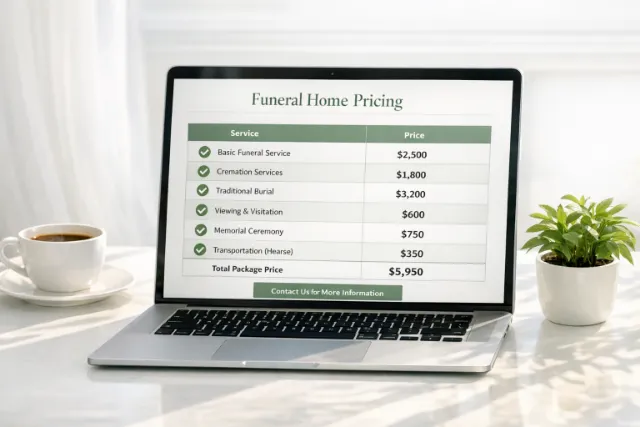
For context, the average cost of an attended funeral in the UK sits around £3,828, according to the SunLife Cost of Dying Report. A direct cremation averages £1,628. These figures help families understand where their choices sit relative to what others typically spend, rather than serving as a sales benchmark. When a family asks "Is that normal?", having an honest, data-backed answer builds trust faster than any reassurance.
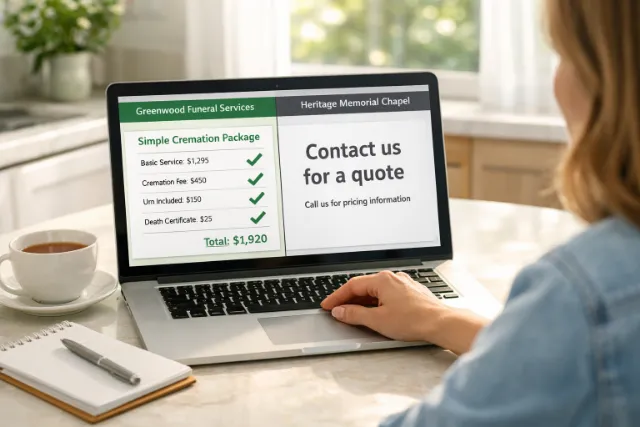
Pricing transparency in the arrangement room should mirror pricing transparency on your website - families who feel informed make more confident decisions, and confident decisions don't generate complaints.
When "Simple" Isn't a Rejection
At some point in the conversation, the son says: "To be honest, we just want the simplest option. Mum wouldn't have wanted a big thing."
Some directors hear this as a rejection - of their expertise, their profession, the value they provide. It isn't. A family choosing simplicity is expressing a preference, not a verdict on your worth.
The skill is in making that simple option feel just as cared-for as the full service. The family choosing a direct cremation still needs someone who handles the paperwork with precision, communicates clearly about timings, and treats their mother with the same respect as any other person in your care. The rise of direct cremation only threatens directors who can demonstrate value through ceremony alone; those who understand this have nothing to fear from it.
A straightforward cremation arranged with warmth and competence is a better advert for your funeral home than an elaborate service where the family felt railroaded into choices they didn't understand.
Key takeaway
A family choosing simplicity is expressing a preference, not a verdict on your worth. Make the simple option feel just as cared-for as the full service.
Back in the Room
The conversation has taken forty minutes. The family chose a crematorium service with a brief eulogy from a celebrant, the elm coffin, no viewing, no limousine, one arrangement of seasonal flowers. The total came in under £3,000.
They understand every line on the estimate. They chose each element because it felt right for their mother, not because it was presented as the default. When the son shakes your hand at the door, he says: "Thank you - that was nothing like what we were expecting."
He means it as a compliment. He expected to feel overwhelmed and pressured. He felt heard instead.
That family will leave a five-star review without being asked. They'll recommend you to their neighbours. When the son's father-in-law dies in four years' time, he'll ring your number from memory.
The funeral arrangement conversation is the most important skill a director has. More than embalming technique, more than logistics coordination, more than regulatory knowledge. It's a forty-minute window in which a family decides whether you were on their side. Every other part of the job flows from what happens in that room.