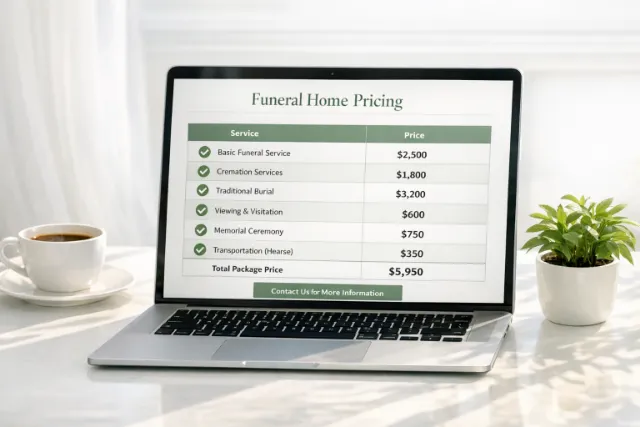
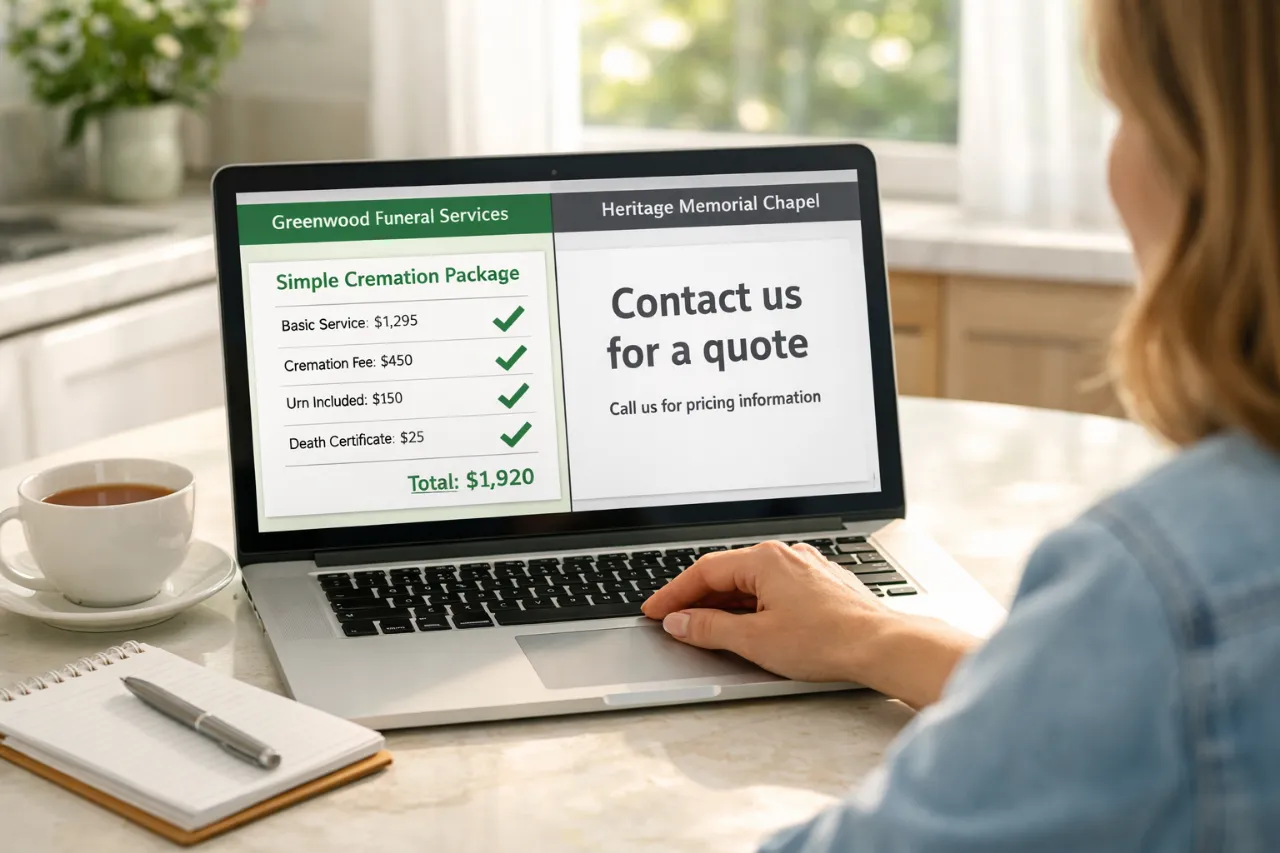
Bring up online pricing in any funeral director forum - LinkedIn, an NAFD group, r/askfuneraldirectors - and watch the thread split in half within twenty minutes. One camp says publishing prices builds trust and filters tyre-kickers. The other says it reduces funerals to a commodity, invites price-shopping, and hands competitors a cheat sheet. Both sides argue with conviction. Neither side is short on anecdotes.
But after the CMA’s Funerals Market Investigation, the growth of direct cremation providers, and a measurable shift in how families research funeral options before picking up the phone, this isn’t a matter of preference anymore. The evidence points in one direction: funeral homes should publish prices online. Not because regulation forces most of them to (though in the UK, it partly does), but because the families they want to serve increasingly expect it - and the homes that resist are losing enquiries to the ones that don’t.
Families Are Already Comparing - With or Without Your Help
The argument for withholding prices often rests on an assumption: that if you don’t publish, families won’t compare. That assumption died years ago.
Pure Cremation, Distinct Cremations, and a growing number of direct cremation providers publish clear, all-inclusive prices as their core proposition. Comparison platforms and consumer advice sites aggregate funeral costs by region. The SunLife Cost of Dying Report publishes national averages every year - £3,828 for a simple attended funeral, £1,628 for a direct cremation. Families Google “funeral costs near me” before they Google “funeral directors near me.”
Withholding your prices doesn’t stop families comparing; it just removes you from the comparison. The family researching options at 11pm - and most initial funeral research now happens outside business hours - isn’t going to bookmark your site and call in the morning. They’re going to click the next result that gives them what they need. NAFD consumer research consistently shows that families expect to find pricing information online before making contact. Directors who withhold it think they’re protecting the value conversation, when in fact they’re ensuring it never starts.
Key takeaway
Withholding your prices doesn’t stop families comparing; it just removes you from the comparison.
The CMA Found That Opacity Hurts Fair-Value Providers Most
The entire premise of the CMA Funerals Market Investigation was that families couldn’t compare effectively. And the investigation found that transparency would help quality providers, not harm them. Opacity was protecting overpriced, underperforming firms by making them indistinguishable from directors offering genuine value.
The CMA Funerals Market Investigation Order 2021 now requires UK funeral directors to publish a Standardised Price List (SPL) prominently on their websites. For the detail on what that entails, see What Your Website Must Show Under CMA Funeral Pricing Rules.
But the principle extends beyond the SPL minimum. If you’re a director who charges fairly, maintains your facilities, trains your staff, and delivers a service worth every penny - price transparency is your ally. It separates you from the operator around the corner who charges the same but delivers less. Hiding prices protects the worst performers in any market. The CMA understood that. Directors who compete on quality should understand it too.
For Irish funeral directors, this matters strategically. Ireland has no statutory regulatory framework for funeral directors and no legal obligation to publish prices. That absence is an opportunity rather than an excuse to stay opaque. Irish directors who publish transparently are differentiating themselves in a market where most competitors don’t. And they’re getting ahead of whatever regulatory direction Ireland eventually takes, rather than scrambling to comply after the fact.
Hiding prices protects the worst performers in any market.
Absence of Price Is a Deal-Breaker for a Growing Segment
Directors who resist online pricing often frame the concern as: “Publishing prices reduces us to a commodity.” The evidence suggests something different.
Families weigh multiple factors when choosing a funeral director - reputation, location, Google reviews, the tone of the first phone call, whether they felt listened to. Price is one input among several. Fifty-three percent of people don’t even know their loved one’s funeral wishes, which means most families are making decisions under uncertainty, looking for guidance and trust as much as affordability. Reducing the decision to price alone gives families far less credit than they deserve.
But here’s what the data also shows: a missing pricing page is a specific, measurable barrier. Obituary pages drive roughly five times more website traffic than all other funeral home pages combined - pricing pages aren’t your most-visited content. However, for the segment of families who do visit them, pricing is often the deciding factor in whether they call or click away. The family who can’t find your prices doesn’t ring to ask. They move on to the director whose site answered the question.
The rise of direct cremation as a mainstream option has only accelerated this. When national providers advertise transparent, fixed-price packages, families develop an expectation that pricing should be findable. Every funeral home is now compared - consciously or not - against that standard.
Published Prices Filter Enquiries - They Don’t Reduce Them
One of the most persistent fears is that publishing prices will scare families off. Directors who’ve actually made the switch report the opposite: the volume of enquiries may stay flat, but the quality improves markedly.
When a family knows your pricing before they call, the conversation starts further along. They’ve already self-selected as being broadly within range. You spend less time on calls that were never going to convert and more time on arrangement conversations with families who’ve already decided you’re a serious option. The arrangement meeting becomes about shaping the service, not justifying the cost.
This isn’t hard data from a controlled study - the funeral profession doesn’t tend to run A/B tests on its websites. But it’s a pattern reported consistently enough by directors who’ve made the change that it’s worth taking seriously. The calls don’t dry up. The time-wasting ones do.
Key takeaway
When a family knows your pricing before they call, the conversation starts further along. The calls don’t dry up. The time-wasting ones do.
The Strongest Objection - And Why It’s an Argument for Better Execution, Not Avoidance
The most credible objection to online pricing isn’t “competitors will see my prices.” They already can, through mystery shopping or simply phoning. The strongest objection is this: funerals are complex. Costs vary significantly based on family choices - coffin selection, venue, vehicles, music, catering, third-party disbursements. A pricing page can’t capture that nuance without either misleading through oversimplification or overwhelming with detail.
That’s a legitimate concern. And it’s true that a bad pricing page - one that quotes a single headline number with no context, or buries critical information in footnotes - is worse than no pricing page at all. It creates false expectations, leads to difficult conversations during arrangements, and damages exactly the trust it was meant to build.
The answer is to publish prices well rather than avoid publishing them. Clear itemisation of your service fees. Honest disbursement estimates with a note that these are approximate and set by third parties. Context about what drives costs up or down. A range where appropriate (“coffin selection typically ranges from £X to £Y”). And, critically, an invitation to call or meet for a personalised quote alongside the published figures - not instead of them.
Getting the pricing page right is a craft in itself. For the common mistakes to avoid, see The Most Common Pricing Page Mistakes Funeral Homes Make.
The Direction Is Clear
The funeral profession is moving toward pricing transparency. The CMA accelerated it in the UK. Consumer expectations are accelerating it everywhere else. National direct cremation providers have normalised it. And every year that passes, the families walking through your door have spent more of their lives buying everything - from cars to medical procedures - with price information available upfront.
Directors can lead that shift or be dragged by it. The homes that publish prices now - clearly, honestly, with context that reflects the real complexity of what they do - are building trust that compounds over years. Every family who finds their pricing page, understands it, and picks up the phone is a relationship that started on solid ground.
The homes that don’t publish are banking on a barrier that gets thinner every year. And when it finally disappears - through regulation, competition, or simply the weight of consumer expectation - the directors who waited won’t have a head start. They’ll have a website to rebuild and a reputation for opacity they’ll need to overcome.
The real threat was never transparency. It’s irrelevance.
Sources
- CMA Funerals Market Investigation Order 2021
- SunLife Cost of Dying Report 2025
- NAFD Consumer Awareness and Preferences Reports
- IAFD Quality Standard