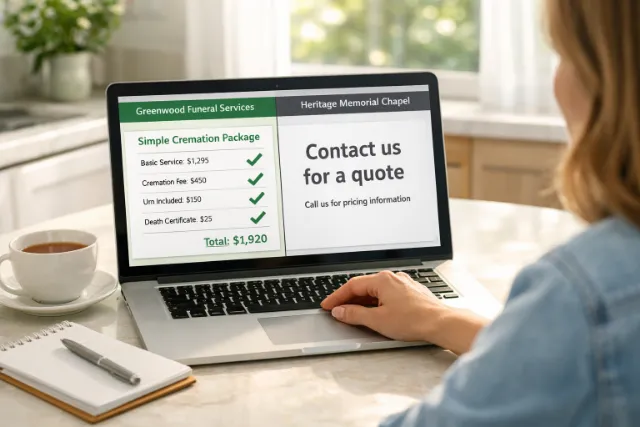
Over 80% of families now research funeral options online before making a single phone call. That number has climbed steadily for a decade, and it's not slowing down. Yet pull up the average funeral home website and try to find a clear, complete pricing page. You'll click around. You'll find "Contact us for a quote." You'll find a PDF buried three levels deep. You'll find package names that mean nothing to someone who's never arranged a funeral before.
In the UK and Ireland, many of those pages are actively breaking the law - or at best, costing firms enquiries every single week.
The Competition and Markets Authority (CMA) Funerals Market Investigation Order 2021 exists because the regulator found that families were unable to compare prices effectively across providers. For a full breakdown of what the Order requires on your website, see our guide to CMA funeral pricing rules. In Ireland, the Irish Association of Funeral Directors (IAFD) has similarly pushed for greater transparency, and consumer expectations have already overtaken the regulation in both markets. Families expect to see prices on your website. When they don't, they move on to the firm that shows them. For the broader argument and the evidence behind it, see should funeral homes publish prices online.
Here are the specific mistakes that cost funeral homes trust, enquiries, and - in some cases - regulatory compliance.
1. Hiding the Pricing Page
If a visitor has to click more than once from your homepage to find your prices, you've already lost a percentage of them. Burying the pricing page under "Resources" or "Planning Ahead" or an unlabelled hamburger menu just adds friction. And friction, for a family already under stress, reads as evasion.
The CMA Order is explicit: UK funeral directors must display a Standardised Price List (SPL) "prominently" on their website. Prominent means findable within seconds, not simply present somewhere on the site. A pricing link should sit in your primary navigation - visible on every page, labelled clearly. "Pricing" or "Our Prices" works. "Service Options" does not.
Research consistently shows that families who can compare prices online are more likely to make first contact with the firms that display them. Hiding your prices doesn't protect you from comparison - it removes you from the consideration set entirely.
Fix it
Put a "Pricing" or "Our Prices" link in your main navigation bar. One click from any page on your site. No exceptions.
2. Using Vague Price Ranges Instead of Actual Figures
"Traditional funeral services from £2,500" or "Our services range from €3,000–€12,000" tells a family almost nothing. What does £2,500 actually include? What pushes the price from €3,000 to €12,000? Ranges without context create anxiety, not confidence. Families read them as "the real price is the higher number, and they're trying to get me through the door before I find out."
The CMA's SPL requirements are specific about what must be listed and at what level of detail. A range doesn't satisfy the obligation to show the price of a defined service. Best practice across the UK and Ireland is clear: itemised pricing - not ranges, not "starting from," not estimates.
Fix it
List actual prices for defined services and items. If the price genuinely varies (say, by location or by specific selection), state the base price and explain clearly what causes variation. "Cremation fee at [Crematorium Name]: £850" is useful. "Cremation fees from £700" is not.
3. Listing Packages Without Itemisation
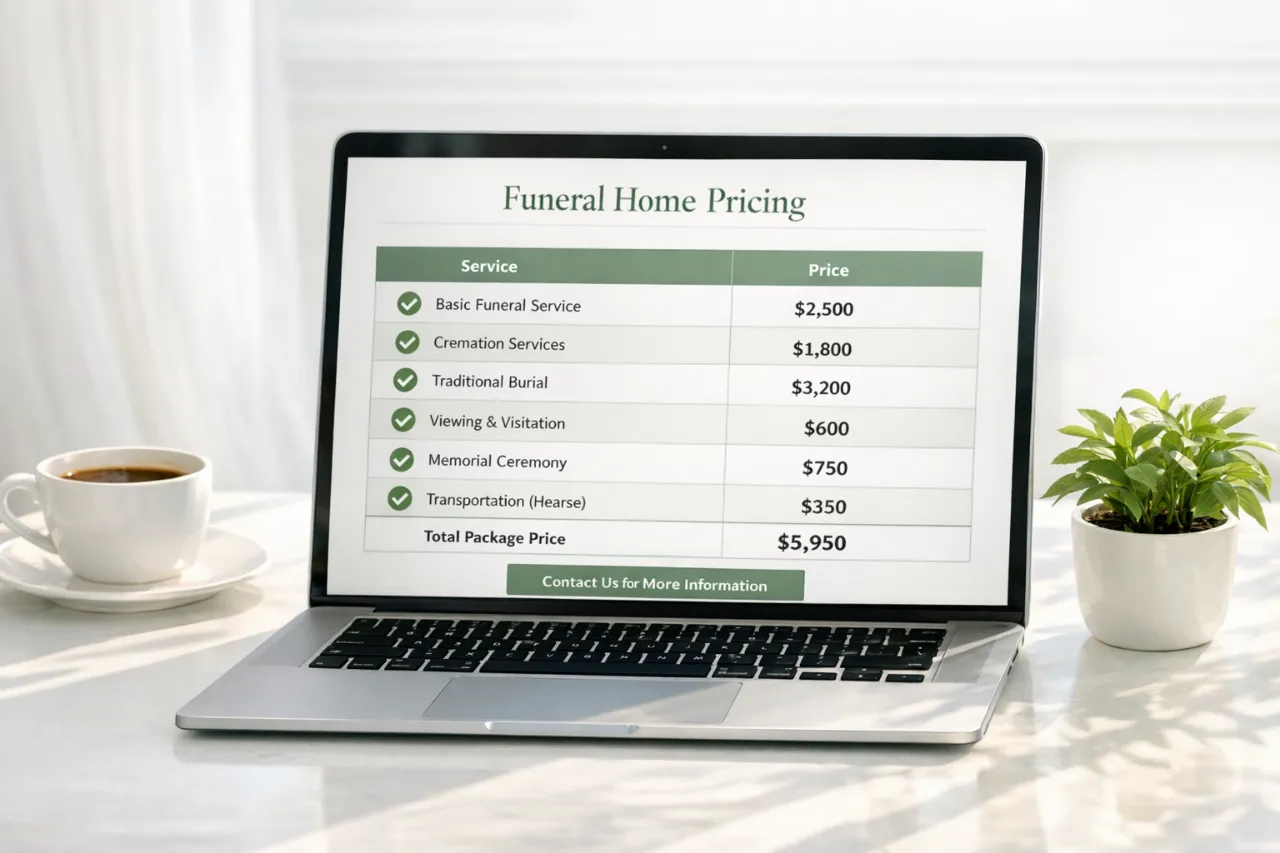
Packages are convenient for families - and there's nothing wrong with offering them. The problem is when a pricing page only shows packages with no breakdown of what's included and no option to see individual item prices.
For UK directors, this is a compliance issue. The CMA Order requires that the SPL include the price of specific individual items and services - not just bundled packages. A family must be able to see what they're paying for the coffin, the hearse, the care of the deceased, and the professional fees as separate line items.
For Irish directors, the same principle applies. Families expect to see what they're paying for - not just a bundled total. If your website only shows packages, you're not meeting the expectations of a family who's trying to understand what they're actually buying.
Fix it
Show packages if you like, but always include a full itemised price list alongside them. Let the family see both the bundle and the components. The SunLife Cost of Dying Report puts the average UK attended funeral at £3,828 and direct cremation at £1,628 - families are paying attention to these numbers and want to understand what drives the total.
4. Missing Legally Required Items from the Standardised Price List (UK)
This one is specific to UK directors, and it's surprisingly common. The CMA Order specifies exactly which items and services must appear on the SPL. Missing even one creates a compliance gap.
The required items include: the cost of professional services, care of the deceased, a defined coffin, a hearse, a defined service (attended funeral, unattended funeral, direct cremation at minimum), and disbursements or estimates of third-party costs. The full requirements are laid out in the CMA Order, and it's worth reading them line by line against your current page.
Directors in Scotland should note that the new funeral sector register, which went live in April 2025, may bring additional scrutiny to pricing practices as the regulatory landscape continues to develop.
Fix it
Download the CMA's SPL template. Compare it against your current pricing page, item by item. If anything is missing, add it. If anything is ambiguously worded, clarify it. Compliance here is binary - you either list the required items or you don't.
5. Using Jargon Families Don't Understand
"Embalming and hygienic treatment," "professional services fee," "facilities use for viewing" - directors know exactly what these mean. Families often don't. A pricing page full of industry terminology creates a barrier. The family doesn't know what they need, can't evaluate what they're being quoted, and may feel embarrassed to ask.
This is about recognising that your pricing page is read by people in crisis, many of whom have never arranged a funeral before, rather than dumbing things down. 53% of people don't even know their loved one's funeral wishes - they're starting from zero.
Fix it
Use plain language descriptions alongside or instead of industry terms. "Preparing your person for viewing (washing, dressing, and cosmetic care)" is clearer than "hygienic preparation." If you must use a technical term, define it in the same line. Don't make families Google your price list.
6. Failing to Update Prices Annually
Third-party costs change every year. Crematorium fees go up. Cemetery charges shift. Doctor's fees are revised. If your pricing page shows last year's disbursement figures - or worse, figures from two or three years ago - you're setting up difficult conversations with families at arrangement time, when the actual cost exceeds what your website showed.
In the UK, the CMA expects pricing information to be current. Displaying outdated prices is poor practice and potentially misleading under consumer protection law. In Ireland, the same consumer protection principles apply - outdated pricing can undermine trust and may fall foul of misleading commercial practices regulations.
Fix it
Set a calendar reminder to review and update your pricing page at least annually - ideally at the start of your financial year or whenever you receive updated fee schedules from crematoria, cemeteries, or other third parties. Date-stamp the page so visitors (and regulators) can see when it was last updated.
7. Not Including Third-Party Disbursement Estimates
Many funeral home pricing pages list only the firm's own charges and leave out disbursements entirely - cremation fees, burial fees, officiant fees, doctor's fees, and other costs the family will ultimately pay. From the family's perspective, the total cost is what matters. Showing only your fees and omitting the rest makes the headline number look lower than reality, which erodes trust the moment the full invoice appears.
The CMA Order requires UK directors to include disbursement estimates on the SPL. In Ireland, the expectation is the same: families should be able to see a realistic picture of total cost before they commit.
Fix it
Include a section for estimated third-party costs, clearly labelled as estimates that may vary. Use current figures from your local crematorium, cemetery, and other providers. If costs vary significantly by location or choice, show a representative example and note the range.
"But Won't Competitors Undercut Me?"
This is the objection that keeps pricing pages vague, buried, or absent entirely. And it's understandable - nobody wants to hand their competitor a pricing benchmark.
Here's the counter-evidence. The CMA's investigation found that the lack of price transparency was harming the firms that offered fair value, because families couldn't tell the difference between a well-priced service and an overpriced one. Transparency doesn't just help families - it helps competent, fairly-priced directors compete on their actual merits.
Consumer research consistently shows that price is rarely the sole decision factor. Families weigh location, reputation, reviews, the quality of the first phone call, and whether they feel the director understands their needs. Showing clear prices doesn't reduce you to a commodity - it removes a barrier to contact. The firm that builds trust early wins the enquiry, even if it's not the cheapest option.
Obituary pages drive roughly five times more website traffic than all other funeral home pages combined. Your pricing page won't be the most-visited page on your site. But for the families who do visit it, it's often the deciding factor in whether they pick up the phone.
Compliance Is the Floor, Not the Ceiling
Meeting the minimum legal requirements - whether that's the CMA's SPL in the UK or consumer protection standards in Ireland - keeps you out of trouble. But it doesn't differentiate you. The funeral homes winning online enquiries go further: they explain what each item means, they include helpful context about what a typical funeral costs in their area, they show families how to build a service within their budget, and they make the pricing page feel like an extension of the same care they provide in person.
That gap between "compliant" and "genuinely helpful" is where trust is built. And trust, in this profession, is the only competitive advantage that compounds.
Your next step
Go check your pricing page. Right now. Click on it from your homepage on your phone. Time how long it takes. Read it as if you've never arranged a funeral. Then fix what needs fixing.
Sources
- CMA Funerals Market Investigation Order 2021
- IAFD Guidelines on Funeral Pricing Transparency
- SunLife Cost of Dying Report (2024)