
Walk into most funeral homes today and you'll find the same setup: a filing cabinet in the corner, a stack of carbon-copy forms on the desk, and a printer that's always running low on ink. It's worked for decades. But it's starting to show its age. For a deeper look at what the transition actually involves day-to-day, see what going paperless actually looks like inside a funeral home.
Families now expect to sign documents from their phone, pay invoices online, and receive updates without having to call. Meanwhile, funeral directors are buried in admin - re-entering the same data across three different systems, chasing signatures, and spending evenings on paperwork instead of with their own families.
Something has to give. And for a growing number of funeral homes, it already has.
The real cost of paper
Paper feels cheap. A ream costs a few euros. But the true cost lies in everything around the paper itself.
- Time: The average at-need case involves 15–20 forms. Printing, filling, scanning, filing, and retrieving those forms adds up to 3–4 hours per case.
- Errors: Handwritten forms lead to misreads, missing fields, and duplicate data entry. One wrong digit on a death certificate can delay everything.
- Storage: Regulatory requirements mean you're storing records for years. Physical storage costs money, and retrieval is slow.
- Friction for families: Asking a grieving family to come in and sign paperwork - sometimes multiple times - lands as a poor experience at the worst possible moment.
When you add it up, paper costs time, creates friction, and introduces risk - whatever it appears to save you on the surface.
What's actually changing
Three shifts are happening at once, and together they're making the move away from paper not just possible, but inevitable.
1. Families expect digital
Post-pandemic, families are used to doing everything online - banking, healthcare, legal. The funeral profession is one of the last to catch up. Younger family members, who are increasingly the ones making arrangements, don't understand why they need to drive across town to sign a piece of paper.
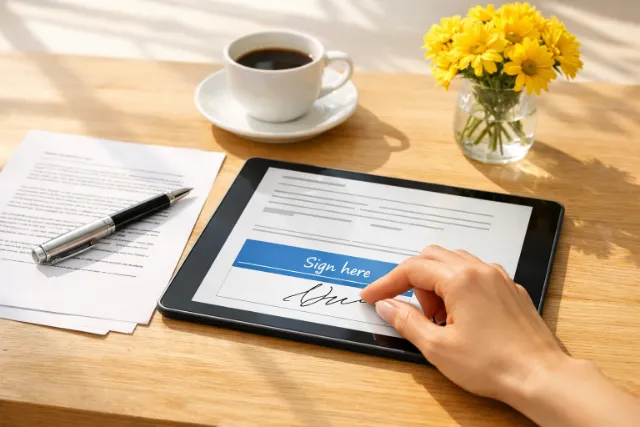
2. eSignatures are legally valid
Under the eIDAS regulation in the EU and similar legislation worldwide, electronic signatures carry the same legal weight as handwritten ones. This removes the biggest objection funeral homes had: "but we need a real signature." You do have a real signature - it's just digital. For a detailed look at the legal framework in both the UK and Ireland, see our guide to e-signatures in funeral service.
3. The tools have caught up
Five years ago, going digital meant stitching together generic tools - DocuSign for signatures, Stripe for payments, Google Calendar for scheduling, and a spreadsheet for everything else. Today, purpose-built platforms handle the entire workflow in one place, designed specifically for how funeral homes actually work. If your team still relies on a whiteboard and group chat, it may be time to consider whether the whiteboard era is ending.
"We didn't switch because we wanted to be 'modern.' We switched because we were spending more time on admin than with families. That's not why any of us got into this profession."
What going paperless actually looks like
Let's be clear: going paperless is a gradual swap, not a cold-turkey purge of every form overnight. You replace the most painful, time-consuming paper processes with digital alternatives, one at a time.
Here's what that typically looks like in practice:
None of this changes the core of what funeral directors do. It just removes the friction around it.
The objections (and why they're fading)
"Our staff aren't tech-savvy"
If your team can use a smartphone, they can use modern funeral home software. The best tools are designed to be simpler than the paper processes they replace, not more complex. Most teams are up and running within a day.
"Families prefer paper"
Some do - and that's fine. Digital doesn't mean mandatory. You can always print a form for someone who wants one. But the vast majority of families, when given the choice, prefer to sign from home rather than make another trip.
"We've always done it this way"
This is the hardest objection to overcome, because at heart it's about change rather than paper. But the funeral homes that have made the switch consistently report the same thing: they wish they'd done it sooner.
The bottom line
Paper isn't going to disappear overnight. But the funeral homes that start moving away from it now will be faster, less error-prone, and - most importantly - able to spend more of their time doing what actually matters: supporting families.
Not sure which system to look at first?
We compared the five funeral management systems independent directors shortlist most, on the ten things that decide whether a case runs without printing, chasing or re-keying. See Obit, Seker eFD, Eulogica, Funeral Manager and EverlyPro side by side.
Where to start
You don't need to digitise everything at once. Start with the process that causes the most pain:
- If you're chasing signatures, start with eSignatures.
- If you're re-entering data, start with digital case management.
- If you're fielding payment calls, start with online invoicing.
Pick one. Get comfortable. Then expand from there. The goal is to get the admin out of the way so you can focus on families, not to turn yourself into a tech company.
That's what this profession has always been about. The tools are just finally catching up.