More families are asking the question than ever before. “What’s the greenest option?” They ask it with genuine concern, sometimes with urgency, and almost always with the assumption that there’s a clear answer. Directors hear it at first arrangement meetings, in pre-need conversations, and increasingly via email before the family has even walked through the door.
The honest answer on green burial vs cremation is more nuanced than most families expect - and more nuanced than much of the marketing around “eco-friendly funerals” suggests. Environmental impact depends on what you measure. Carbon emissions tell one story. Chemical use tells another. Land use tells a third. A family’s idea of “green” might mean a woodland setting, or it might mean the lowest possible carbon footprint. Those two priorities don’t always point in the same direction.
What follows is a genuine comparison of the options available across the UK and Ireland - with trade-offs laid out plainly. No ranking, no winner declared. Directors who understand these distinctions can guide families toward the choice that fits their values, their geography, and their circumstances.
Option 1: Natural Green Burial
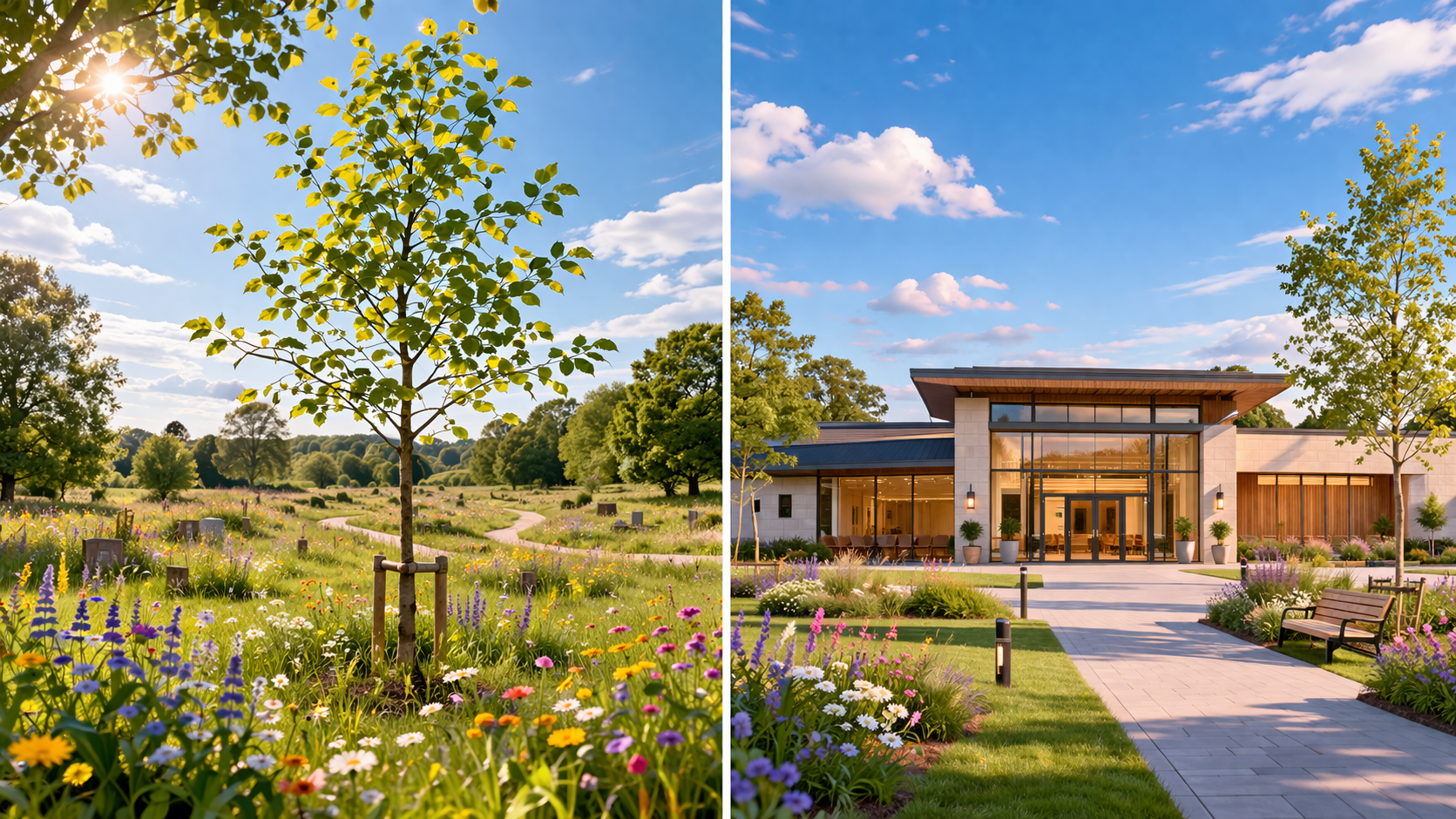
A natural or green burial means interment in a biodegradable coffin or shroud, in a designated natural burial ground, with minimal or no embalming. The body returns to the earth as directly as the process allows. Grave markers are typically a tree, a wildflower planting, or a simple wooden or stone marker - not a traditional headstone.
The environmental case is straightforward. No combustion, no energy-intensive process, no emissions from cremation. Formaldehyde-based embalming is avoided or replaced with non-toxic alternatives. The burial site itself becomes a conservation area - meadow, woodland, or grassland managed for biodiversity rather than maintained as a manicured lawn.
Cost varies significantly by site. In England, natural burial plots typically range from £500 to £2,000, often comparable to or lower than conventional cemetery plots. In Ireland, options are more limited, but sites like Woodbrook Natural Burial Ground in County Galway offer plots from around €1,000. A biodegradable coffin - willow, bamboo, seagrass, or cardboard - generally costs less than a traditional veneered coffin.
Availability is the real constraint. The Natural Death Centre lists over 270 natural burial grounds across the UK, but coverage is uneven. Some regions have several within reasonable distance; others have none. In Ireland, dedicated natural burial sites remain few. Families committed to green burial may face a longer journey to the site - which introduces its own carbon footprint and logistical complications.
The experience differs from what most families know. There’s no chapel of rest in the traditional sense. Grave preparation may be less precise. The setting is beautiful but informal. For families accustomed to conventional funerals, this can feel deeply meaningful or uncomfortably unfamiliar - and directors should prepare them honestly for both possibilities.
The trade-off: geographic limitation restricts access. Families may need to travel further, and the less structured setting requires emotional readiness. Green burial also means the grave won’t look the way conventional graves look. Some families find that liberating. Others find it unsettling when they visit months later and the site has naturalised.
Option 2: Flame Cremation
Cremation accounts for roughly 65% of all dispositions in the UK, making it the default for most families. It’s widely available, operationally flexible, and well understood. Ashes can be scattered, kept, divided among family members, or interred - giving families options that burial doesn’t easily offer.
The environmental profile, however, is worse than most families assume.
A single flame cremation produces approximately 320kg of CO2 - roughly equivalent to driving 800 miles in a petrol car. Energy consumption is significant: a cremator operates at 850–1,000°C for 60–90 minutes. Mercury emissions from dental amalgam fillings remain a recognised pollutant, though abatement equipment is now fitted in many UK crematoria following the DEFRA mercury abatement programme. Not all crematoria have fully compliant systems, and families have no practical way of knowing whether the crematorium handling their loved one’s cremation has effective abatement in place.
Cost is typically lower than burial. The average attended cremation service costs around £3,828 in the UK, though much of that figure reflects professional fees, vehicles, and ceremony costs rather than the cremation itself. Direct cremation - without a service - averages approximately £1,628, and is approaching 20% of all cremations nationally.
Availability is cremation’s strongest advantage. With over 300 crematoria across the UK and growing capacity in Ireland, families rarely face geographic barriers. Scheduling is flexible, the process is familiar, and the ritual around it is well established.
The trade-off: the carbon footprint is substantial, and the family has limited control over it. Crematorium technology, maintenance standards, and abatement equipment vary. A family choosing cremation for environmental reasons may be surprised by the actual impact - and has no practical way to choose a “greener” crematorium over a less efficient one.
Option 3: Water Cremation (Resomation)
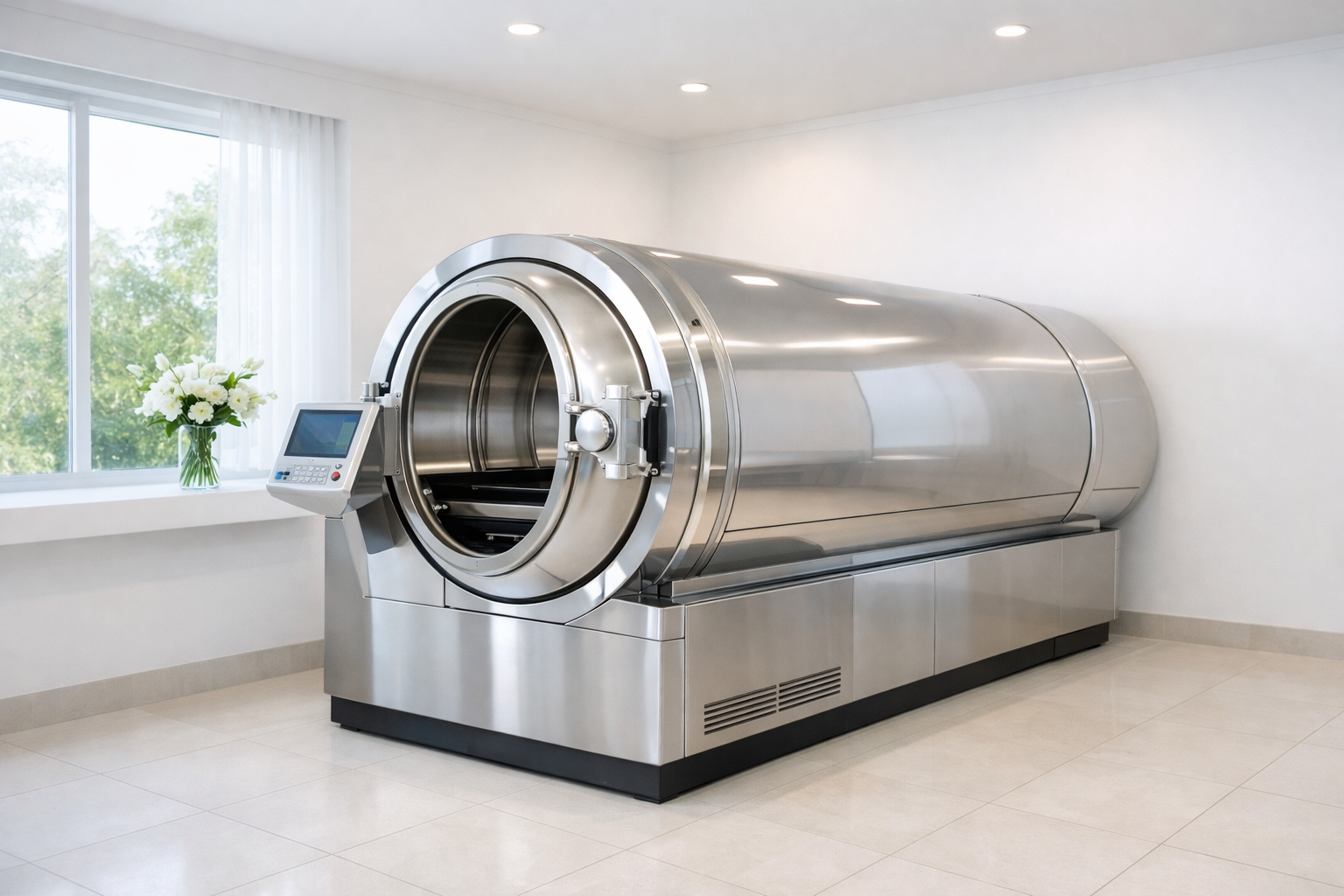
Water cremation - technically alkaline hydrolysis, commercially known as resomation - is the emerging third option. The process uses heated water and an alkaline solution to break down the body over several hours, returning the skeletal remains as a white powder similar to cremation ashes.
The environmental difference is significant. Water cremation produces approximately 28kg of CO2 per process - less than one-tenth of flame cremation. No mercury is released. Energy consumption is a fraction of conventional cremation. There are no direct emissions to atmosphere. The sterile liquid byproduct can be safely returned to the water system.
Availability is severely limited - but expanding. In Ireland, Pure Reflections in Navan, County Meath, offers water cremation commercially, making it one of the few operational facilities in Europe. In Scotland, water cremation became legal in March 2026 under provisions of the Burial and Cremation (Scotland) Act 2016, though facilities are not yet operational at the time of writing. In England and Wales, water cremation is not yet legal - the process doesn’t fall within current cremation legislation, and regulatory change has been slow despite growing interest.
Cost is currently comparable to or slightly higher than flame cremation, reflecting the limited number of providers and the novelty of the process. As availability increases, pricing is expected to align more closely with conventional cremation. For further detail on how the process works and where it stands, our earlier piece on water cremation covers the practicalities.
The trade-off: very limited availability means most families in the UK cannot currently access it. The process is unfamiliar, and some families find the description uncomfortable - even though the outcome (ashes returned to the family) is essentially identical to flame cremation.
Option 4: Hybrid Approaches
Families don’t have to choose a single path. Hybrid approaches are becoming more common, and directors who present them as options often find they resolve the tension families feel between environmental values and practical constraints.
Cremation followed by interment in a natural burial ground is the most common hybrid. The family proceeds with cremation - flame or water, where available - and then inters the ashes in a biodegradable urn at a natural burial site. Some natural burial grounds welcome ashes interments even when they’re primarily designed for full-body burial. Fees are typically lower for ashes plots.
Direct cremation followed by a memorial gathering in a natural setting is another variation. The cremation happens without ceremony; the family then organises a scattering or interment at a meaningful outdoor location, with or without a celebrant. For families who want both the flexibility of cremation and the connection to nature that green burial offers, this approach can feel like the best of both.
Woodland memorial schemes - where ashes are interred and a tree planted - offer a permanent, living marker without requiring a full natural burial. Several organisations across the UK operate dedicated memorial woodlands.
These combinations acknowledge that environmental values exist on a spectrum. Not every family who cares about environmental impact will choose the lowest-carbon option. Some want a natural setting more than a minimal footprint. Others prioritise avoiding embalming chemicals. Hybrid approaches let families assemble a disposition that reflects what “green” actually means to them.
The Complicating Factor: “Green” Means Different Things
This is the part most marketing material skips. When a family says they want a green funeral, they might mean any of the following - and they rarely mean all of them simultaneously.
Carbon footprint. Minimising CO2 and energy use. Water cremation wins on the numbers. Natural burial eliminates combustion entirely but involves transport and land use.
Chemical avoidance. No embalming fluid, no formaldehyde, no mercury release. Green burial and water cremation both perform well here. Flame cremation is the weakest option on this measure.
Natural setting. A woodland, a meadow, a sense of returning to the earth. Only natural burial - or ashes interment in a natural burial ground - delivers this.
Simplicity. Minimal processing, minimal intervention. A shroud burial in a natural ground is arguably the simplest. Direct cremation is procedurally simple but industrially intensive.
The key question for families
Directors who ask families what specifically matters to them - rather than assuming “green” is a single preference - give better guidance. A five-minute conversation about priorities can steer a family toward the option that genuinely fits, rather than the one that sounds most environmental in the abstract.
For Directors: Practical Considerations
Families trust you to know what’s available locally and to present it honestly. A few practical points worth considering.
Know your local natural burial grounds. Visit them. Understand their rules on coffin types, markers, embalming, and visiting. Build a relationship with the site managers. When you recommend a site, you should be able to describe it from personal experience, not from a website.
Source biodegradable coffins and shrouds. Have options available to show families - willow, bamboo, wool, cardboard. Families respond to seeing and touching these products. A photograph in a brochure doesn’t have the same effect.
Be honest about what you don’t know. If a family asks about water cremation and you haven’t encountered it, say so - and direct them to reliable sources like Resomation Ltd or the facility in Navan. Honesty about the limits of your experience builds more trust than bluffing.
Avoid greenwashing. Offering a single biodegradable coffin option doesn’t make a funeral home “green.” If environmental disposition matters to your community, invest in genuine knowledge and relationships - or partner with specialists who have. The Green Burial Council offers certification for providers committed to verified environmental standards, though its primary presence is in North America. In the UK and Ireland, the Natural Death Centre remains the most comprehensive resource.
Marketing environmental options requires care. Families are increasingly sceptical of vague green claims. Specific, verifiable information - “we offer willow coffins sourced from UK growers” or “we work with three natural burial grounds within 30 miles” - carries more weight than “we offer eco-friendly funerals.”
Making the Decision
There is no single greenest option. There is only the option that best matches what a particular family values, what’s available where they live, and what they can afford. A family in Meath has access to water cremation. A family in East Anglia may have three natural burial grounds within driving distance but no water cremation facility at all. A family in central London may find that direct cremation followed by ashes interment in a memorial woodland is the most practical environmental choice available to them.
The best advice a director can offer is honest information rather than a recommendation - what each option involves, what it costs, what it means environmentally, and what it feels like for the family on the day. Armed with that, families make the decision that’s right for them. And they remember the director who helped them make it clearly.