
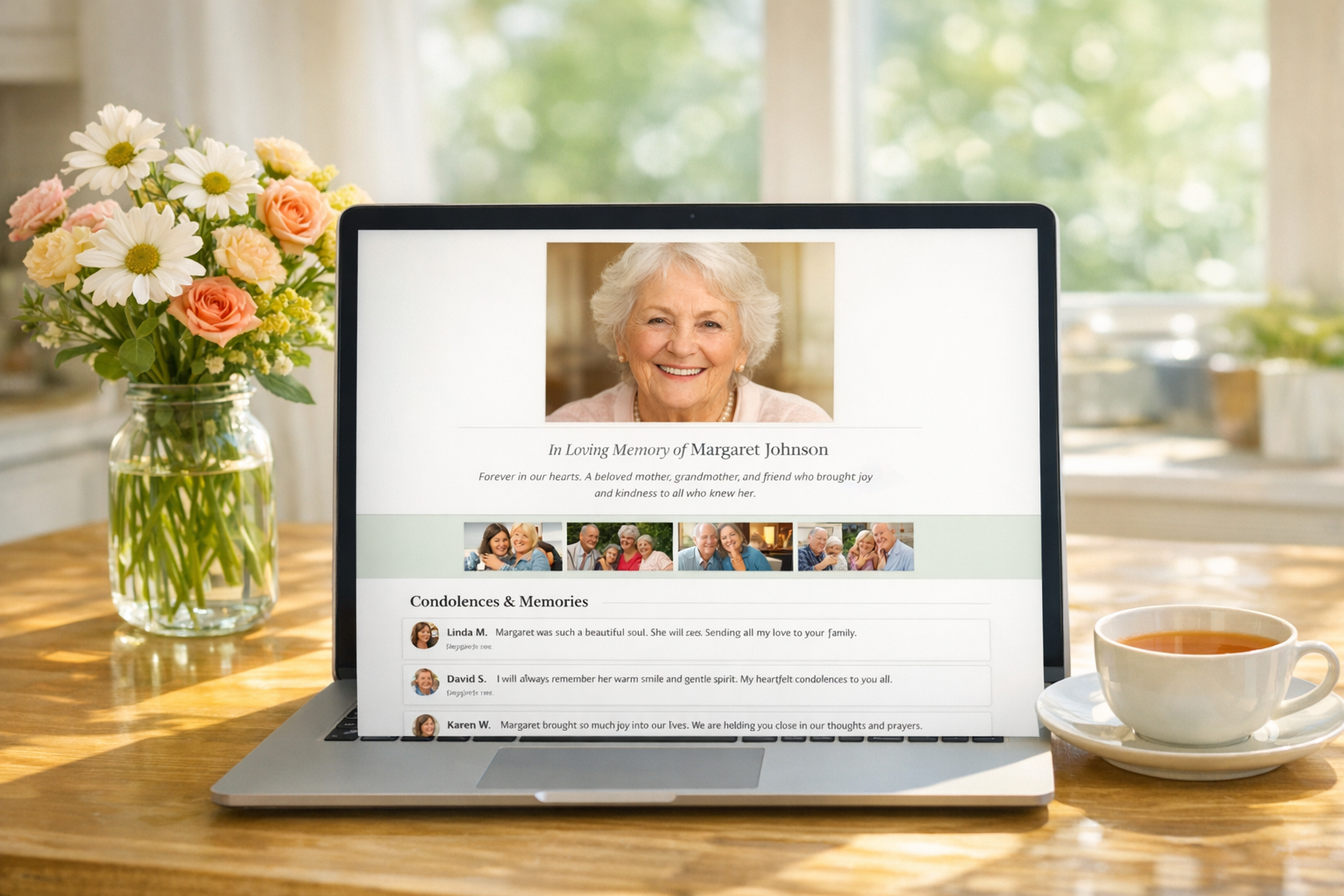
Obituary pages drive roughly five times more website traffic than all other funeral home pages combined. They are, by a wide margin, the most visited content on your site. Every time someone dies in your care, dozens - sometimes hundreds - of people visit your funeral home obituary page to check service details, read the notice, or pay respects.
Yet most obituary pages are functional at best. Name, dates, a paragraph, funeral time and location. A death notice, not a tribute. They do the minimum job and waste the maximum opportunity. Not just a marketing opportunity - though it is that - but an opportunity to provide genuine value to grieving families and their wider community.
What follows is a teardown of seven things that separate an obituary page worth visiting from one people leave immediately after copying the service time into their calendar.
1. Rich, Personalised Content - Not Just a Death Notice
A death notice tells you someone died. An obituary tells you someone lived. Most funeral home obituary pages contain the former and call it the latter.
The difference matters. A meaningful obituary - one that captures who the person was, what they cared about, how they'll be remembered - gives visitors a reason to read, to share, to return. Families who receive dozens of condolence messages saying "that obituary was beautiful" associate that experience with your funeral home.
The problem is timing. Families are asked to write or approve obituary text within days of a death, often while sleep-deprived and overwhelmed. Many produce something minimal not because they don't care, but because they don't know where to start.
Directors who actively help with obituary writing - asking the right questions, offering structure, suggesting what to include - deliver a service families remember. Everly Pro's AI obituary generator lets directors create a structured first draft by selecting tone (heartfelt, formal, celebratory), length, and keywords, then adding the family's anecdotes and details. The draft gives the family a starting point to refine - not a replacement for their words, but a scaffold that makes writing less daunting at a difficult time. Whether you use a tool like that or simply sit with the family and ask good questions, the result is the same: a page worth reading.
2. A Photo, at Minimum - a Gallery If Possible
Pages with a photograph get dramatically more engagement than text-only notices. A face makes the page personal. Without one, an obituary reads like a classified ad.
Offer families the option to include multiple photos or a slideshow. A life told in pictures - childhood, wedding day, grandchildren, that holiday they always talked about - resonates more deeply than any paragraph. Many families have photos ready on their phones within minutes if you ask.
Make the photo display clean and mobile-friendly. Most visitors will view obituary pages on their phones, often while standing in a car park deciding whether to attend, or sitting at home unable to make it in person. A single blurry thumbnail doesn't do the job.
3. A Tribute or Condolence Wall
A static obituary page is read once. A page with a tribute wall is visited repeatedly.
Allowing visitors to leave written condolences or share memories transforms a notice into a living memorial. Families return to read new messages - sometimes for weeks, sometimes for years. Each return visit reinforces your funeral home as the place that facilitated something meaningful.
From a practical standpoint, condolence walls also increase time-on-site and page engagement, both of which support your broader SEO efforts. But the primary value is emotional: families consistently cite online condolence messages as one of the most comforting parts of the process, particularly from people who couldn't attend in person.
Moderate submissions to filter spam, but keep the barrier to posting low. Requiring registration or account creation kills participation.
4. Service Details That Are Actually Useful
Too many obituary pages include a date and time but nothing else. Visitors - many of whom may not have attended a funeral at your premises before - need more.
Include the full address (not just the name of the church or crematorium), parking information, whether there's a livestream link, dress code if the family has specified one, and any donation or charity requests in lieu of flowers. If the family wants attendees to wear bright colours or a favourite team's jersey, say so clearly.
Treat service details the way you'd treat event information: assume the reader knows nothing and give them everything they need to attend without having to phone your office. Every call you prevent is time saved for your staff and stress saved for visitors who didn't want to bother anyone by asking.
5. Sharing Functionality That Works
Most people hear about funeral arrangements through shared links - a WhatsApp message, a Facebook post, a forwarded email. Newspaper notices still serve a purpose, but the digital share is how news travels fastest among the people most likely to attend.
Your obituary pages need visible, functional sharing buttons for Facebook, WhatsApp, email, and direct link copying at minimum. Test them regularly. A broken share button on a page that exists specifically to be shared is an avoidable embarrassment.
Position sharing options near the top of the page, not buried at the bottom. The person sharing the link is often doing so before they've finished reading - they've confirmed the details and want to pass them along immediately.
6. SEO Structure That Makes the Page Findable for Years
Every obituary you publish becomes a permanent indexed page on your website. When someone searches a deceased person's full name - and people do this months, even years later - a well-structured obituary page should appear.
Include the person's full name in the page title and H1 heading. Include location and year of death. Use structured, clean HTML rather than a single block of unformatted text. These basics ensure search engines can properly index and surface the page.
Over time, hundreds of indexed obituary pages create significant domain authority for your site. Each page is a doorway. Families researching funeral homes may first encounter your site through an obituary for someone they knew - and form their impression of your business based on the quality of that page. Investing in obituary page structure isn't separate from your SEO strategy; it is a major part of it.
7. Integration With the Rest of Your Site
A visitor reading an obituary page is already on your website. Many are experiencing bereavement personally - a parent, a spouse, a friend. Some will need a funeral director themselves, soon or eventually.
Your obituary pages should sit within your main site template, displaying your branding, navigation, and contact details naturally. A visitor should be able to see your other services, your approach and values, or your pricing page without hunting for it. Clean site design achieves this without being promotional - the navigation is simply there, the way it would be on any professional website.
What you want to avoid is the opposite: obituary pages that feel disconnected from the rest of your site, hosted on a third-party platform with no branding, or buried behind a search function that makes visitors feel like they're querying a database rather than visiting a memorial. Every obituary page should feel like part of your funeral home, because it is.
An Audit You Can Do This Week
Pull up your five most recent obituary pages and ask:
- Content: Does each read as a tribute or merely a notice? Would a stranger understand who this person was?
- Photos: Is there at least one clear photograph? Is a gallery option available?
- Condolences: Can visitors leave messages? Is the process simple?
- Service details: Could someone attend the funeral using only the information on this page?
- Sharing: Do share buttons work on mobile? Have you tested WhatsApp sharing specifically?
- Search: Google the deceased person's full name. Does your page appear in the first few results?
- Branding: Does the obituary page look and feel like part of your main website?
Score each page honestly. Any gap you find is a gap that's been present for every obituary you've published - and every future family you serve will encounter the same experience until you fix it.
The Bigger Picture
Your obituary pages are not a back-office function. They are the front door of your digital presence - the content that brings the most visitors, creates the strongest emotional associations, and reaches people at the exact moment they're forming opinions about funeral care.
Treating them as an afterthought - a name, a date, a paragraph - undersells both the families you serve and the business you're building. Investing in better obituary pages extends the same care you provide in person into the space where most people will actually encounter your funeral home. Getting that right is worth the effort.
Your next step
Audit your five most recent obituary pages using the checklist above. Fix one gap this week - add photos, enable condolences, or improve service details. Small changes compound across every future obituary you publish.