Repatriation of remains - moving a deceased person across international borders - is among the most complex processes a funeral director will manage. The paperwork is exacting, the timelines are tight, the costs are significant, and a single documentation error can delay a flight or border crossing by days. What follows is a working reference for funeral directors handling repatriation into or out of the UK and Ireland.
Repatriation Into the UK or Ireland From Abroad
When a British or Irish citizen dies overseas, the family’s first point of contact is usually their local funeral director. The director’s role is to coordinate between the overseas funeral home, the relevant consulate, the airline, and the family - often across time zones and language barriers.
Consular Involvement
The British consulate (via the FCDO - Foreign, Commonwealth & Development Office) or the Irish consulate (via the Department of Foreign Affairs) will assist the family in the country of death. Consular staff can help identify local funeral directors, confirm legal requirements, and facilitate documentation. They cannot, however, pay for repatriation or override local laws.
Contact the relevant consulate early. In many countries, the consulate must issue a letter of no objection or equivalent before remains can be released for transport.
Documentation Required
The following documents are typically required before remains can leave the country of death:
- Death certificate issued by the relevant authority in the country of death
- Certified translation of the death certificate (if not in English), usually requiring apostille or legalisation depending on the country
- Freedom from infection certificate (also called a sanitary certificate or certificate of non-contagious disease), issued by a medical authority in the country of death
- Embalming certificate, confirming that the deceased has been embalmed to international transport standards
- Consular documentation - varies by country, but may include a letter of no objection, a mortuary passport, or a laissez-passer for human remains
Requirements vary significantly by country. Some nations require a court order before remains can be released. Others require police clearance if the death was unnatural. Always confirm requirements with both the overseas funeral director and the relevant consulate before assuming standard documentation will suffice.
Coffin and Preparation Requirements
For international air transport, remains must typically be placed in a zinc-lined coffin (or hermetically sealed casket) within an outer wooden shipping case. Zinc lining is a legal requirement for entry into most European countries and is standard practice for long-haul repatriation.
The coffin must be clearly labelled with the deceased’s name, flight details, and destination. Some airlines require specific dimensions and weight limits for the cargo hold - confirm these with the carrier before the coffin is prepared.
Embalming is required by most receiving countries and virtually all airlines. Full arterial embalming to a high standard is essential; surface treatment alone is insufficient for international transport.
Airline Regulations
The International Air Transport Association (IATA) sets baseline standards for the carriage of human remains. Key requirements include:
- Remains must be embalmed and placed in a hermetically sealed container within an outer shipping case
- Documentation must accompany the remains, including the death certificate, embalming certificate, and freedom from infection certificate
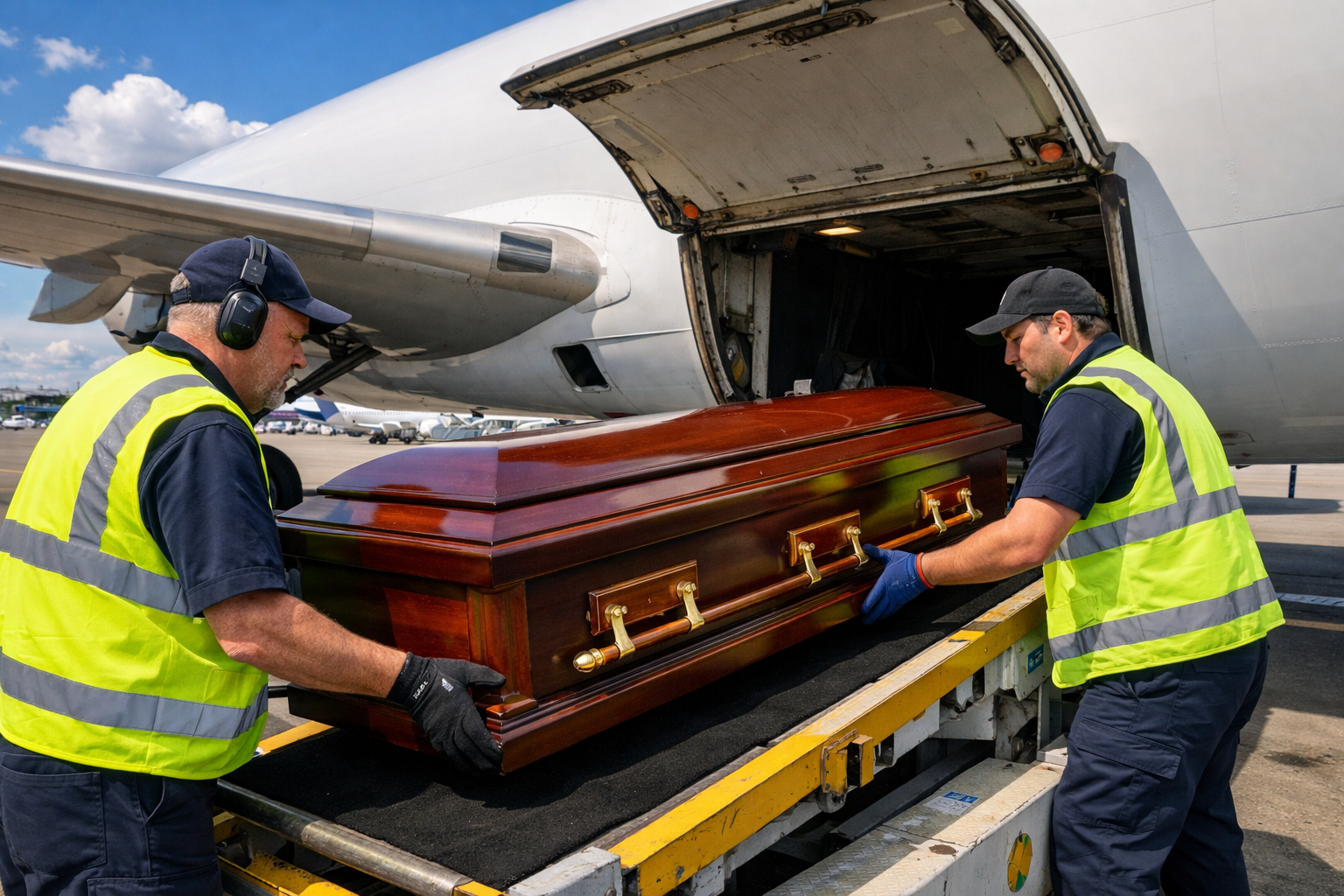
- The airline must be notified in advance; human remains travel as cargo, not checked baggage, and require specific handling
- Not all airlines carry human remains - confirm with the carrier and book well in advance
Direct flights are preferable. Transit through a third country may trigger additional documentation requirements from that country’s authorities.
Customs and Border Requirements
On arrival in the UK or Ireland, remains must clear customs. The funeral director receiving the remains should have copies of all documentation and be present (or have an agent present) at the airport cargo facility.
In the UK, HMRC does not charge duty on the importation of human remains, but customs clearance is still required. Border Force may inspect documentation. In Ireland, Revenue Commissioners handle the equivalent process. Neither jurisdiction routinely charges import fees, but delays can occur if paperwork is incomplete.
Repatriation From the UK or Ireland to Another Country
When a foreign national dies in the UK or Ireland and their family wishes remains returned to their home country, the process runs in reverse - with the added complexity of UK/Irish death registration and coroner involvement.
Coroner and Registration
Before remains can leave the UK or Ireland, the death must either be fully registered or the coroner (or procurator fiscal in Scotland) must provide clearance for the body to be released.
If the coroner is involved - which is common when the deceased is a foreign national and the death was sudden, unexplained, or occurred in hospital under certain circumstances - removal of remains from the jurisdiction cannot proceed until the coroner releases the body. This can take days or, in complex cases, weeks. (For a detailed guide to coroner processes across jurisdictions, see: Understanding the Coroner System: What Funeral Directors Need to Know.)
Removal Documentation by Jurisdiction
Each UK jurisdiction and Ireland has specific documentation requirements before remains can be taken out of the country.
England and Wales: The coroner must issue Form 104 (Out of England form) authorising removal. If the death has been registered and no inquest is pending, the registrar can confirm this to the coroner. Application is made to the coroner for the district where the body lies.
Scotland: The procurator fiscal must be notified of the intention to remove remains from Scotland. A Certificate of No Objection or equivalent communication from the fiscal’s office is required. Application should be made to the procurator fiscal for the area where the death occurred or where the body lies.
Northern Ireland: The coroner must authorise removal. The process is similar to England and Wales, though the specific forms differ. Contact the Coroner’s Service for Northern Ireland directly.
Republic of Ireland: The coroner for the relevant district must be notified. If the death has been reported to the coroner and they have no objection to removal, they will confirm this in writing. If a post-mortem has been directed, removal cannot proceed until it is complete. Death registration is handled through the HSE registrar. (For more on registering a death in Ireland, see: Registering a Death in Ireland.)
Embalming and Coffin Preparation
Full arterial embalming is required for international repatriation in virtually all cases. The embalmer should confirm that preparation meets the standards required by the receiving country - some countries specify minimum formalin concentrations or require a particular preservation method.
Zinc-lined coffins are standard for international repatriation. The coffin should be sealed in the presence of a witness (often the overseas consulate representative or a funeral director acting on their behalf), and a certificate of sealing should be prepared.
Receiving Country Documentation
Contact the embassy or consulate of the deceased’s home country in the UK or Ireland. They will specify:
- Any consular documentation required (mortuary passport, consular death certificate, visa for remains)
- Whether their own embalming or preparation standards differ from UK/Irish norms
- Customs or import requirements in the receiving country
- Whether a representative must meet the remains on arrival
Some embassies are efficient and responsive. Others are not. Begin this process immediately upon receiving instructions from the family - embassy turnaround times are the single most common cause of repatriation delays.
UK to Ireland / Ireland to UK
Movement of remains between the UK and Ireland is the most common cross-border repatriation route for funeral directors in both jurisdictions. Requirements are simpler than full international repatriation, but documentation is still necessary.
Common Travel Area Considerations
The UK and Ireland share the Common Travel Area (CTA), which simplifies movement of people between the two jurisdictions. However, the CTA does not eliminate documentation requirements for the transport of human remains. Remains still require:
- Coroner or procurator fiscal clearance from the jurisdiction of death (Form 104 in England/Wales, equivalent elsewhere)
- A certified copy of the death certificate (or interim certificate if registration is pending)
- Embalming certificate - while zinc lining is not always legally required for UK-Ireland transfers, embalming is standard practice and expected by receiving funeral directors
Transport
Remains moving between the UK and Ireland typically travel by ferry (in a hearse or dedicated transport vehicle) or by air cargo on commercial flights between major airports. Ferry crossings via Dublin-Holyhead, Rosslare-Fishguard, or Belfast-Cairnryan are common and straightforward, provided documentation is in order.
For air transport, IATA regulations apply as with any international flight. Confirm carrier requirements in advance.
Practical Notes
- Northern Ireland to the Republic of Ireland (and vice versa) involves a land border with no physical checkpoints, but the legal requirements remain - a death in Northern Ireland falls under the Northern Ireland coroner’s jurisdiction, and clearance is needed before remains cross into the Republic
- Funeral directors on both sides of the border often have established working relationships. Use them. A reliable partner in the receiving jurisdiction saves significant time and prevents errors
- Families sometimes assume that because they can drive freely between the UK and Ireland, moving remains is equally simple. It is not. Managing this expectation early prevents frustration later
The Director’s Role in Repatriation
A funeral director managing repatriation is coordinating between an overseas (or cross-border) funeral home, a consulate, an airline or ferry operator, customs authorities, and a grieving family - often simultaneously. Repatriation is the highest-value service many homes provide and, without question, the most stressful.
Working With International Partners
Build relationships with funeral directors in countries your community has strong ties to before you need them. A trusted contact in Poland, Nigeria, India, or Pakistan (to name the most common UK repatriation routes) is worth more than any amount of Googling during a live case.
For Irish funeral directors, strong contacts in the UK and the US cover the majority of repatriation work. For Northern Irish directors, a reliable partner in the Republic is essential.
Verify credentials. Use FIAT-IFTA (the international federation of funeral directors’ associations) or equivalent professional body directories to identify reputable firms abroad.
Avoiding Errors
Three rules that prevent the majority of repatriation problems:
- Confirm every document twice before it reaches the airport. Check spelling of names against the passport. Check dates. Check that certificates are originals (or certified copies) where required, not photocopies.
- Never assume requirements are the same as last time. Regulations change. Airlines update policies. Embassy staff rotate. Confirm requirements fresh for each case.
- Communicate timelines honestly with the family. Repatriation typically takes 7–14 days from the date of death, sometimes longer. Families hoping for 48-hour turnarounds will be disappointed - prepare them early.
Costs
Repatriation costs vary enormously depending on the route, but families should expect to budget between £3,000 and £8,000 (or €3,500 to €9,000) for a standard international repatriation including embalming, zinc-lined coffin, airline cargo fees, documentation, and receiving funeral director’s charges. Some routes - particularly from parts of Africa, Asia, or South America - may exceed this range significantly.
Travel insurance may cover repatriation costs, but policies vary widely. Advise families to check their policy (or the deceased’s policy) immediately. Some policies cover repatriation of remains in full; others cover only a fixed sum; many exclude it entirely.
For the chain of custody requirements that apply throughout the repatriation process, see: Chain of Custody: Documentation Standards for Funeral Directors.
Repatriation Checklist
Use the following as a working checklist. Not every step applies to every case - adapt to the specific route and circumstances.
On Receiving the First Call
- Confirm country of death and circumstances
- Identify whether the coroner/procurator fiscal/local authority is involved
- Contact the relevant consulate (FCDO for British nationals abroad, DFA for Irish nationals)
- Identify a funeral director or agent in the country of death (or receiving country)
- Advise family on expected timeline and approximate costs
- Check whether travel insurance covers repatriation
Documentation Phase
- Obtain death certificate from country/jurisdiction of death
- Arrange certified translation and apostille/legalisation if required
- Obtain freedom from infection certificate
- Obtain embalming certificate
- Obtain consular documentation (letter of no objection, mortuary passport, etc.)
- For repatriation FROM UK: obtain Form 104 (England/Wales) or equivalent clearance
- For repatriation FROM Ireland: obtain coroner’s written confirmation of no objection
- Contact receiving country embassy for their specific import requirements
- Confirm all names, dates, and details match across every document
Preparation and Transport
- Embalm to international transport standard (full arterial)
- Place remains in zinc-lined coffin within outer shipping case (confirm dimensions with airline)
- Seal coffin in presence of witness; prepare certificate of sealing
- Label coffin clearly: deceased’s name, flight/transport details, destination
- Book cargo space with airline or arrange ferry/road transport
- Provide copies of all documentation to the airline/transport operator
- Provide copies of all documentation to receiving funeral director
Arrival and Handover
- Confirm receiving funeral director will be present at airport/port
- Ensure customs clearance documentation is complete and available
- Confirm family’s wishes for onward arrangements in receiving country
- Retain copies of all documentation for your records
- Invoice family or arrange payment (confirm what insurance will cover before invoicing full amount)
Sources
- Gov.uk - bringing someone who has died back to the UK
- Citizens Information Ireland - bringing a body to Ireland for burial
- IATA Regulations for the Transport of Human Remains
- FCDO consular assistance guidance
- Department of Foreign Affairs Ireland
- NAFD guidance on international repatriation
- Working with Coroners - Ministry of Justice guidance