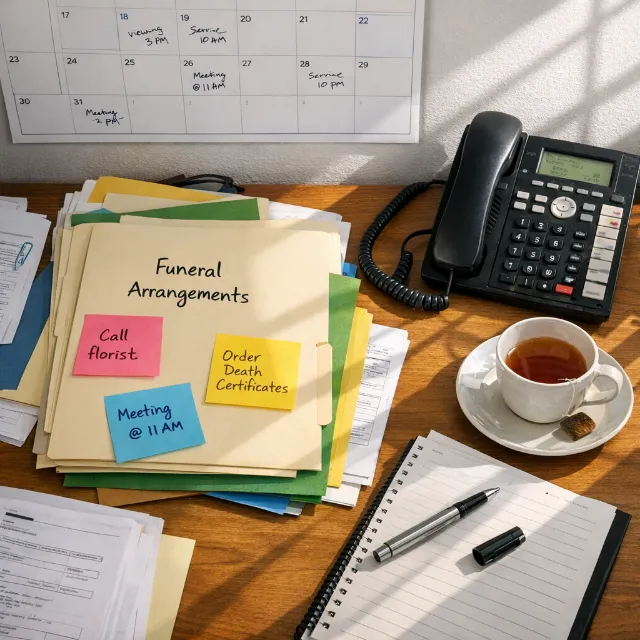
A coroner rings on a Tuesday afternoon. A solicitor sends a letter on Friday. A family member - distraught, angry, looking for answers - stands in your office and asks you to account for exactly where their mother was, who handled her, and what was done, from the moment she came into your care to the moment of cremation. You need to produce that record.
How long does it take? If the answer involves opening a filing cabinet, cross-referencing a mortuary logbook, checking a whiteboard, and hoping the night-call driver’s handwriting is legible - you have a chain of custody problem. It’s one of the clearest arguments for moving away from paper-based systems. And the question was never whether you’d be asked. It was whether you’d be ready when you were.
What Chain of Custody Actually Means in Funeral Service
In a legal or forensic context, chain of custody refers to the documented trail that tracks possession of evidence. In funeral service, the principle is the same but the stakes are different: it’s the complete, unbroken record of who had responsibility for the deceased at every point in your care.
That means documenting collection and transfer, receipt into the mortuary, storage location, any movement between sites or branches, all preparation and care, viewings, transport to the crematorium or cemetery, and final disposition. Every handoff. Every stage. Every person involved.
It’s the line that proves the right person was in the right place at every step. When that line is unbroken and documented, you can answer any question with confidence. When it’s not, you’re reconstructing from memory - and memory is not a compliance strategy.
Memory is not a compliance strategy.
Why This Matters Now - Not Later
The regulatory ground is shifting, and it’s shifting in one direction: toward higher documentation standards.
In England, the fallout from the David Fuller case and subsequent inquiries has pushed mortuary oversight, handling standards, and record-keeping firmly back into public and regulatory focus. The recommendations that followed were not abstract - they pointed directly at the quality of documentation, access controls, and accountability within mortuaries and funeral premises. The push toward statutory regulation in England continues to build momentum, and the standard of documentation expected of funeral homes is rising.
Scotland’s funeral sector register went live in April 2025, establishing a formal regulatory framework with explicit expectations around professional standards and record-keeping. That register is not a suggestion - it’s the direction of travel for the rest of the UK.
In Ireland, the picture is different but the pressure is no less real. Without a statutory regulatory framework for funeral directors, there is no regulator to vouch for your standards. Your records are the only proof of your professionalism. When a family, a coroner, or a solicitor asks questions, you cannot point to a licence or an inspection certificate. You can only point to what you documented.
Directors who can demonstrate rigorous chain of custody records now are ahead of wherever regulation lands. Those who cannot are exposed - not necessarily to penalties today, but to reputational damage, legal vulnerability, and the slow erosion of trust that comes from being unable to answer straightforward questions about your own operations.
Key takeaway
Directors who can demonstrate rigorous chain of custody records now are ahead of wherever regulation lands.
The Records That Should Exist at Every Stage
Most funeral homes track some of this. Very few track all of it in one place. Here is what a complete funeral home chain of custody record looks like, broken down by stage.
Collection and Transfer
The record starts the moment the deceased comes into your care. Document:
- Date and time of collection
- Location (hospital, residence, nursing home, coroner’s facility)
- Who collected (name of staff member or contracted transfer service)
- Who released the deceased (name, role, and facility)
- Identification confirmed (name band checked, ID verification, any identifying details cross-referenced)
- Condition on receipt (brief note - not a clinical assessment, but enough to establish the state of the deceased at handover)
Important
This is where chain of custody begins. If the first link is missing, everything that follows is weaker.
Receipt Into Premises
When the deceased arrives at your mortuary or preparation room:
- Date and time of arrival
- Received by whom (name of staff member)
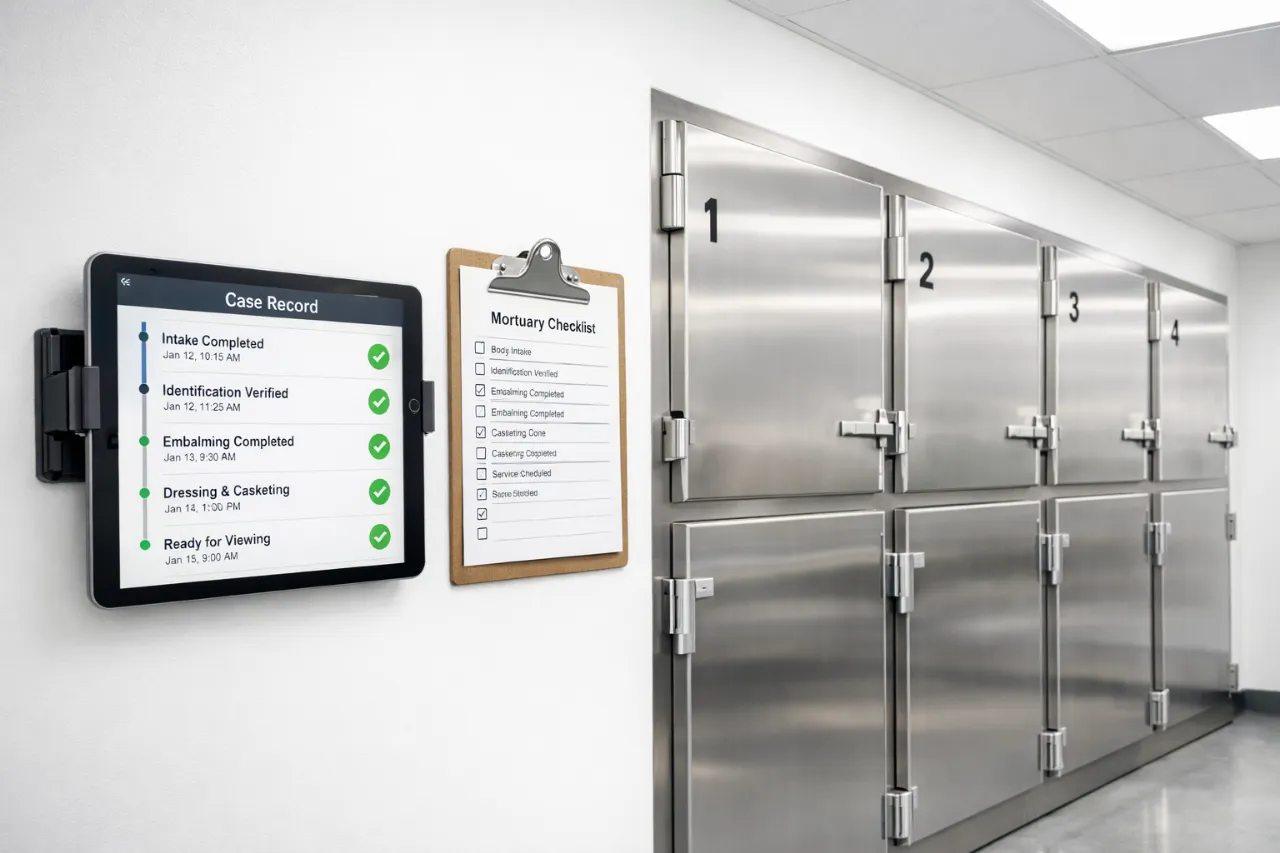
- Storage location assigned (specific unit number, bay, or fridge - not just “the mortuary”)
- Any personal property received with the deceased, itemised and logged
- Confirmation that identification was re-verified against your case file
A mortuary logbook covers some of this. But a logbook entry that says “Mrs. Jones - Fridge 3” with no time, no receiving signature, and no property note amounts to a reminder, not a chain of custody record.
Care and Preparation
Every action taken in preparing the deceased should be recorded against the case:
- What was done: washing, dressing, embalming, cosmetic work, any restorative procedures
- Who performed it (name of staff member or embalmer)
- When (date and time)
- Family instructions noted and confirmed (specific clothing, jewellery on or off, religious or cultural requirements)
This matters because families ask. Regulators ask. And if a complaint arises about the condition of the deceased at viewing, you need to show exactly what was done, by whom, and on whose instructions.
Movement Between Locations
Any transfer - between branches, to a chapel of rest for viewing, to a third-party facility for embalming, to a hospital for a post-mortem - creates a gap in custody unless it’s documented:
- Date and time of departure and arrival
- From where, to where
- Who transported
- Who received at the destination
- Reason for transfer
Watch out
This is where handoff failures tend to cluster. A deceased person moves between premises, and no one logs the transfer because “we all knew.” That’s fine until someone who wasn’t there needs to account for the movement - and can’t.
Release for Final Disposition
Before the deceased leaves your care for cremation or burial, the record should confirm:
- Date and time of release
- Released to which crematorium or cemetery
- Confirmed by whom (name of staff member who verified and authorised release)
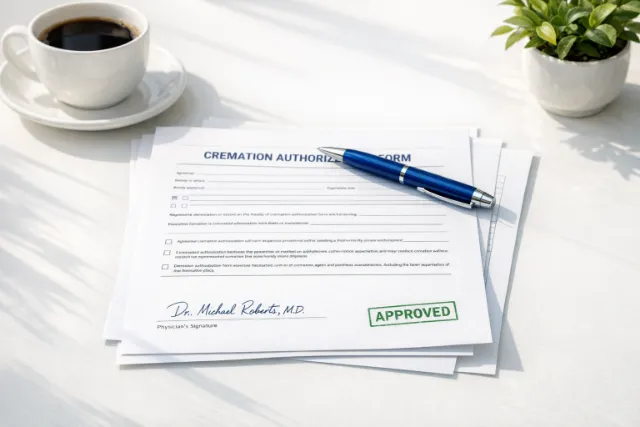
- All authorisation paperwork verified complete: cremation application forms, medical certificates, coroner’s documentation where applicable, family authorisations signed
This is the highest-risk handoff in your chain. Releasing the wrong person, or releasing without complete paperwork, is the kind of error that ends careers and triggers investigations. Your documentation should make it impossible to release without a verified, recorded sign-off.
Post-Disposition
The chain doesn’t end at the crematorium gates or the graveside:
- Cremation confirmation received and logged against the case
- Ashes collected or returned: date, by whom, and confirmed receipt (by family or by your premises for holding)
- Burial register confirmation received
- Case file closed with a complete audit trail
If ashes sit uncollected for months and a family eventually asks where they are, you need a record that shows exactly when they were returned to your premises, where they’ve been stored, and that the family was notified. Anything less is a gap.
The Real Problem: Fragmented Records
Here’s the truth that most directors already know: the work gets done. The deceased is collected properly, stored properly, cared for properly, and released properly. Funeral professionals take this responsibility seriously.
The problem is rarely the work. It’s the record of the work.
Transfer details live in a driver’s notebook. Mortuary assignments are on a whiteboard that gets wiped every Monday. Preparation notes are in a separate logbook - or in someone’s head. Family instructions were confirmed by text message to a personal phone. Cremation confirmations are filed in a folder that’s two rooms away from the case file.
The information exists. It’s scattered across mortuary logbooks, transfer forms, case folders, emails, text messages, WhatsApp threads, and the memories of staff who may or may not be working next week. Reconstructing a full chain of custody after the fact is slow, stressful, and unreliable. And if you’re reconstructing it under pressure - with a solicitor waiting, a family in distress, or an inspector at the door - the gaps become painfully visible.
The problem is rarely the work. It’s the record of the work.
Which systems record custody at all?
Three of the five funeral software systems we compared list custody or mortuary tracking; two do not reference it. Our UK & Ireland funeral software comparison shows which is which, alongside eSignatures, payments and pricing.
Centralising the Record
This is where digital case management earns its place. A platform like EverlyPro ties every touchpoint to the case file - transfer records, storage assignment, preparation notes, authorisation documents, disposition confirmation - so that producing a complete chain of custody report means opening one screen, not five filing cabinets. Task checklists ensure each step is logged as it happens rather than reconstructed later, and document storage keeps signed authorisations attached to the case they belong to. The record builds itself as the work progresses, not after the fact when details have faded.
The Five-Minute Audit
Here’s a practical exercise. Pick five recent cases at random - not your best-documented ones, not the straightforward ones, just five at random. For each, try to reconstruct the full chain of custody from your existing records:
- Who collected the deceased, when, and from where?
- Who received them at your premises, and where were they stored?
- What care and preparation was carried out, by whom, and when?
- Were there any movements between locations? Documented?
- Who released the deceased for cremation or burial, and were all authorisations verified and recorded?
- Is there a post-disposition confirmation on file?
Time yourself. If it takes more than five minutes per case, or if there are gaps you simply cannot fill, that tells you something important about your current system.
Treat this as a self-assessment rather than a scare tactic. Most homes will find they’re strong in some areas and weak in others - solid on collection records, thin on internal movements, inconsistent on post-disposition confirmation. Knowing where the gaps are is the first step toward closing them.
With Scotland’s regulatory framework already in place and statutory regulation in England looking increasingly likely, the window to get your documentation right on your own terms - before someone else sets the terms for you - is narrowing. In Ireland, where your records are your regulation, the case for getting this right is already made.
The standard
The standard is completeness, consistency, and the ability to produce the record when it’s needed. Perfection isn’t the bar. Five minutes. One case. Every stage accounted for.
Related reading: First Call to Final Disposition: Where Your Workflow Actually Breaks Down
Coming soon
What an Internal Audit Checklist for Funeral Case Files Should Include - a step-by-step framework for reviewing your own documentation. Also: Where Case Management Breaks Down: Handoffs, Approvals, and the Tasks That Slip Through.
Sources
- CMA Funerals Market Investigation Order 2021
- Scottish Government Funeral Sector Register (April 2025)
- David Fuller Independent Inquiry Recommendations
- NAFD Quality Assurance Standards