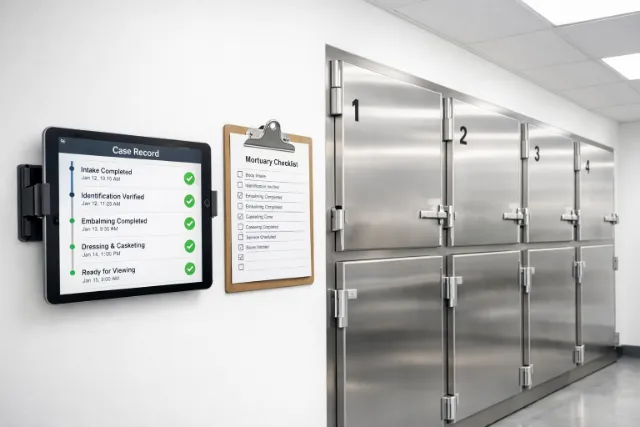
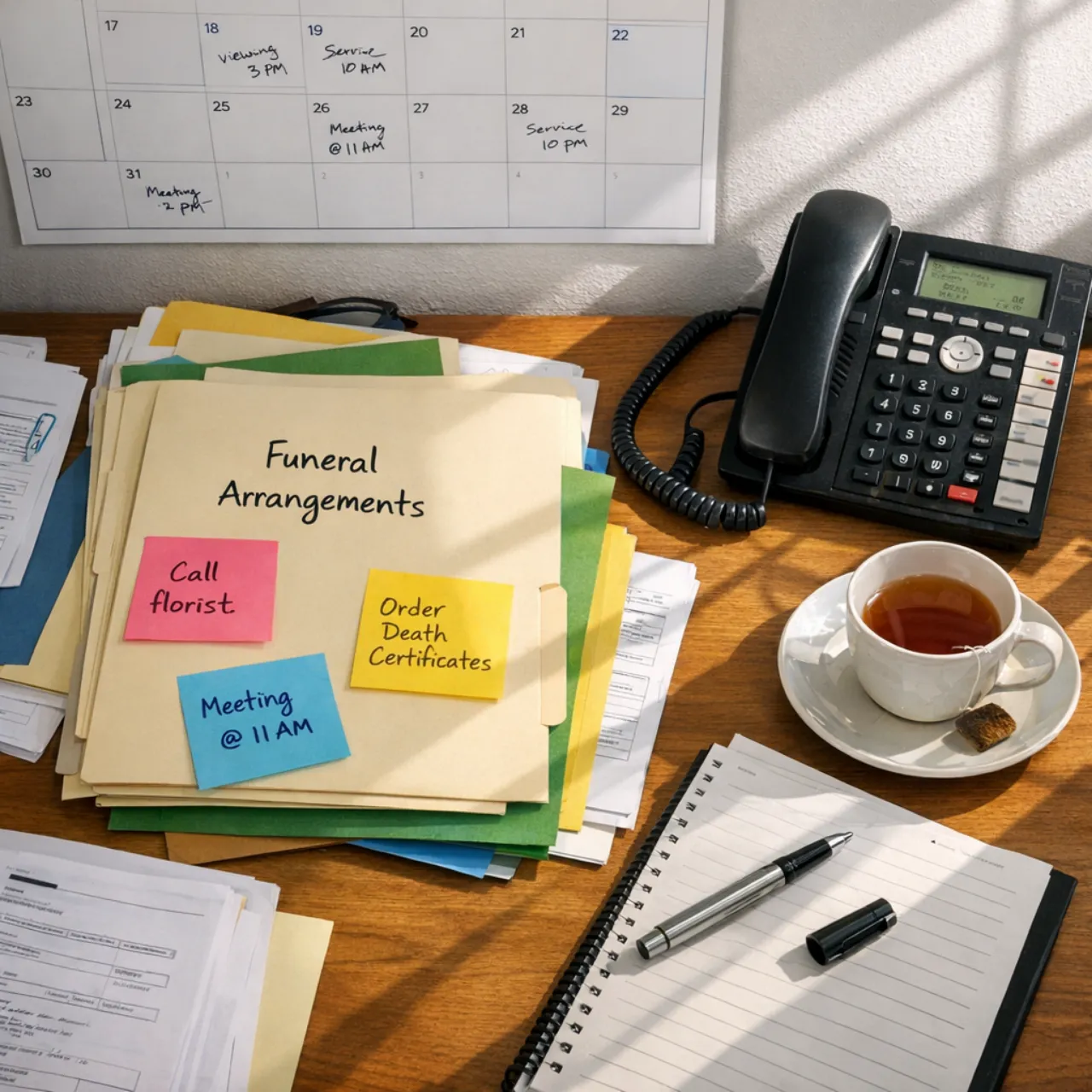
Every funeral director in the UK and Ireland can walk you through their process from first call to final disposition. The steps aren’t a mystery. You’ve done them hundreds of times - thousands, if you’ve been at it long enough. First call, transfer, care of the deceased, arrangement meeting, documentation, service, post-service. You could do it in your sleep. Some weeks, you practically do.
But here’s the honest question: on your busiest week last month - three or four cases running simultaneously, a coroner referral complicating one of them, a family changing their mind about the service two days out - can you say, hand on heart, that nothing slipped? That every document was filed, every task completed, every invoice sent within a reasonable window?
Most directors can’t. The systems they rely on simply weren’t built for the volume, complexity, or pace they’re actually working at, and carelessness rarely comes into it. The workflow holds up in theory and breaks in practice, under pressure, in the gaps between people.
The Pressure Points Are Where It Breaks
The NFDA’s 2025 industry survey data - the most comprehensive workforce snapshot available globally - shows that funeral professionals are working longer hours with fewer staff than a decade ago, while family expectations around personalisation and communication have only increased. That’s a global trend, but it lands hard in the UK and Ireland, where independent homes often operate with skeleton crews and regulatory paperwork hasn’t got any lighter.
What follows is a walk through the full case lifecycle, not to explain what you already know, but to name the specific points where things go wrong. If you recognise yourself in any of these, take it as a sign your systems need to catch up with your workload rather than an indictment.
First Call and Intake: Where Information Goes to Die
The first call sets the trajectory for the entire case. Name, date of death, location of the deceased, next of kin details, any immediate requirements - transfer timing, religious or cultural needs, coroner involvement. Most of that information comes in by phone, often outside office hours, often to whoever happens to pick up.
Here’s where it starts to unravel. The person taking the call writes down the details - on a notepad, on the back of an envelope, in a text message to themselves. If you’re a sole operator in rural Kerry or the Scottish Borders, maybe that’s fine, because you’re the only person who needs the information and you’ll act on it in the morning. But the moment a second person is involved - a colleague who’ll handle the transfer, an embalmer, an arranger - you’ve created a handoff. And handoffs are where information dies.
The family mentioned that the deceased had a pacemaker. The caller noted it, but it didn’t make it into the case file that the arranger reviewed before the arrangement meeting. Now the cremation authorisation paperwork is incomplete, and you’re chasing a detail you already had - three days ago, on a Post-it note that’s since been buried under a stack of Forms B.
The fix
The fix is capturing information once, in a place everyone on the team can see, at the moment it comes in. Better handwriting won’t save you.
Transfer and Care of the Deceased: The Silent Assumptions
Transfer and mortuary care tend to run smoothly when they’re routine. Problems surface when there’s an assumption that doesn’t get checked. The family requested a viewing, but the embalmer wasn’t told - they prepared the deceased for a closed coffin. The deceased needs to be dressed in specific clothing the family is bringing in, but nobody confirmed when it’s arriving or who’s receiving it.
These aren’t communication failures in the dramatic sense. Nobody forgot. Nobody was negligent. The information simply sat in the wrong place - in an email the embalmer doesn’t check, in a verbal aside during a busy morning, in the arranger’s mental to-do list rather than a written task attached to the case.
In homes with two or three staff, this manifests differently. With nobody to hand off to, it becomes a cognitive overload problem instead. You’re the person taking the first call, doing the transfer, meeting the family, filing the paperwork, and conducting the service. Nothing is written down because there’s no time to write it down, and there’s nobody else who needs to read it. Until the one time you forget, and the family notices before you do.
Documentation and Authorisations: The Bottleneck Nobody Talks About
Ask most directors what slows their cases down, and paperwork will be in the top three answers. In England and Wales, cremation requires a suite of authorisation forms - the medical certificate of cause of death, Form Cremation 1 (application by next of kin), the confirmatory medical certificate - each with its own signatory and timeline. In Ireland, the process differs in specifics but shares the same structural bottleneck: multiple signatures, from multiple parties, on multiple documents, often with no single person tracking which ones are outstanding.
Delays compound. A second doctor hasn’t signed off. The family hasn’t returned the application form because they’re overwhelmed and the envelope is sitting on their kitchen table. E-signatures eliminate this delay entirely - families sign from their phone in seconds. The registrar appointment is booked but the supporting documents aren’t assembled yet. Each of these is minor on its own. Stack three or four across simultaneous cases, and you’ve got a director spending their Wednesday morning chasing paper instead of supporting families.
The core issue is visibility. In a paper-based or loosely digital system (by which I mean a combination of Word documents, email, a shared drive, and someone’s memory), there’s no single view of which documents are outstanding across all active cases. Each case is a separate mental thread the director has to hold. Drop one thread during a busy week, and a cremation gets delayed or a registration window narrows uncomfortably.
The five-day registration deadline in England and Wales (and the similar timeframe expected in Ireland) doesn’t leave much margin. When a document is sitting in an email inbox that nobody checks on a Saturday, Monday morning becomes a scramble.
The test
If you can’t see which documents are outstanding across all active cases in under thirty seconds, your system isn’t giving you what you need.
Scheduling: The Conflict You Don’t See Until It’s Too Late
Scheduling failures are among the most visible breakdowns because they affect families directly. A double-booked hearse. A chapel slot that clashes with another service. We cover the six most common scheduling failures in detail elsewhere. A celebrant confirmed verbally by one arranger but never entered into the shared calendar - if a shared calendar even exists.
In multi-staff homes, the root cause is usually concurrent access: two arrangers checking vehicle or venue availability at different times, each seeing it as free, each booking it. By the time the conflict surfaces, one family needs to be moved, and that’s a conversation nobody wants to have.
In smaller homes, scheduling failures tend to be about cognitive load again - you confirmed the crematorium slot on the phone but didn’t write it down because you were already thinking about the next task. Or you wrote it in your personal diary but not on the wall planner, and your colleague (or your future self, next Monday) doesn’t know it’s booked.
Resource scheduling - staff, vehicles, venues - is one area where digital tools have a clear, measurable advantage over analogue systems. A shared visual timeline that shows all commitments in one view, with conflict detection that flags a double-booking before it’s confirmed, eliminates an entire category of operational failure. Tools like EverlyPro give every team member a single view of where each case stands: which tasks are done, which documents are outstanding, which events are scheduled. That visibility is what stops handoff failures before they become family complaints. EverlyPro’s task checklists auto-populate from templates when a new case is created, so nothing relies on someone remembering to add the standard steps. The resource scheduling timeline shows staff, vehicle, and venue availability in one view, flagging conflicts before they become double-bookings. One place, one truth, accessible to everyone on the team. That’s the principle - and it matters more than which specific tool you choose, though having used several, I’d say the gap between purpose-built funeral case management and cobbled-together generic tools is wider than most directors expect.
The Post-Service Drop-Off: Where Finished Cases Come Back to Bite You
The service is done. The family has been looked after. There’s a moment of relief - and then the next case demands your attention, and the one you just finished quietly slides to the bottom of the pile.
This is where the post-service tasks start slipping. The invoice doesn’t go out for two weeks because the case file wasn’t closed out and the billing prompt never triggered. Ashes sit at the crematorium longer than they should because the collection wasn’t tracked - the crematorium sent a notification, but it went to a general inbox and nobody picked it up. Death certificate copies weren’t ordered because that task fell off the list once the funeral was over. The family’s signed documents aren’t all on file because two of three were returned but the third is still outstanding, and nobody flagged it.
None of these are urgent in the moment. All of them become problems later - a family calling to ask where the ashes are, an aged debt that’s harder to collect at sixty days than at seven, a compliance gap that surfaces during an audit or an NAFD Quality Assurance review.
The post-service phase is the least glamorous part of the workflow and, not coincidentally, the most neglected. It doesn’t have the emotional urgency of the arrangement meeting or the logistical pressure of the day of service. But it’s where your professional reputation lives or dies in the details. Late invoices signal disorganisation. Unreturned ashes signal carelessness. Missing documents signal a home that isn’t on top of its administration. None of those are the impression you want to leave.
Just as your pricing page needs to be clear to families, your internal pricing and invoicing workflow needs to be airtight to avoid confusion and aged debt. We covered the family-facing side in The Most Common Pricing Page Mistakes Funeral Homes Make.
For the One-Person Home: A Different Kind of Breakdown
Much of the above assumes a team - handoffs between people, shared calendars, delegation. But a significant number of homes in rural Ireland and across the UK operate with one to three staff. In those settings, the workflow breakdowns look different.
There are no handoff failures because there’s nobody to hand off to. Instead, there’s a single person carrying every active case in their head, switching between roles - arranger, embalmer, driver, administrator, grief counsellor - sometimes within the same hour. The risk here is memory itself: when everything lives in your head, the thing you forget is the thing you were most confident you’d remember.
For sole operators, the value of a structured system - digital or otherwise - lies in externalising your mental load rather than coordinating a team. Getting the details out of your head and into a record that will remind you what needs doing, even when you’re exhausted, even when you’re mid-service and can’t think about the paperwork waiting on your desk.
Smaller homes sometimes resist case management tools on the basis that they’re designed for larger operations. That’s a fair concern with some platforms. But the cognitive relief of a task list that tells you what’s outstanding across all your cases - without you having to reconstruct it from memory each morning - is arguably more valuable to a sole operator than to a team of ten.
Which systems close these gaps?
Documents, custody, scheduling and payments are exactly the rows in our side-by-side comparison of five UK and Ireland funeral software systems. It shows which vendors list each capability, in their own words, and where each one falls short.
Audit Your Own Workflow This Week
Theory is useful. Practice is better. Here’s a concrete exercise you can do in thirty minutes.
Pull your last ten completed case files. For each one, ask five questions:
- Was every standard task completed before the case was closed? Check against your usual process - were any steps skipped or done out of order?
- Was the invoice sent within seven days of the service? If not, how long did it take, and why?
- Were ashes returned to the family (or stored with confirmed instructions) and logged? Is there a record, or just a memory?
- Are all signed documents on file? Every consent form, every authorisation, every contract - physically or digitally present and accounted for?
- Was the case file complete enough that a colleague could pick it up and understand the full history without asking you a single question?
Your next step
If the answer is no on more than two cases out of ten, you have a workflow gap. The next step is figuring out where - which of the stages above is your consistent weak point.
Coming soon
Chain of Custody: The Records Every Funeral Home Should Produce in Under 5 Minutes - a future post exploring what a complete, audit-ready case record looks like.
Coming soon
The Whiteboard Is Dead: Why Digital Dashboards Beat Physical Boards and Group Texts - a future post on the specific advantages of digital case visibility over analogue tracking.
The Workflow You Describe Isn’t the Workflow You Run
Every director has a process. The gap between the process as described and the process as executed is where families get let down, where invoices go unpaid, where compliance risks accumulate, and where directors burn out trying to hold it all together through sheer effort and memory.
Closing that gap doesn’t require perfection. It requires visibility - across cases, across team members, across stages. Whether you get there with a whiteboard, a spreadsheet, or a purpose-built platform, the principle is the same: if you can’t see what’s outstanding at a glance, you’re relying on luck. And luck is not a workflow.
If you can’t see what’s outstanding at a glance, you’re relying on luck. And luck is not a workflow.
Sources
- NFDA 2025 Industry Survey
- SunLife Cost of Dying Report 2025
- CMA Funerals Market Investigation Order 2021
- NAFD Quality Assurance Standards