Co-op Funeralcare and Dignity plc between them handle a substantial share of the UK funeral market. Behind them, a growing queue of smaller consolidators and private equity-backed groups are quietly acquiring independent homes - often approaching owners who haven’t yet decided whether they’re ready to sell. In Ireland, the market remains overwhelmingly independent, but the pattern is forming. Every independent funeral home owner has asked themselves the same question, even if they haven’t said it out loud: can I compete with this, and for how long?
The Landscape Has Shifted - and It’s Still Shifting
The CMA Funerals Market Investigation laid bare the structure of the UK funeral market: a sector where a handful of large operators hold significant market share while thousands of independents serve their local communities. The investigation found limited price competition and, in many areas, families choosing providers based on proximity and reputation rather than informed comparison.
That market structure creates opportunity for consolidators. Acquiring an established independent - one with a known name, a loyal community, and steady case volume - is a lower-risk growth strategy than building from scratch. The acquirer gets the goodwill; the owner gets a cheque. Both sides have rational reasons to do the deal.
But the decision facing independent owners is more complicated than sell or don’t sell. There are at least four distinct paths, each with genuine advantages and real costs. The right choice depends on circumstances that no industry commentator can assess from the outside - your stage of career, your financial position, your family situation, your energy, and your vision for what your business should be in ten years.
Here are the options, laid out honestly.
Option 1: Compete and Differentiate
The independent advantage is not a myth. Local knowledge, personal relationships, community trust, flexibility to personalise services, and speed of decision-making - these are structural strengths that corporate operators struggle to replicate. Standardised processes and centralised management create consistency, but they sacrifice individuality. When a family calls a corporate-owned home, they may get a perfectly competent service. When they call an independent where the director knows the family, knows the parish, knows the gravedigger by name - that’s a different experience, and many families can feel the difference.
Directors who lean into what makes them local and personal can hold market share. The broader shift toward simpler funerals is changing how families evaluate value, and independents who adapt can serve that demand better than corporate operations. Community involvement, distinctive service offerings, genuine relationships with local clergy, celebrants, florists, and venues are competitive moats that a regional head office two hundred miles away cannot easily replicate, whatever they look like from a balance sheet.
The trade-off
Competing effectively requires investment. A strong digital presence, active local marketing, service innovation, and willingness to adapt to changing family expectations around personalisation, technology, and transparency. The CMA’s pricing transparency requirements under the Funerals Market Investigation Order apply to everyone, but independents who embrace transparency as a genuine differentiator - rather than treating it as a compliance burden - stand to gain trust.
This path demands energy. For owners approaching retirement, or those already stretched thin running the business day-to-day, the prospect of also becoming their own marketing department and innovation lead is daunting. Competing and differentiating is a viable strategy, but only if the owner has the runway and the appetite for it.
Option 2: Sell and Exit
For some owners, selling is the most rational financial decision available - and acknowledging that isn’t defeat.
The data on succession is sobering. Nearly half of US funeral home owners plan to retire within five years, and only a minority have a formal succession plan in place (NFDA data). While the UK and Irish markets differ in scale and structure, the demographic pattern holds: many independent owners are ageing, their children have chosen different careers, and the pipeline of potential buyers is thin.
A sale to a consolidator - whether Dignity, a regional group, or a private equity-backed operator - delivers a financial return on decades of work. Staff typically keep their jobs, at least initially - though retaining experienced staff through ownership transitions is rarely straightforward. The brand may continue locally. Families in the community may not notice an immediate change.
The trade-off
The owner loses control over how families are served. Corporate ownership brings standardisation, and standardisation inevitably changes culture. Pricing structures shift. Staffing decisions get made further from the community. The personal touch that defined the home may erode over time - not maliciously, but structurally.
There’s an emotional cost too. For many owners, the business is a family legacy - a name on the building that represents generations of service. Selling that to a corporate entity feels, to some, like a betrayal of what it stood for. That feeling is legitimate, even when the financial logic is sound. Both things can be true.
If this is the path, the key is to sell from a position of strength - with clean financials, documented processes, and a clear understanding of the business’s value - rather than waiting until fatigue or declining case volume forces a fire sale on unfavourable terms.
Option 3: Prepare the Business for the Next Generation
Family succession or a management buyout keeps the home independent, but it doesn’t happen by accident. It requires deliberate, sustained planning - and most owners start too late.
Effective succession planning means documenting operations so the business can run without the founder. It means building a team with the skills and authority to manage cases, finances, and relationships independently. It means establishing the business’s market value through proper valuation, not guesswork. And it means having uncomfortable conversations early - with family members about their willingness and readiness to take over, or with senior staff about buyout terms and timelines.
The trade-off
Succession planning is slow, emotionally complex, and easy to defer. The conversations are difficult. A founder who has run the business for thirty years may struggle to step back, to delegate, to accept that the next generation will do things differently. Family dynamics add layers of complication that no business textbook adequately prepares you for.
The risk of delay is real. An owner who puts off succession planning until they’re burnt out or unwell has fewer options and less negotiating power - whether they’re handing over to family or selling externally.
Done well, though, succession is the only option that preserves both the business’s independence and its culture. It’s the hardest path, but it’s the one that carries the legacy forward intact.
Option 4: Partner or Collaborate Without Selling
This is the least discussed option, but it’s emerging - particularly in rural areas where independents face the same pressures but resist the idea of selling outright.
Buying groups. Shared services. Informal networks of independents who pool resources: vehicles, on-call cover, mortuary facilities, back-office functions, even joint marketing. The goal is to capture some of the scale advantages that corporates enjoy - purchasing power, operational efficiency, coverage flexibility - without surrendering ownership or identity.
In Ireland, where the market is more geographically dispersed and the tradition of independence runs deep, informal collaboration between neighbouring funeral homes has long been part of the culture, even if it’s rarely formalised. In the UK, SAIF and NAFD membership already provides some collective infrastructure. The question is whether independents can push collaboration further - into shared operational capacity rather than just shared lobbying and training.
The trade-off
Collaboration requires trust between competitors. It requires a willingness to coordinate, to compromise, and to invest time in relationships that may not produce immediate returns. Not every independent owner has the temperament for it. Governance structures for shared-service arrangements can be complex, and without clear agreements, partnerships sour quickly.
It also doesn’t solve the succession problem. Collaboration can make the business more competitive and more resilient, but if the owner still retires without a plan, the business still faces the same endpoint.
The Complicating Factor Nobody Can Ignore
Corporate consolidation isn’t the only competitive force reshaping the market. Direct cremation and online-first providers represent a separate axis of disruption - one that affects corporates and independents alike.
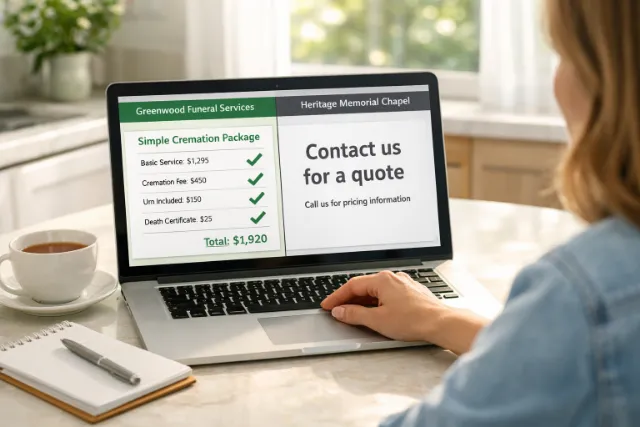
The UK’s direct cremation rate is approaching 20%, up from negligible levels a decade ago. The SunLife Cost of Dying Report consistently documents the price sensitivity driving this shift: with the average simple attended funeral costing £3,828 and direct cremation available from £1,628, families under financial pressure are making a rational calculation. Funeral poverty affects over 75,000 UK families annually, which makes it a structural market force rather than a niche concern.
An independent that differentiates on high-touch, deeply personalised funeral services is competing on one axis. But the market is also moving on the cost-and-simplicity axis. The consolidation conversation cannot be separated from this broader shift.
An owner deciding whether to compete, sell, succeed, or collaborate needs to account for both pressures simultaneously - the squeeze from corporates above and the erosion from low-cost providers below.
There Is No Single Right Answer
The honest conclusion is that this decision is deeply personal. It depends on where you are in your career, what your finances look like, whether your children want the business or have built lives elsewhere, how much energy you have left, and what you believe your community needs.
Romanticising independence for its own sake helps nobody - especially an owner who is exhausted, under-resourced, and watching case volume drift toward the corporate home down the road. Equally, treating consolidation as inevitable and selling as the only sensible option ignores the thousands of independents who are thriving precisely because they are independent.
This post won’t tell you what to do. It aims to make sure that whatever you decide, you decide it deliberately - with clear eyes, honest numbers, and enough lead time to execute on your terms rather than someone else’s.
Your next step
Wherever you are on this spectrum, your business runs better when the admin is handled. EverlyPro helps independent funeral homes streamline case management, documents, and payments - so you can focus on the families and the future.
Sources
- CMA Funerals Market Investigation - gov.uk
- CMA Funerals Market Investigation Order - gov.uk
- SunLife Cost of Dying Report - sunlife.co.uk
- NFDA - nfda.org
- SAIF - saif.org.uk
- NAFD - nafd.org.uk