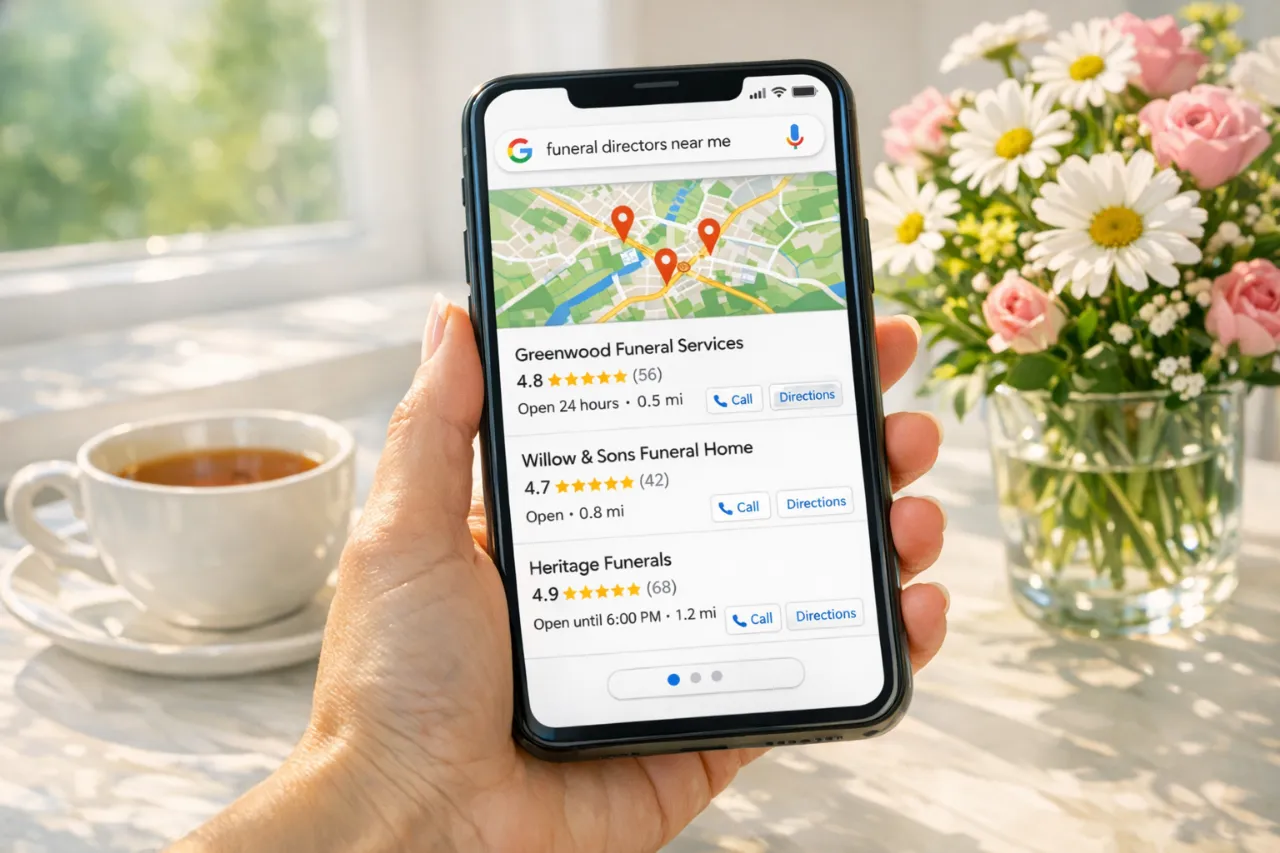
When a family needs a funeral director, the majority search online first. They type “funeral home near me” or “funeral directors [town name]” into Google, and they choose from what appears. Not page two. Not the organic results below the fold. They choose from the Google Maps local pack - the three businesses that appear with a map pin, a star rating, and a phone number at the top of the results page.
If your funeral home isn’t in those three results for your area, you are functionally invisible to a significant proportion of families at the exact moment they’re making a decision. Word of mouth still matters - particularly in smaller communities across Ireland and the UK - but it’s no longer enough on its own. Funeral home SEO is the mechanism that determines whether families find you or find your competitor.
What follows are seven specific actions, stripped of jargon. None requires a marketing agency. Each can be started today.
1. Your Google Business Profile Is Your Single Most Important Digital Asset
Before your website, before social media, before anything else - your Google Business Profile (GBP) is what appears in the Maps pack. It’s the first thing most families see, and for many, it’s the only thing they look at before picking up the phone.
Claim and verify it if you haven’t already. Google will send a postcard or offer phone verification. Until you’ve verified, you can’t control what appears. Some funeral homes have unclaimed profiles with incorrect opening hours, outdated phone numbers, or no photos - all of which signal neglect to families browsing at a vulnerable moment.
Complete every field. Business name (exactly as it appears on your signage - no keyword stuffing), address, phone number, website, opening hours, business description, and service areas. Select the correct primary category (“Funeral Home” or “Funeral Director”) and add relevant secondary categories (“Cremation Service,” “Memorial Service”).
Add real photographs. Interior shots, exterior, the chapel, your vehicles, your team. Google’s own data confirms that businesses with photos receive significantly more direction requests and website clicks than those without. Stock images are worse than no images - families can tell.
Post regular updates. Google Business Profile has a “Posts” feature. Use it monthly - a brief note about a community event, a seasonal reflection, or an update about your services. Activity signals to Google that the business is current and engaged.
2. Reviews Drive Ranking, Not Just Reputation
Google’s local search algorithm weights three primary factors: relevance, distance, and prominence. Prominence is heavily influenced by reviews - their quantity, recency, and rating. A funeral home with 30 reviews from the past year will consistently outrank one with five reviews from 2019, even if the older reviews are all five stars.
This means reviews are not just a trust signal for families - they are a direct ranking factor that determines whether you appear in the Maps pack at all.
Ask for reviews systematically. Not aggressively, not at the funeral, but through a thoughtful follow-up process. Our earlier post on asking bereaved families for reviews covers timing, tone, and templates in detail. The approach matters enormously - but so does consistency. A steady flow of reviews month by month outperforms a burst followed by silence.
Respond to every review. Positive or negative, every review deserves a brief, genuine response. Google has confirmed that businesses that respond to reviews are considered more trustworthy. For families reading reviews, seeing that the director personally acknowledged feedback demonstrates attentiveness. Keep responses professional, warm, and short.
3. Your Website Needs Location Pages, Not Just a Homepage
If your funeral home serves multiple towns or areas - and most do - a single homepage trying to rank for all of them will rank poorly for each. Google wants to show searchers the most relevant local result. A page that mentions six different locations is less relevant to any single one than a dedicated page about that specific area.
Create individual location pages for each town or area you serve. Each page should include the area name in the title tag and H1 heading, a paragraph about your services in that community, the address of your nearest premises (if applicable), and local details that demonstrate genuine presence - the cemetery you work with, the crematorium families use, the churches and community spaces you know.
A funeral home in County Cork serving Midleton, Cobh, and Youghal needs three distinct pages - not one generic “Areas We Serve” list. Each page gives Google a clear, specific answer to “funeral directors Midleton” or “funeral home Cobh.”
4. Obituary Pages Are Your Organic Traffic Engine
Here’s a data point that surprises most directors: obituary pages drive approximately five times more website traffic than all other funeral home pages combined. Every obituary you publish is a new page indexed by Google, targeting a specific person’s name in a specific location. When someone searches for the deceased - and they do, in large numbers - your website appears.
That traffic isn’t wasted. Visitors who arrive via an obituary see your branding, your services, your professionalism. Some are local. Some will need a funeral director in the future. Every obituary is a quiet, persistent advertisement for your home.
Structure obituaries for search. Use the deceased’s full name in the page title and the H1 heading. Include their location, key dates, and service details. Avoid publishing obituaries as images or PDFs - Google can’t read them. Plain text with proper HTML headings ensures every obituary is indexed and discoverable.
Link from obituaries to your service pages. A brief line at the bottom - “Funeral arrangements by [Your Home]. Learn more about our traditional funeral services / direct cremation options” - creates an internal link that passes authority to your key pages and gives visitors a natural next step.
Quick win
If your current website doesn’t support individual obituary pages with unique URLs, that’s a problem worth solving before almost anything else on this list. Every obituary published as a PDF or image is invisible to Google.
5. NAP Consistency: Name, Address, Phone - Identical Everywhere
Google cross-references your business information across the web to verify legitimacy. If your business name appears as “O’Brien & Sons Funeral Directors” on your website, “O’Brien Funeral Home” on Yell, “O’Brien and Sons” on Facebook, and “OBrien & Sons Funeral Directors” on the NAFD directory - that inconsistency confuses Google’s algorithm and weakens your local ranking.
Audit every listing. Google Business Profile, your website, Facebook, Yell (UK), Golden Pages (Ireland), NAFD directory, IAFD directory, Bing Places, Apple Maps, and any other platform where your business appears. The name, address, and phone number must be identical - same format, same punctuation, same spacing.
This is tedious work. Do it once, then check annually. Inconsistencies creep in when directories auto-generate listings or when staff update one platform but not others. A single afternoon spent aligning your NAP data across every platform can produce measurable ranking improvements within weeks.
6. Service Pages Written for Search, Not Just Display
Most funeral home websites have an “Our Services” page with three or four bullet points: traditional funerals, cremation, repatriation, pre-planning. That page won’t rank for anything. Google ranks individual pages for individual search queries. A single page listing multiple services competes with competitor pages dedicated entirely to each one.
Create individual service pages. One for traditional funerals. One for direct cremation. One for repatriation. One for pre-arranged funerals. Each page should be 300–500 words, written in plain language that reflects how families actually search - not industry terminology they don’t use.
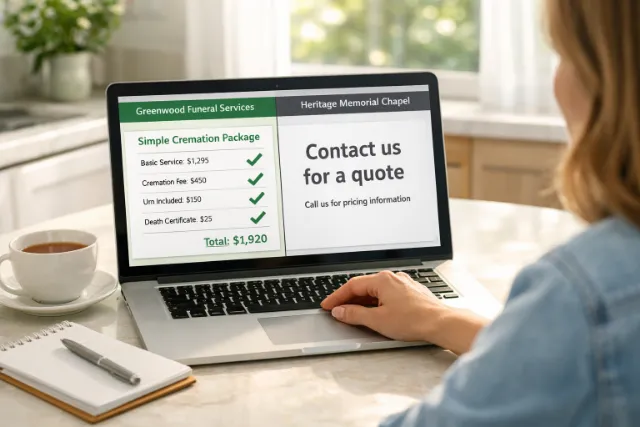
A direct cremation page should include what it is, what it costs (or a starting price), what’s included, and what happens step by step. Publishing prices transparently builds trust and aligns with regulatory expectations. A page about what families actually look for when choosing a funeral director can inform how you structure your content.
Each service page should target a specific keyword naturally: “direct cremation [your town],” “repatriation funeral services [your area],” “traditional funeral [your county].” The keyword belongs in the page title, the H1, and the opening paragraph - not forced in unnaturally, but present clearly enough that Google understands what the page is about.
7. Mobile Speed Is Non-Negotiable
Most families searching for a funeral director are doing so on a phone. Google has confirmed that mobile page speed is a ranking factor - slower sites rank lower. Beyond ranking, a site that takes more than three seconds to load loses visitors. A family in distress, searching on a phone with average signal, will not wait for your homepage to render. They’ll tap the back button and call whichever competitor loaded first.
Test your site at PageSpeed Insights. Enter your URL and review the mobile score. A score below 50 needs urgent attention. Common culprits: oversized images (the hero photo of your premises doesn’t need to be 4MB), uncompressed files, excessive plugins, and cheap hosting with slow server response times.
If your website was built more than five years ago and hasn’t been optimised since, it’s almost certainly slower than it should be. Speak to your web provider with specific numbers from the PageSpeed test - “our mobile score is 35, what can you do to get it above 70?” gives them a concrete target rather than a vague request to “make it faster.”
Avoid auto-playing videos, large sliders, and pop-ups on mobile. They slow load times and frustrate users. A clean, fast-loading site with clear contact information, service pages, and obituaries will outperform an elaborate site that takes five seconds to appear every single time.
What This Looks Like in Practice
Funeral homes that consistently appear in local search results share a pattern. Their Google Business Profile is complete, current, and verified. They have a steady stream of recent reviews - not hundreds, but enough to demonstrate consistent quality. Their website loads quickly on mobile, has individual pages for each service and each location they serve, and publishes obituaries as indexed, searchable pages that bring in traffic week after week. NAP data is consistent across every platform where they appear.
None of this is technically difficult. None of it requires an agency or a large budget. What it requires is attention - the same attention you give to every other aspect of running a funeral home well. An hour a month maintaining your Google Business Profile, a consistent process for requesting reviews, and a website that’s built for families searching on their phones rather than for impressing other funeral directors at a conference.
Start with your Google Business Profile. Complete every field, add photos, respond to your existing reviews. Then test your website speed. Then look at your obituary pages. Each step builds on the last, and each one moves you closer to being the funeral home families actually find when they need one most.