A family felt the cost was too high. The coroner's delay got blamed on your firm. A grieving son, exhausted and angry, directed that anger at the last professional he dealt with - you. Or maybe it was a genuine mistake: a misspelled name on the service sheet, a late start, an unreturned phone call.
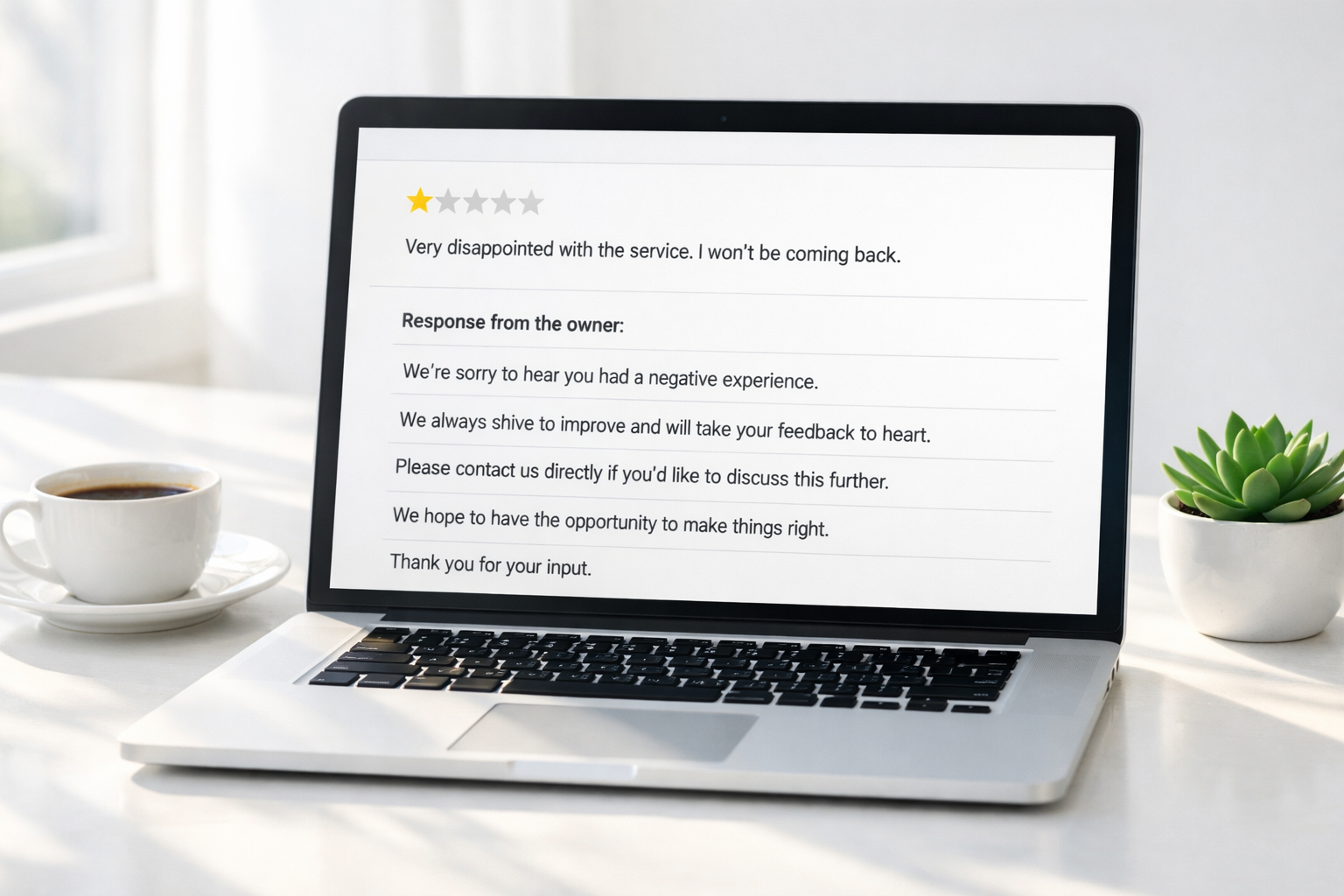
Whatever caused it, the result is the same. A one-star review, sitting on your Google Business Profile, visible to every family who searches your name. Permanent. Public. And now it's the first thing the next bereaved family sees when they're deciding who to trust with their mother's funeral.
Funeral home negative reviews happen to every firm eventually. The question isn't whether you'll get one. The question is what you do next - because how you respond matters far more than the review itself.
1. Respond to Every Negative Review
Silence is the worst possible response. To a grieving family, silence reads as indifference. To a prospective family reading your reviews, silence reads as guilt - or worse, as a firm that simply doesn't care.
A thoughtful, composed response does something powerful: it shows every future family browsing your profile that you take concerns seriously. Remember, your response is really for the hundreds of prospective families who will read it over the coming months and years, far more than for the reviewer. Those people are forming an opinion about your character based on how you handle criticism, not on the criticism itself.
According to Google's own guidance on managing reviews, responding to reviews - positive and negative - demonstrates that you value your clients' feedback. Directors who respond consistently build a profile that looks attentive, professional, and human.
2. Respond Within 48 Hours
Speed signals attentiveness. A review that sits unanswered for three weeks tells prospective families that nobody's watching - that the business either doesn't notice or doesn't care. Neither impression helps you.
Aim for a response within 24 to 48 hours. You don't need to resolve the issue in your reply; you need to acknowledge it promptly. If you're a sole practitioner or a small team, set a weekly calendar reminder to check your Google Business Profile reviews. Better yet, turn on notifications so you see them the moment they're posted.
Quick responses also reduce the chance of the reviewer escalating their frustration elsewhere - on social media, in community groups, or to their wider circle. (For more on managing your Google Business Profile effectively, see our earlier post on how to ask bereaved families for reviews.)
3. Lead With Empathy, Not Defence
Your opening line sets the entire tone. Get it right and even a critical reader will see professionalism. Get it wrong and you've confirmed whatever the reviewer accused you of.
Use this approach: “Thank you for sharing your experience. We're sorry that [specific aspect] didn't meet the standard we set for ourselves.”
Never use: “We're sorry you feel that way” - this is dismissive. It tells the person their feelings are the problem, not your service.
Never open with: “Actually, what happened was...” - leading with a correction, even a factually accurate one, reads as defensive. Every prospective family scanning your reviews will see a business that argues rather than listens.
Empathy first. Always. Even when the review makes your blood boil.
4. Acknowledge the Specific Concern Without Admitting Fault Publicly
You can validate someone's frustration without agreeing with their version of events. This is the most important skill in review responses, and it's where most directors struggle.
For cost complaints
“We understand that funeral costs are a significant concern, and we work hard to be transparent about our pricing from the earliest conversation. We're sorry if that wasn't your experience in this case.”
For delay complaints
“We appreciate that any delay during such a difficult time is deeply frustrating, and we're sorry for the distress this caused. A number of factors can affect timing, some outside our direct control, but that doesn't diminish how this felt for your family.”
For service quality concerns
“We hold ourselves to a high standard of care and we're sorry to hear we fell short of your expectations. Every family deserves our very best, and we take this feedback seriously.”
Don't litigate the facts publicly. Don't explain that the coroner caused the delay, that the family changed the coffin selection three times, or that you tried calling back twice and got no answer. Even if every word is true, it looks defensive - and families judge funeral homes by the warmth and professionalism they see online, not by who won the argument.
5. Take It Offline
Every negative review response should include an invitation to continue the conversation privately. One sentence is enough:
We'd welcome the opportunity to discuss this with you directly - please contact us at [phone number] or [email address] so we can understand your experience fully and see if there's anything we can do.
Moving the conversation to a private channel does three things. It shows willingness to engage genuinely. It prevents a public back-and-forth that benefits nobody. And it gives you the chance to hear the full story, which is often more nuanced than the review suggests.
Some families will take you up on it. Many won't. Either way, you've demonstrated to every reader that you tried.
6. Keep It Short
Three to five sentences. That's it. Long responses - no matter how reasonable - make you look defensive. Every additional paragraph of explanation chips away at the composed, professional image you're trying to project.
Prospective families are scanning, not reading closely. A brief, empathetic, dignified response stands out. A six-paragraph defence - even a well-written one - looks like a firm that can't let go of a fight. Resist the urge to explain everything. Your response is a signal, not a court submission.
7. Never Argue, Never Blame, Never Get Personal
Some reviews are unfair. Factually wrong. Occasionally abusive. A family member processing grief can write things that bear no resemblance to what actually happened. Your staff did everything right, and you know it.
Respond with the same composure anyway. A funeral director who responds to an unfair review with grace earns more trust from readers than a wall of five-star reviews ever could. Families judge character by how you handle criticism, not praise. The restraint you show in that moment tells prospective families exactly who you are.
Never reference confidential details about the deceased or the arrangement. Never imply the reviewer is lying. Never use a tone you wouldn't use in your arrangement room. If a staff member is named unfairly, address it privately - not in a public reply.
8. When the Review Is Genuinely Unfair or Fake
Google does have a process for flagging reviews that violate their review policies - spam, fake reviews, reviews from someone who wasn't a client, or reviews containing hate speech or personal attacks. You can flag these through your Google Business Profile.
Be realistic, though: removal is rare and slow. Google's threshold for taking down a review is high. Flag it if it clearly violates policy, but don't rely on removal as your strategy. In the meantime, respond using the same principles above. A composed response to an obviously unfair review is arguably more impressive than a response to a legitimate one - because readers can see the unfairness too, and they're watching how you handle it.
Ready-to-Use Response Templates
Below are four templates you can adapt for your firm. Each follows the same structure: empathy, acknowledgement, invitation to continue offline.
Template 1 - Cost Complaint
“Thank you for taking the time to share your experience. We understand that funeral costs weigh heavily, especially during an already difficult time, and we're sorry if our pricing wasn't communicated as clearly as it should have been. Transparency is something we work hard to get right. We'd very much like to discuss this with you directly - please don't hesitate to contact us at [phone/email] so we can talk through your concerns.”
Template 2 - Delay or Timing Complaint
“We're sorry to hear about your experience. Any delay during such a painful time is distressing, and we understand your frustration. While there are sometimes factors that affect timing beyond our control, that doesn't change how this felt for your family, and we take that seriously. If you'd be willing, we'd welcome the chance to speak with you directly at [phone/email].”
Template 3 - Service Quality Complaint
“Thank you for this feedback. We set a high standard for the care we provide, and we're genuinely sorry to hear that your family's experience didn't reflect that. Every family matters to us, and we want to understand where we fell short. Please contact us at [phone/email] - we'd value the opportunity to discuss this privately.”
Template 4 - General Dissatisfaction
“We're sorry that your experience with us wasn't what you expected or deserved. We take every piece of feedback seriously because it helps us improve the care we offer to families. We'd like the chance to hear more about your experience - please reach out to us at [phone/email] whenever suits you.”
A Quick Audit for Your Current Reviews
Set aside twenty minutes this week and work through your Google Business Profile:
- Have you responded to every review - positive and negative? If not, start with the negatives.
- Are any responses defensive, long, or argumentative? Consider editing or replacing them. Google allows you to edit your responses.
- Is your contact information correct in every response that invites offline contact?
- Are notifications turned on so you see new reviews promptly?
- Does your overall profile look active and cared for? A strong local SEO presence amplifies the impact of good review management.
The Firms With the Strongest Reputations
Funeral homes with the strongest online reputations aren't those with zero negative reviews. Families understand that no business is perfect. What they look for - and what they find reassuring - is evidence that a firm listens, responds with compassion, and takes accountability.
A single thoughtful response to a one-star review can tell a prospective family more about your values than fifty glowing testimonials. Every negative review is a chance to demonstrate your character publicly - an opportunity you already know how to handle. You do this work every day, in every arrangement room, with every family. Responding to a review is no different: meet the person where they are, lead with care, and let the composure speak for itself.