
Funeral poverty touches more than 75,000 UK families every year, according to the SunLife Cost of Dying Report. In Ireland, where average funeral costs exceed €6,000 and no universal state funeral payment exists, the numbers are harder to pin down - but the pressure on lower-income families is no less real. For many of those families, the funeral director is the first person they tell. Not a social worker, not a benefits adviser. You.
How you respond in that moment - the first five minutes after a family says we can’t afford this - shapes everything that follows. Their experience, your reputation, and in many cases, whether they walk out the door to a national direct cremation provider or stay with someone local who treated them with dignity.
There Is No Single Right Answer
This is the uncomfortable truth. Directors face three competing pressures simultaneously: genuine compassion for a family in crisis, the financial sustainability of a business with fixed overheads and thin margins, and fairness to the families who do pay full cost for the same service. Any approach that ignores one of those three will eventually cause problems.
What follows are four practical options. Most directors will use a combination, depending on the family, the circumstances, and the financial realities of their business. None of them is perfect. All of them are better than having no plan at all and making it up in the arrangement room under emotional pressure.
Option 1: Offer a Genuinely Affordable Basic Option
This means a clearly defined, dignified service at a lower price point - not a discount on the full package, but a separate offering. A direct cremation at cost or near-cost. A simple attended funeral with a standard coffin, no extras, no upselling. Something you can quote without hesitation.
The trade-off is obvious: margins are minimal or zero. On paper, it looks like lost revenue. In practice, the alternative is worse. If you don’t offer something affordable, the family doesn’t simply go without - they go to a national direct cremation provider, or the local authority arranges a public health funeral without you. Either way, you’ve lost them entirely. And you’ve lost the chance to serve their wider family and community in the future.
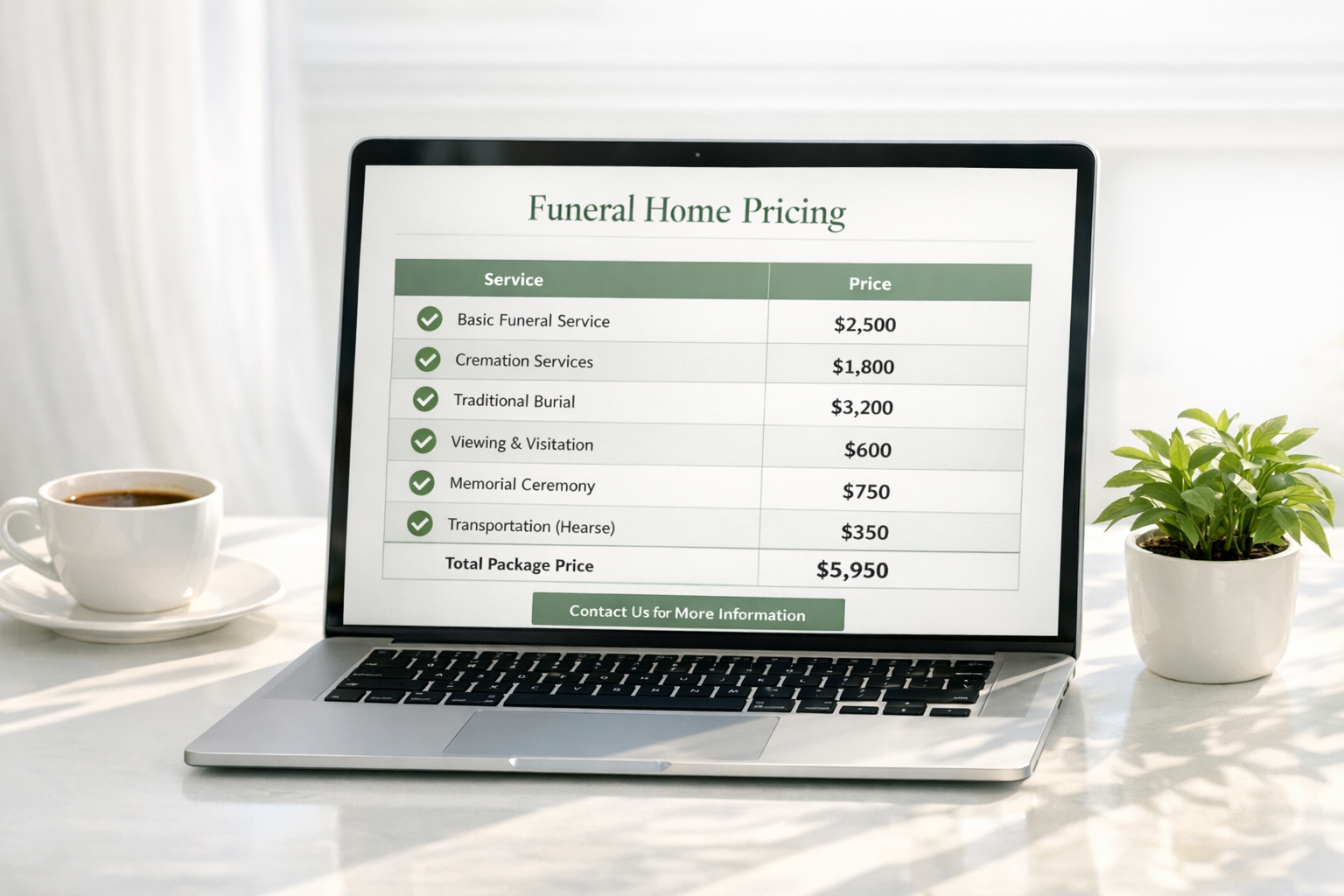
The key is making this option visible. If families have to ask whether you have something cheaper - or worse, if they have to guess - most will assume you don’t and look elsewhere. Affordable options belong on your pricing page, presented without shame or fine print. Direct cremation is the most common entry point, but it’s not the only one.
The honest question to sit with
Can you build a basic package that covers your direct costs, serves the family with dignity, and doesn’t leave you resenting the work?
Option 2: Payment Plans and Staged Billing
Some directors offer instalments informally - a quiet arrangement, a handshake, a note in the file. Others use structured payment plans over three to six months, sometimes longer. Both approaches are increasingly common. Both carry risk.
The trade-off here is cash flow. Funeral homes carry significant upfront costs - crematorium fees, disbursements, third-party charges - that don’t wait for instalments. A family paying £300 a month over six months is real money, but it doesn’t help when the crematorium invoice lands in week two.
Then there’s the collection reality. Chasing bereaved families for unpaid invoices is deeply uncomfortable. It happens. Directors who’ve done it will tell you it’s one of the worst parts of the job. Some families genuinely intend to pay and life gets in the way. Others disappear. You’re not a credit agency, and most funeral homes don’t have the infrastructure or the appetite for debt recovery.
If you offer payment plans, be specific about terms upfront - in writing, before the funeral. How many instalments, over what period, what happens if payments stop. Vagueness at the arrangement stage creates conflict six months later.
The honest question
Are you prepared to absorb the administrative overhead and the occasional default, or would that cash flow pressure put your own business at risk?
Option 3: Guide Families to Available Financial Support
This is where you can be most specifically useful - not as a financial adviser, but as someone who knows what exists and can point families in the right direction. Most families in funeral poverty have no idea what support is available. The information is fragmented, buried in government websites, and written in language designed to discourage applications.
In the UK
The Funeral Expenses Payment (administered by the DWP) covers a basic funeral for families where the applicant or their partner receives a qualifying benefit - Universal Credit, Pension Credit, Income Support, income-based Jobseeker’s Allowance, or income-related Employment and Support Allowance. It can cover cremation or burial fees, travel to arrange or attend the funeral, and up to £1,000 for other costs (coffin, flowers, funeral director fees). The claim must be made within six months of the funeral.
Bereavement Support Payment is separate - a lump sum and monthly payments for the surviving spouse or civil partner of someone who paid National Insurance contributions. It’s not means-tested, but it only applies to spouses and civil partners, not unmarried partners or other family members.
Beyond government support: Turn2Us maintains a grants search tool that identifies charitable funds by circumstance and location. The British Red Cross offers emergency grants in some areas. Local benevolent funds, trade-specific charities, and faith organisations sometimes help. These are smaller amounts, but they can fill the gap between a Funeral Expenses Payment and the total cost.
In Ireland
Ireland does not have a state funeral payment equivalent to the UK’s Funeral Expenses Payment. The closest mechanism is the Exceptional Needs Payment, administered through Community Welfare Officers. It is discretionary and means-tested - there is no guaranteed amount, no fixed eligibility threshold, and approval depends on the individual officer’s assessment.
The Widowed or Surviving Civil Partner Grant provides a one-off payment to qualifying individuals, but again, this applies only to spouses and civil partners, and the amount (currently €8,000, but paid over time through weekly increases) is not specifically designated for funeral costs.
Charitable support in Ireland is more limited than in the UK. The Society of St Vincent de Paul assists in some cases. Some local community organisations help. But the safety net has wider gaps, and directors in Ireland should be honest with families about the limitations.
Your Role - and Its Limits
You are not a benefits adviser, and you should not position yourself as one. Getting eligibility criteria wrong, or giving a family false hope about a payment they won’t receive, creates more harm than saying nothing. But knowing what exists, keeping a printed summary or a simple one-page guide in the arrangement room, and being able to say here’s where to start - that is a core part of the service. It costs nothing and it changes the conversation.
Option 4: Crowdfunding and Community Support
GoFundMe campaigns for funeral costs have become common enough that most directors have encountered them. Some directors help families set these up - suggesting language, sharing the link, occasionally contributing to the fund. Others find the practice uncomfortable and prefer not to be involved.
Both positions are reasonable. Crowdfunding works - campaigns for funeral expenses frequently reach their targets, particularly when the death is sudden, involves a younger person, or affects a well-connected family. The money is real.
The trade-offs are less visible. Not every family wants their financial situation made public. There is a dignity question that deserves honest consideration. Crowdfunding also favours families with large social networks, social media literacy, and stories that generate sympathy. A 90-year-old who died quietly after a long illness raises less money online than a young parent killed in an accident. That asymmetry is worth acknowledging.
If you do support families with crowdfunding, be clear about boundaries: you can suggest it as an option, you can point to examples, but the family drives the campaign. Your name and your business should stay out of it unless the family specifically asks otherwise.
The Complicating Factor: The Family Who Falls Through Every Gap
The hardest conversations aren’t with families who qualify for government support - once you point them to the Funeral Expenses Payment or the Exceptional Needs Payment, there’s a path forward, even if it’s slow. The hardest conversations are with the family earning too much for means-tested benefits but not enough to absorb a £3,828 or €6,000 funeral cost without genuine hardship.
They’re working. They pay taxes. They don’t qualify for the Funeral Expenses Payment because nobody in the household receives a qualifying benefit. The Exceptional Needs Payment in Ireland is discretionary and may be refused. Charitable grants are small and uncertain. Crowdfunding feels wrong to them.
This is the most common funeral poverty scenario, and the existing support systems do not catch it. Pretending otherwise does families a disservice. The rise of direct cremation is driven in part by exactly these families - not people who reject tradition, but people who can’t afford it.
For directors, this is where Option 1 and Option 2 matter most. An affordable basic option and a payment plan, offered without judgement, may be the only practical help available.
Drawing Your Own Line
Every funeral home operates in a different community, with different overheads, different demographics, and different competition. A rural independent serving a tight-knit community will answer these questions differently from an urban multi-branch firm. A home with one full-time director and no spare capacity will draw the line in a different place from a larger operation that can absorb a few low-margin cases per month without strain.
There is no universal policy that works for everyone. What matters is having a policy - something considered, written down, discussed with your team - rather than making individual decisions under emotional pressure in the arrangement room at half past nine on a Tuesday morning.
The families who can’t afford a funeral aren’t going away. The gap between funeral costs and household incomes has widened every year for a decade. The directors who think clearly about this now will serve their communities better and protect their businesses at the same time.
That’s not a contradiction. It’s the job.
Your next step
Review your current approach to affordability. Do you have a clearly defined basic option? Do you know the financial support routes in your area? Can your team answer the question we can’t afford this without hesitation? If not, start there.
Sources
- SunLife Cost of Dying Report (2024)
- GOV.UK - Funeral Expenses Payment
- Citizens Information Ireland - Exceptional Needs Payment
- Turn2Us - Grants Search Tool