Monday, 6:40am
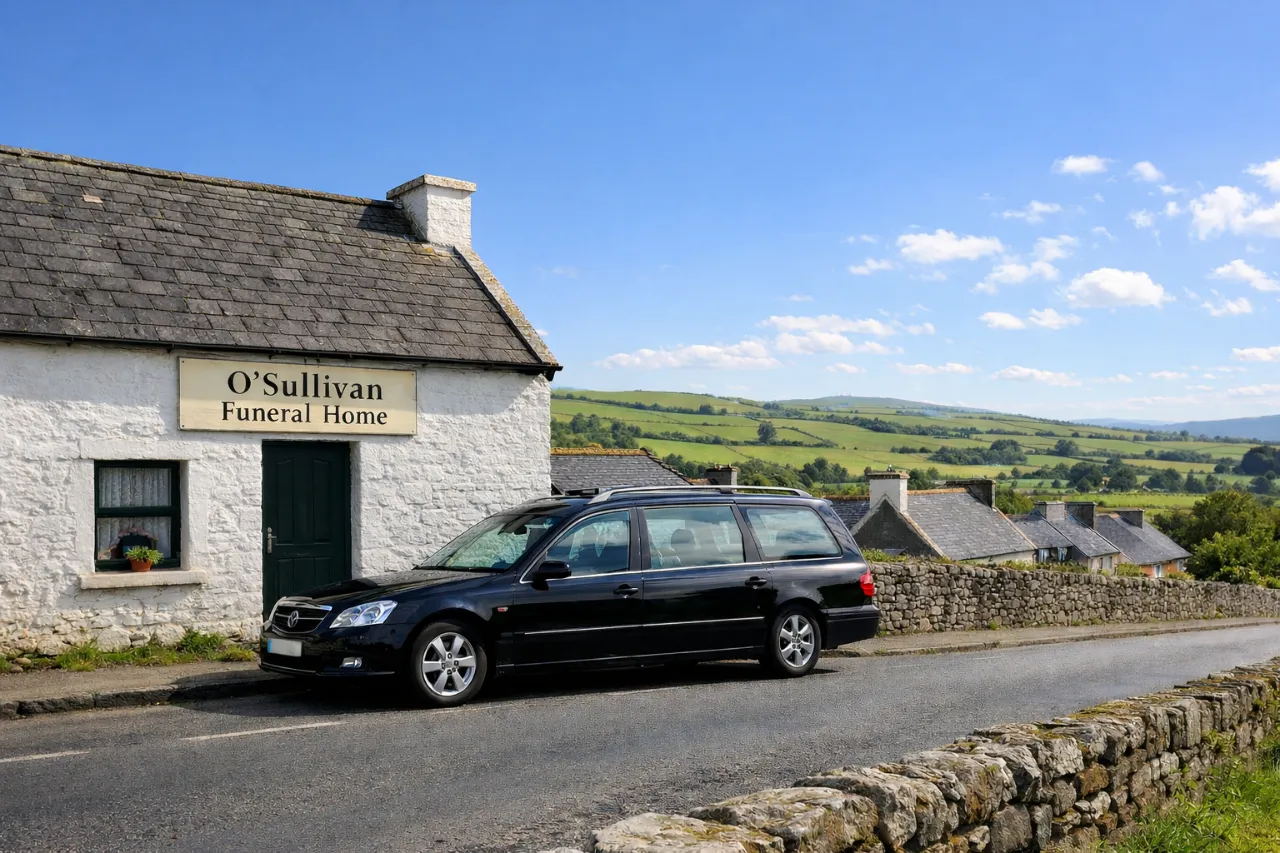
Seán's phone hasn't rung overnight, which counts as a good start. He's a funeral director in a town of just under two thousand people in the west of Ireland. He is also the embalmer, the driver, the office manager, and the 24-hour on-call service. His wife, Marie, answers the phone when he's out on a transfer. His son helps carry coffins when he's home from college in Galway. There is no other staff.
The nearest crematorium is nearly two hours away. The nearest colleague who could cover for him - another independent, a good man - is forty-five minutes in the opposite direction. Seán hasn't taken a proper holiday in three years. Last month, four funerals fell in a single week - the most he's ever handled - and he ate a sandwich in the hearse between the cemetery and the church because there was no other time.
Nobody here is doing anything wrong. This is the structural reality of running a rural funeral home, and the profession needs to start talking about it honestly.
The Rural Reality
Rural funeral directing is a fundamentally different job from its urban equivalent, yet the industry rarely acknowledges the distinction. Conference programmes, trade publications, supplier catalogues, training schedules - almost everything is designed around a model of a firm with multiple staff, regular case volume, and services within a thirty-minute radius. Rural practice is structurally different from that model, not simply a scaled-down version of it.
One person fills every role. Community expectations are more personal and more visible - in a town of two thousand, everyone knows whether you did a good job or a poor one, and they'll discuss it at Mass on Sunday. Distance transforms every transfer, every service, every family meeting into a logistical exercise. A removal from a hospital fifty minutes away means two hours of driving before you've done any of the actual work.
Seasonal pressures compound everything. Winter brings more deaths, worse roads, isolated farmhouses accessible only by a single-track lane. Flooding in parts of the west of Ireland and rural Wales can make a twenty-minute journey an hour-long detour. And the community relationship that makes rural practice meaningful is also its heaviest burden - because the person in the coffin is never a stranger. You coached their grandson. You bought cattle from their brother. You sat beside them at a match three months ago.
Tuesday Morning
The call comes at 7:15am. A death at a farm about thirty minutes outside town. Elderly man, expected - the family had been caring for him at home for weeks. They want a traditional wake at the house. Seán knows the family well; he went to school with one of the sons.
He drives out, meets the family, discusses arrangements in the kitchen while the kettle boils. They want the wake to begin that evening. He'll need to prepare the deceased at the family home - embalming, dressing, placing in the coffin - and return the following evening for the removal to the church. A full day's work before accounting for anything else.
On the drive back, Marie rings. Another family has been in touch. Pre-planned funeral, death happened overnight in a nursing home in the next county. Chapel is available Thursday - but Seán is already committed to the removal on Wednesday evening and the funeral Mass and burial on Thursday morning for the farm family. There is no one to delegate to. Every scheduling conflict in a one-person operation is personal, because there's only one of him.
He rings the second family. Explains, carefully, that he wants to give them his full attention and asks whether Friday would work. They understand - they know him, they know how it is. In a city, this conversation might feel like a service failure. Here, it's an honest exchange between neighbours. But it weighs on him all the same.
What Rural Directors Need - and What the Industry Doesn't Provide
Step back from Seán's week and patterns emerge that apply to rural funeral directors across Ireland, the UK, and beyond. The NAFD and SAIF offer guidance for small firms, but the particular pressures of genuine rural practice - single-operator, geographically isolated, community-embedded - deserve more focused attention.
Formalised peer support and mutual cover. Most rural directors have an informal understanding with a nearby independent: “I'll call Paddy if I'm stuck.” That's not a system. Directors need structured cover arrangements - written, reciprocal, regularly reviewed - so that illness, a family emergency, or simply four funerals in one week doesn't become a crisis. IAFD membership data shows how many Irish funeral homes are single-operator businesses, yet formalised mutual-aid networks remain rare.
Technology that reduces admin burden for a one-person operation. When you are the embalmer, the driver, the arranger, and the bookkeeper, every hour spent on paperwork is an hour taken from rest or family. For a sole practitioner, going digital with case management, documentation, and family communications is the difference between finishing at eight in the evening and finishing at eleven. For a sole practitioner, time saved is a basic necessity for sustainability.
Honest recognition that the business model is different. Rural firms typically see lower revenue per case, unpredictable volume month to month, and proportionally higher overhead - fuel costs alone can be staggering when every transfer involves an hour's round trip. Industry benchmarks built on urban averages don't apply. Rural directors need financial guidance and business support that accounts for their actual operating conditions, not a metropolitan ideal.
Mental health support that accounts for isolation. Urban directors have colleagues in the prep room, staff to debrief with after a hard case, peers they see at local association meetings. Rural directors often have none of that. The emotional weight of the profession falls on one set of shoulders, with no natural peer network to share it. Targeted support - whether through association-facilitated peer groups, regional meetups, or confidential phone lines staffed by people who understand the work - is overdue.
Wednesday Evening - The Wake
Seán arrives at the farmhouse at half six. The kitchen is already full. Neighbours have brought sandwiches, cake, enough tea to float the house. A fire is lit in the parlour where the deceased rests. The room smells of turf smoke and furniture polish.
Over the next three hours, half the town passes through. Seán knows most of them by name. He moves between rooms - adjusting the coffin position, accepting a cup of tea he didn't ask for, shaking hands with people he'll see again on Sunday. The eldest daughter finds him by the back door and tells a story about her father that Seán already half-knew - something about a donkey and a hay bale and a county final in 1987. He laughs, properly, for the first time in days.
This is why he does it. In a community this size, the funeral director is a neighbour who happens to possess a particular set of skills that the community needs at its worst moments. The funeral is a communal act - the town gathering around one of its own, and the director holding the shape of it so the family doesn't have to.
You did well by him, Seán. Four words. Enough to carry him through Thursday.
The Conversation the Industry Owes
Most industry conversations about technology, growth, marketing, and best practice are shaped by urban experience. Conference panels discuss multi-location firms, digital marketing funnels, and staff retention strategies that assume you have staff to retain. Trade publications profile businesses with ten employees and three hundred cases a year. CPD events cluster in Dublin, London, Birmingham - places that require a rural director to close their business for a full day just to attend.
Rural directors are not a footnote to the profession. They serve communities that depend on them absolutely - communities where there is no alternative, no second option, no competitor down the road to pick up the slack. When Seán is unavailable, there is no funeral director in that town. Full stop.
The profession owes these directors more than it currently gives. More attention to their structural challenges. More support designed for single-operator realities. More honesty about the fact that the succession question hits hardest in places where there's nobody coming up behind, and where consolidation often means a community losing something that can never be rebuilt once gone.
Seán will keep going. He'll manage the Thursday funeral and the Friday funeral. He'll answer the phone on Saturday night if it rings. Marie will make him a dinner he'll eat standing up, and his son will carry a coffin at Christmas. He is, in many ways, the most complete expression of what the funeral profession is supposed to be - one person, fully present, serving a community that knows his name and trusts him with its dead.
He is also the most under-supported person in the industry. And until that changes, every conference speech about “the future of funeral service” is only telling half the story.
Sources
- IAFD membership data
- NAFD and SAIF guidance for small firms