
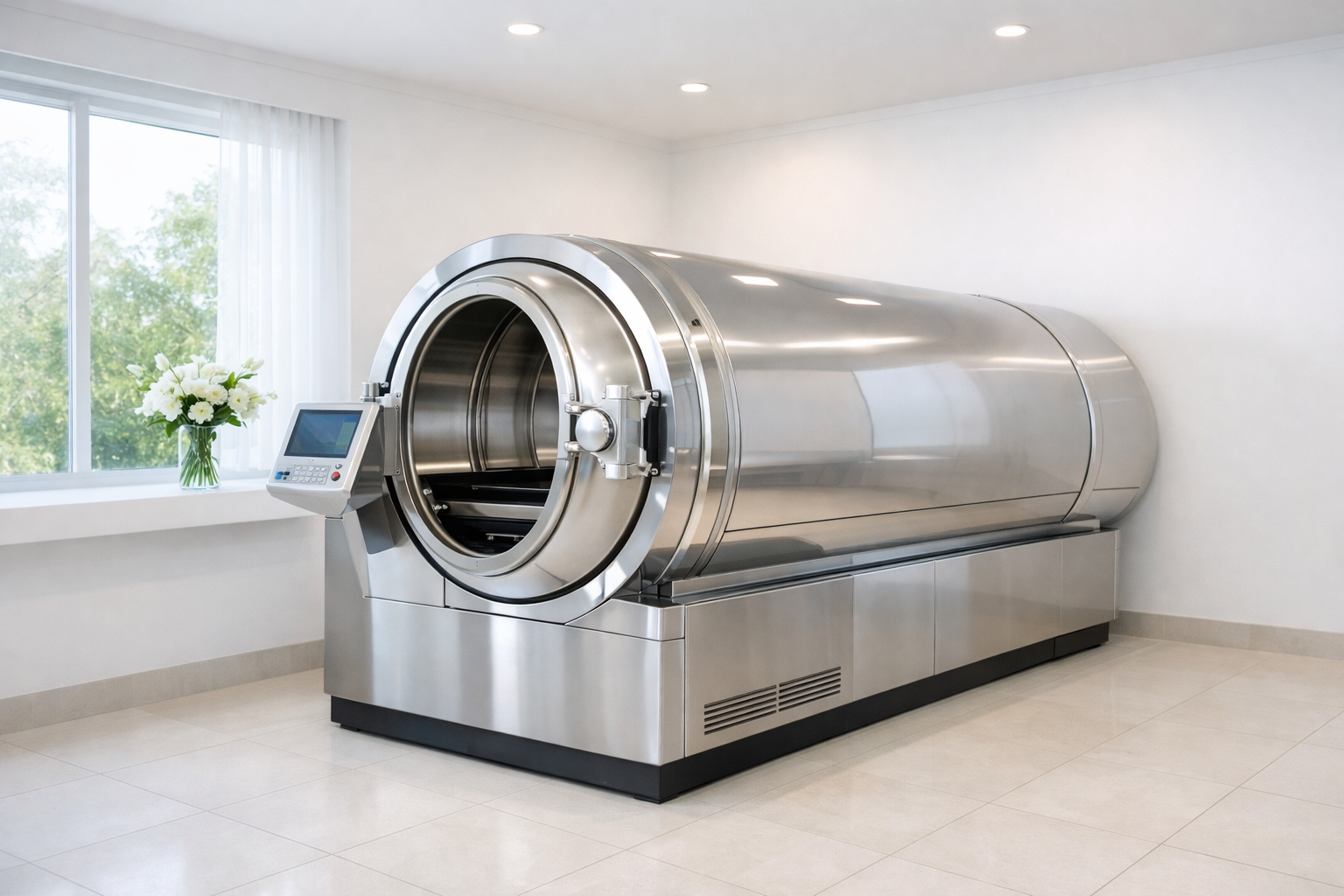
Most funeral directors have heard of water cremation by now. Fewer can explain the process clearly to a family sitting across the arrangement table. And fewer still know the current legal position in their own jurisdiction - which has shifted significantly in the past twelve months. This is the reference guide that gets you current.
How Water Cremation Works
Water cremation - also called resomation, alkaline hydrolysis, or aquamation - uses water, heat, and an alkali solution to do what soil bacteria do naturally after burial, but in a controlled environment over hours rather than decades.
The body is wrapped in a biodegradable shroud (typically silk or wool) and placed in a pressurised steel chamber. The chamber fills with a solution of 95% water and 5% potassium hydroxide, then heats to approximately 150°C under pressure. Over three to four hours, the solution breaks down soft tissue into its chemical components - amino acids, peptides, sugars, and salts - leaving behind bone fragments.
Those bone fragments are dried and processed in a cremulator, exactly as they would be after flame cremation, producing a fine white powder returned to the family in an urn. One difference: families typically receive around 30% more remains than from flame cremation, because the gentler process preserves smaller bones that would disintegrate in a furnace.
The Liquid Byproduct - What Families Will Ask About
This is the part directors need to be prepared to discuss without flinching. The liquid output is a sterile solution of amino acids, peptides, sugars, and mineral salts. It contains no DNA. After the resomation process, it undergoes further treatment and testing to confirm it meets water authority standards before being discharged to the local wastewater treatment system.
That discharge route is the same one used by hospitals, mortuaries, and embalming facilities for clinical waste fluids. It is not untreated, and it is not unregulated. If a family asks - and they will - the honest answer is straightforward: the liquid is a sterile, organic solution that is safely processed through standard wastewater infrastructure. No different in principle to what already enters the system from healthcare settings daily.
Director tip
Don't wait for the family to raise the liquid byproduct question - bring it up yourself. Hesitation on this point will undermine confidence in everything else you've said.
Ireland: Operational Since 2023 and Leading Europe
Water cremation arrived in Ireland over two years ago, and the country is already well ahead of the rest of Europe.
Ireland's first water cremation facility opened in Co. Meath in late 2023, becoming Europe's first operational site. The facility had handled over 40 ceremonies by April 2024.
The facility operates a chapel on site for committal services. Families can arrange directly or through their funeral director. Several established Irish funeral homes already list water cremation as a service option.
How the Referral Process Works in Practice
For directors who want to offer water cremation without operating their own facility, the model is straightforward:
- The family's funeral director manages the arrangement as normal
- The facility handles collection, resomation, and return of ashes
- The funeral director maintains the family relationship throughout
- Ashes are typically returned within four days, giving the family time to arrange a funeral Mass, celebration of life, or memorial on their own terms
The national association of funeral directors in Ireland has confirmed that its members support families exploring environmentally conscious options, including resomation, as part of a broader commitment to reflecting each family's wishes.
Pricing and Positioning
A full water cremation service ranges from approximately €3,700 to €4,300, depending on the services selected. For context, the CSO figures put average Irish funeral costs at approximately €6,000 and upward for a traditional burial. A direct resomation - without a chapel service - comes in at a lower price point, closer to direct flame cremation pricing.
Positioning note
Water cremation sits naturally alongside direct flame cremation and attended funeral options on your price list. It is a third disposition option and should be listed as one, not presented as a luxury upsell. For more on how these options compare environmentally, see green burial vs. cremation.
Ireland has approximately 36,000 deaths annually (CSO data). Flame cremation rates remain relatively low at around 28%, though the proportion of people who say they want to be cremated is significantly higher - around 47%. Water cremation may appeal to families who are drawn to cremation but uncomfortable with the flame process, or to those specifically seeking a lower environmental footprint. For more on the cremation landscape, see Direct Cremation Explained Without the Jargon.
Scotland: Legal Since March 2026, Facilities Pending
Scotland became the first part of the UK to legalise water cremation when the Hydrolysis (Scotland) (No. 1) Regulations 2026 came into force on 2 March 2026, made under the Burial and Cremation (Scotland) Act 2016.
The regulations treat hydrolysis as a third legal method of disposition alongside burial and cremation. Providers must meet the same regulatory standards as crematoria - including safeguards around documentation, medical certification, and the dignified treatment of remains.
The Scottish Government's 2023 public consultation found 84% support for the introduction of alkaline hydrolysis. Public Health Minister Jenni Minto called it the most significant change to funeral options in Scotland in over 120 years.
What's Operational and What Isn't
Here is the critical distinction for directors: Scotland has the legal framework, but no operational facilities yet.
The UK equipment manufacturer has indicated it could take up to nine months from the date of legalisation before the first facility is running. Providers still need to secure local planning permission and approval from Scottish Water for discharge permits.
The Scottish Government expects the first procedures to take place in summer 2026. Several of Scotland's largest independent funeral directors have been part of the working group advising the Scottish Government and have publicly welcomed the change.
Action for Scottish directors
Directors in Scotland should begin preparing now: updating service literature, briefing staff, and considering how to present the option alongside burial and cremation when families ask - because families are already asking.
England and Wales: Not Yet Legal
Water cremation cannot currently be offered in England and Wales. There is no legal framework permitting it.
A council in the West Midlands received planning permission for a water cremation facility years ago but was blocked when the local water authority refused to grant a trade effluent discharge permit, citing the absence of a water industry standard.
That water authority refusal - not a lack of planning permission - has been the primary obstacle. Without water industry guidance and an explicit legal framework, no provider in England or Wales can operate.
The Law Commission Review
The Law Commission published its final report on burial and cremation reform on 18 March 2026. A separate report specifically addressing the regulation of new funerary methods - including alkaline hydrolysis and human composting - is expected shortly, along with a draft Bill.
What this means practically: even once the report is published, the government must then decide to act on it, parliament must pass legislation, and providers must obtain planning and water authority approvals. Directors in England and Wales should be realistic about the timeline. Water cremation is coming - but not this year, and quite possibly not next year either.
The question is when, not if.
Northern Ireland: No Current Legislation
Northern Ireland has not legalised water cremation. Cremation in Northern Ireland is still governed by the Cremation (Belfast) Regulations 1961, and there is no equivalent of Scotland's 2016 Act or the Law Commission's review process underway.
Families in Northern Ireland who specifically request water cremation would need to explore cross-border arrangements - the Republic of Ireland's operational facility in Co. Meath is accessible from Northern Ireland. Any such arrangement would require attention to cross-jurisdictional death registration and transfer protocols.
The Environmental Case - Stated, Not Sold
Directors should be equipped with the data without becoming advocates for any particular method. Here are the figures, sourced from industry data:
- CO² emissions: Approximately 28kg per water cremation versus approximately 320kg per flame cremation
- Mercury release: None from water cremation; flame cremation releases mercury from dental amalgam fillings
- Energy consumption: Water cremation uses approximately one-tenth the energy of flame cremation
- Combustion byproducts: No direct emissions to air - no particulates, no dioxins, no nitrogen oxides
These are meaningful differences, and they matter to a growing number of families. But directors should present them as data points, not sales arguments. Some families will weigh environmental impact heavily. Others won't consider it at all. Your job is to inform, not to steer.
Several high-profile water cremation choices have brought public attention to the process internationally. In Ireland, personal stories of families choosing resomation for deeply meaningful reasons have resonated with others considering the option.
Talking to Families About Water Cremation
When a family asks about water cremation, the conversation should follow the same principles as any arrangement discussion: clear language, honest answers, no overselling.
Start with what it is. Use the phrase "water cremation" rather than the technical term "alkaline hydrolysis" - most families find it immediately understandable. Explain that the body is placed in a chamber with warm water and an alkali solution, the process takes three to four hours, and the result is ashes returned in an urn, just as with flame cremation.
Acknowledge that it's newer. Families appreciate honesty. You might say: "This is a process that's been used in parts of the US, Canada, and Australia for some years. Ireland has had an operational facility since 2023. It's newer than flame cremation, but it's well-established where it's available."
Address the liquid byproduct directly. Don't wait for the family to raise it - bring it up yourself. Hesitation on this point will undermine confidence in everything else you've said. A simple, factual explanation is all that's needed.
Don't lead with the environmental angle. Let families discover that for themselves. If they ask about it, share the data. If they don't, respect that it may not be a priority for them.
Be clear about what you can and can't offer. If you're an Irish director, you can offer this now through the operational facility in Co. Meath. If you're in Scotland, you can explain that facilities are expected in summer 2026. If you're in England, Wales, or Northern Ireland, be straightforward: it's not currently available in your jurisdiction.
Religious and Cultural Considerations
Acceptance of water cremation varies across faiths and cultural traditions, and directors should be prepared for this:
- Catholic Church: Has not issued a formal position on water cremation specifically, though it permits flame cremation. Individual clergy may hold varying views
- Church of Ireland / Anglican: No formal prohibition; likely to follow a similar trajectory to the acceptance of flame cremation
- Islam and Judaism: Generally require burial; water cremation, like flame cremation, is unlikely to be acceptable
- Hinduism and Sikhism: Traditionally emphasise flame cremation; water cremation may not be viewed as equivalent
- Secular and non-religious families: Often the most receptive, particularly where environmental or personal values drive the choice
The most prudent approach is to present water cremation as an available option and let the family determine whether it aligns with their beliefs. If a family has questions about their faith's position, suggest they speak with their religious leader before making a decision.
Quick Reference: Legal Status by Jurisdiction
| Jurisdiction | Legal Status | Operational? | Key Detail |
|---|---|---|---|
| Ireland | Legal and operational | Yes - since late 2023 | Europe's first facility, operational in Co. Meath. Multiple funeral directors offer it as standard. |
| Scotland | Legal since 2 March 2026 | Not yet - facilities expected summer 2026 | Hydrolysis (Scotland) (No. 1) Regulations 2026. Equipment manufacturing underway. Planning and water authority approvals pending. |
| England & Wales | Not yet legal | No | Law Commission New Funerary Methods report and draft Bill expected 2026. Government action and parliamentary approval still required. |
| Northern Ireland | Not yet legal | No | No active review process. Cross-border arrangements with Ireland's facility may be possible. |
Key Contacts and Resources
- Burial and Cremation (Scotland) Act 2016: legislation.gov.uk
- Law Commission - New Funerary Methods project: lawcom.gov.uk/project/new-funerary-methods
Water cremation is a third option that is here to stay - operational in Ireland, newly legal in Scotland, and on its way to the rest of the UK. The directors who take the time to understand it now will be the ones families trust when they ask about it later.
Water cremation is a third option. The directors who understand it now will be the ones families trust when they ask about it later.
Sources
- Industry technical data
- Ireland's operational water cremation facility
- Scottish Government - Hydrolysis Regulations 2026
- Law Commission - New Funerary Methods
- CSO Ireland - Vital Statistics
- Burial and Cremation (Scotland) Act 2016