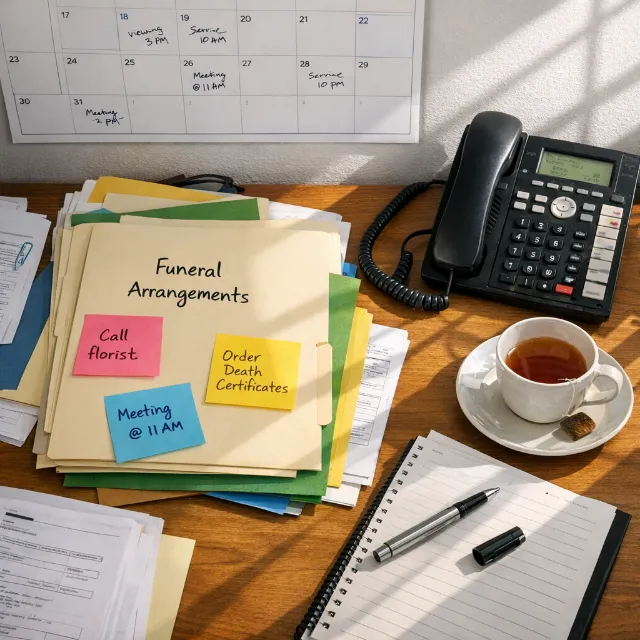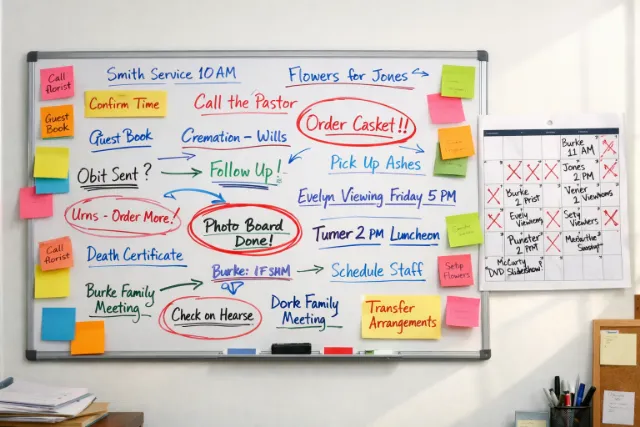
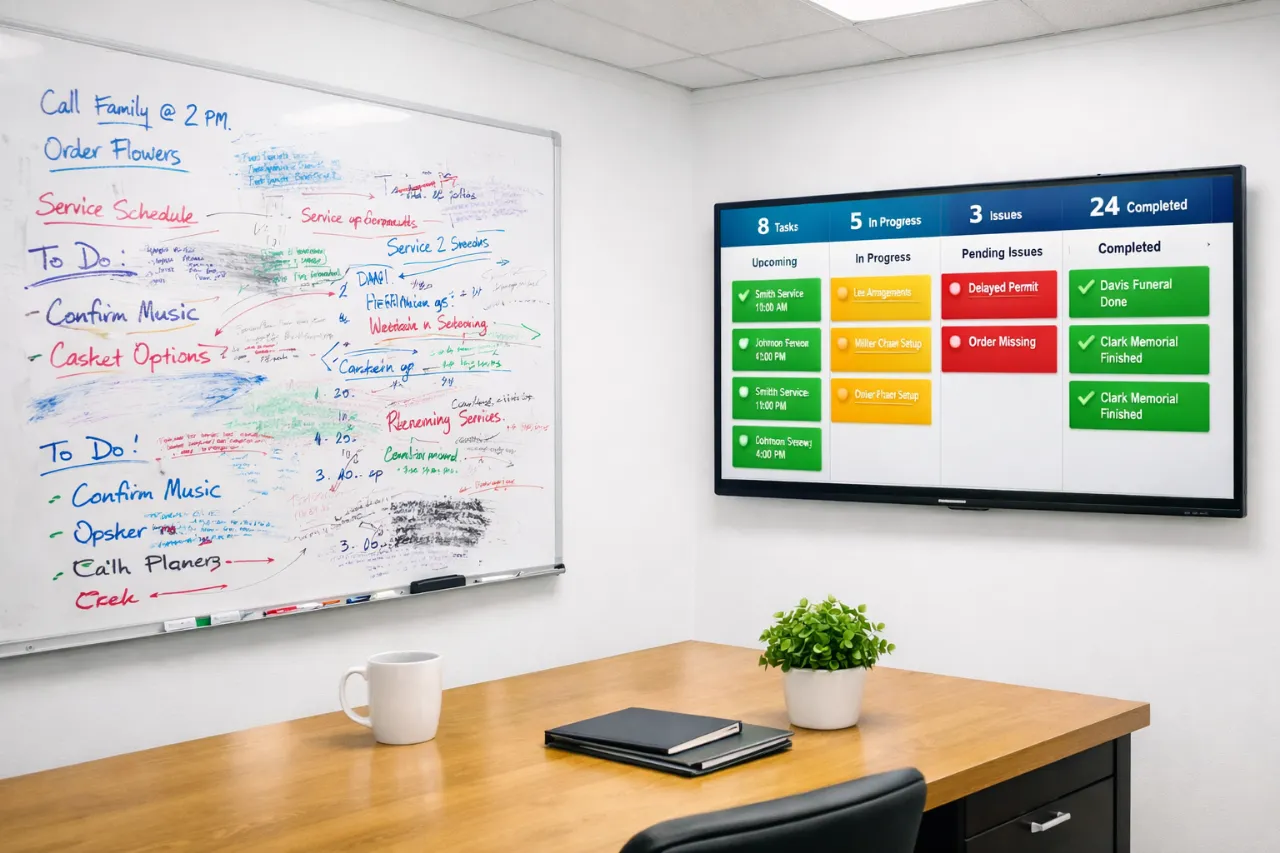
The whiteboard has been a fixture in funeral homes for as long as most of us can remember. Case names in marker pen, service dates, task assignments, maybe a colour-coded system someone devised years ago. It works. Everyone walks past it. Everyone glances up. Everyone knows roughly where things stand.
Except they don’t. Not really. Not anymore.
The whiteboard served the profession well when a single premises handled a manageable caseload with a stable team who were almost always on site. Those conditions have changed. Multi-site operations, remote on-call, part-time staff, regulatory demands, family expectations - the information load has outgrown what a static board on a wall can carry. A funeral home dashboard has become the minimum viable tool for case visibility in a modern practice, well past the point of being a luxury.
Here’s why. And here’s why the group WhatsApp is even worse.
Single Location, Single Point of Failure
A whiteboard exists in one place. If you’re standing in front of it, it’s brilliant. If you’re anywhere else, it’s useless.
Your on-call director gets a 3am transfer call and needs to check whether the deceased’s family has already been in contact. Can’t see the board. Your arranger is sitting with a family at their kitchen table and needs to confirm service availability. Can’t see the board. Your manager is at a second branch and wants to know which cases need attention before tomorrow. Can’t see the board.
A funeral home dashboard lives on any device with a browser. Phone, tablet, laptop - at the premises, at home, on the road. Every director sees the same information, updated in real time. No phone calls to ask “what’s on the board for Thursday?” No relying on someone to text a photo of it (which, remarkably, happens more often than anyone admits).
No Memory, No Trail
When you update a whiteboard, the previous state disappears. Wipe a name, write a new one. Move a task from one column to another. There’s no record of what changed, when, or by whom.
For day-to-day operations, that feels fine - until it isn’t. A family queries why their paperwork wasn’t filed on time. A staff member disputes what they were assigned. A coroner’s office asks when you received authorisation. You’re working from memory, or from whatever scribbled notes someone kept in a desk drawer.
Digital systems log every update with a timestamp and a user. Audit trails protect everyone - the business, the staff, and the families - and that holds true however much you trust your directors. With regulatory requirements tightening across both the UK and Ireland, having a clear record of who did what and when is increasingly not optional. It’s expected.
Everything Looks the Same on a Whiteboard
Here’s the problem that catches homes out most often: a whiteboard treats every case identically. A case running smoothly towards Friday’s service looks exactly the same as one where the cremation paperwork is three days overdue and nobody’s noticed.
Nothing flags. Nothing turns red. Nothing sends a nudge. The board just sits there, passively displaying whatever someone last wrote on it. Overdue tasks, missing signatures, approaching deadlines - all invisible unless someone is actively tracking every detail in their head.
A well-designed dashboard surfaces what needs attention. Overdue items stand out visually. Approaching deadlines appear before they pass. Outstanding tasks filter by urgency, not just by date. Instead of relying on a director’s memory to catch what’s slipping, the system does the watching. The director does the deciding.
The Group Text Is Worse
Some homes moved away from the whiteboard - straight into a WhatsApp group. That swap is arguably a step backwards rather than any kind of improvement.
Critical case information gets buried in scroll. Last Tuesday’s update about the Henderson family is somewhere between a message about the boiler repair and someone’s holiday photos. Finding it means scrolling through dozens of messages, hoping you recognise it when you see it. New staff joining the group have no way to catch up on active cases - they’re dropped into a stream with no structure and no context.
WhatsApp and similar consumer messaging apps are unsearchable in any meaningful way for case management. They have no structure, no assignment, no status tracking. A message saying “can someone chase the doctor’s cert for Murphy” sits in the feed with no way to confirm whether it was done, by whom, or when.
Then there’s the data protection issue that too few homes take seriously. Sharing deceased persons’ details, family contact information, medical references, and financial data through an unencrypted consumer messaging app raises genuine GDPR and UK Data Protection Act concerns. The ICO has been increasingly clear that using consumer platforms for business communications involving personal data carries risk. A family’s details shouldn’t live in the same app as your group chat about Friday’s lunch order.
“But It Works for Us”
This is the most common response, and it deserves an honest hearing. For many homes, the whiteboard does appear to work. Cases get managed. Services happen. Families are served.
But the whiteboard’s failure mode is invisible. It works until the moment it doesn’t - and by then the damage is done. A task falls through because the person responsible was off-site and couldn’t see the board. A document goes missing because nobody logged when it was received. A family is let down because an overdue step wasn’t caught in time.
These are quiet failures rather than dramatic ones. Small lapses that erode trust, create stress, and occasionally cause real harm. The problem with a system that has no alerts, no history, and no remote access is that you only discover its limits when something goes wrong. By then, you’re managing the consequences rather than preventing them.
What replaces the board?
Every system on the market stores a case. Far fewer let you run the day from a phone. Our UK & Ireland funeral software comparison scores five systems on ten capabilities, including a workflow designed for mobile rather than merely accessible on it.
The Honest Counterargument
Whiteboards have genuine cognitive benefits. There’s real value in a large, physical, always-visible display that shows all active cases at a glance without requiring a login or a click. Research on spatial cognition supports this - physical boards offer tangible, ambient awareness that screens don’t automatically replicate. No training required. No password to forget. No system to go down.
Directors who’ve used a whiteboard for twenty years are relying on a tool that offers something real: immediacy and simplicity. The habit is practical, not stubborn.
But here’s the counter to the counter: a well-designed funeral home dashboard provides the same at-a-glance visibility - and then extends it. The glanceability carries over and is enhanced. A dashboard on a wall-mounted screen in the office gives you the same ambient awareness as a whiteboard, with the addition of colour-coded status, overdue alerts, and live updates. And when you leave the office, it follows you.
How EverlyPro approaches this
The EverlyPro dashboard shows every active case in a pipeline view - Intake, Arrangement, Service Scheduled, Closing - with staff workload, overdue tasks, and outstanding balances visible at a glance. The personal My Work view gives each director their own cases, tasks, and schedule. It’s the whiteboard, but it follows you home, it doesn’t get erased, and it tells you when something’s slipping.
The Board Served Well. Let It Retire.
The funeral profession’s information needs have outgrown the whiteboard. Caseloads are more complex. Teams are more distributed. Regulatory expectations around documentation, data protection, and accountability are higher than they were a decade ago. Families expect a level of organisation and responsiveness that single-location, single-version, no-alert tools simply can’t support consistently.
Acknowledging that takes nothing away from directors who’ve relied on marker pen and melamine for years. It simply recognises that the demands placed on funeral homes have changed - in volume, complexity, and accountability - and the tools need to change with them.
Every funeral home has workflows built around a physical board or a group chat (building efficient workflows, moving from paper to digital systems, managing scheduling complexity). Many of those workflows are sound. The question is whether the tool underneath them can still carry the weight.
The whiteboard had a long, honourable career. It’s time to let it retire gracefully - and replace it with something that actually keeps up.