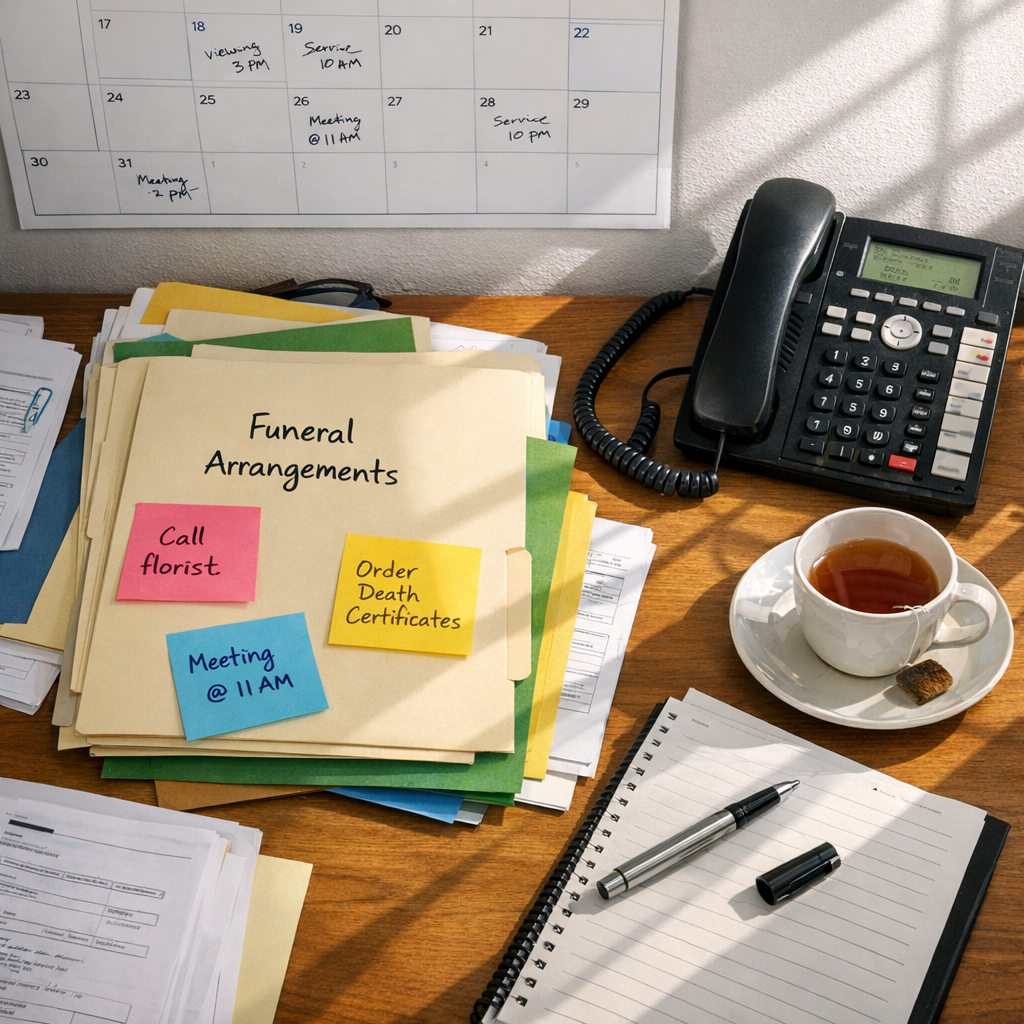

AI is already working inside funeral homes. Not the dramatic, headline-grabbing version - no hologram eulogies, no robot celebrants. The quiet version. The version that auto-fills a form, drafts a first pass at an obituary, or turns a phone call into a case file without anyone transcribing the same details three times. Whether you’ve consciously adopted it or not, AI has arrived in funeral service.
The debate about whether directors should engage with AI is already behind us. The real question - the one worth your time - is more specific: where does AI add genuine value, where does it create risk, and where is the industry being sold a future that doesn’t exist yet? The answer, it turns out, is clearer than the noise suggests. AI is most useful for the administrative work that drains your day. It is least useful for the human work that defines your profession. And the line between the two isn’t as blurry as the tech evangelists would have you believe.
That’s the argument this post makes. AI in funeral service is a tool, not a transformation - and directors who understand the distinction will use it better than those who either reject it outright or swallow the hype whole.
Where AI Works Right Now: The Admin You Shouldn’t Be Doing Manually
Let’s start with what’s real and practical - not theoretical, not “coming soon,” but working in funeral homes today.
Obituary Drafting
This is the most immediate, most defensible application of AI in funeral service. Here’s the problem it solves: a family sitting across from you, emotionally exhausted, handed a blank page (or a blank screen) and asked to summarise a life in 300 words before the newspaper deadline.
Some families write beautifully. Most struggle. The pressure of the moment, the fear of leaving something important out, the paralysis of trying to capture a whole person in a few paragraphs - it’s a task that causes genuine distress at precisely the wrong time.
AI obituary tools take a different approach. For more on what families and directors value in these pages, see our post on obituary and tribute pages. The director or family inputs the basics - name, age, family members, career, personality traits, hobbies, a few anecdotes - and the tool generates a structured first draft. Not the final version. A starting point. The family reads it, edits it, adds the details only they would know, removes what doesn’t feel right, and ends up with something that sounds like them, not like a template.
The value lies in sparing a grieving daughter from starting at a blank page, not in AI writing a better obituary than she could.
Case Intake and Data Entry
A first call comes in at 2am. You take down the details - name of the deceased, next of kin, location, doctor, circumstances. Then you enter those same details into your case management system. Then again into the crematorium paperwork. Then again into the death registration forms. The same information, transcribed multiple times, with each transcription introducing the possibility of error.
Voice-to-text case creation changes that workflow. This is one of the key advantages of going paperless in a funeral home. A director dictates the first-call details and the system populates the case file - once. The data flows through to every document and form that needs it. According to the NFDA’s 2025 technology survey, adoption of digital case management tools has grown steadily, but most firms are still re-entering data across disconnected systems. AI-assisted intake eliminates that redundancy.
Administrative Automation
Email templates that populate with case-specific details. Task reminders that trigger at the right stage of a case. E-signatures that eliminate the need for families to return to the office. Scheduling suggestions based on resource availability. Document generation that pulls from existing case data rather than requiring manual entry.
None of this is glamorous. None of it will feature in a conference keynote. But collectively, it represents hours of a director’s week - hours currently spent on repetitive work that demands attention but not judgment. That’s the distinction that matters: AI handles the tasks that require accuracy and speed. Directors handle the tasks that require wisdom and presence.
Where AI Has No Business Being
The useful applications above share a characteristic: they involve structured, repeatable tasks where the inputs are predictable and the margin for nuance is low. The moment you move into territory that requires human judgment, emotional intelligence, or professional expertise, AI stops being helpful and starts being dangerous.
The Arrangement Conversation
A family arrives for the arrangement meeting. The widow is composed but fragile. The adult children disagree about burial versus cremation. The deceased’s brother, estranged for a decade, has turned up and is quietly hostile. The family’s budget is tighter than anyone wants to admit.
No AI system can read that room. The micro-expressions, the body language, the moment when you need to pause and let silence do the work - these are irreducibly human skills. The arrangement conversation is where a funeral director’s training, experience, and emotional intelligence matter most. AI cannot replicate the judgment required to navigate family conflict, to know when to offer options and when to gently steer, to hold space for grief while still moving a conversation toward the practical decisions that need making.
Grief Support and Bereavement Communication
AI-generated condolence messages or aftercare emails that sound personal but aren’t represent a trust risk that outweighs any efficiency gain. If a family discovers that the thoughtful follow-up email they received three weeks after the funeral was written by a chatbot, you haven’t saved time - you’ve destroyed credibility. Bereavement communication works because it’s personal. Automate the timing if you like. Never automate the words.
Professional Judgment About Care of the Deceased
Embalming decisions. Presentation choices. Reconstruction work. Anything involving the physical care and preparation of someone’s loved one requires professional judgment that cannot and should not be delegated to an algorithm. A director’s assessment of what a family needs to see - and what they don’t - is built on years of training and case experience. There is no dataset for that.
This Is the Approach We’ve Taken With Everly Pro
Everly Pro’s AI obituary generator creates a structured first draft based on tone, length, and personal details the director inputs - a starting point the family refines, not a replacement for their words. AI-assisted case creation lets directors dictate first-call details by voice and have the case populated in under a minute. The AI handles the admin. The director handles the family. That’s the line, and it’s deliberate.
The EverlyPro approach
AI for the admin. Humans for the families. We built our tools around that line - obituary drafting and voice-to-case creation that save time without replacing the human judgment that defines the profession.
The Counterargument Worth Taking Seriously
Some directors argue that any AI involvement in funeral service is inappropriate - that the entire profession is built on personal, human care, and that introducing AI anywhere, even in administration, diminishes that foundation. This isn’t a frivolous objection. It comes from a genuine commitment to the craft.
But consider what “technology in funeral service” already looks like in practice. You email families. You use digital calendars. You run accounting software. You publish obituaries on websites. You accept online payments. Every one of those tools was, at some point, a departure from the purely personal, purely analogue way things were done before.
AI is an extension of the same principle, not a break from it. The question was never human versus machine. It was always: which tasks benefit from human judgment, and which ones simply need to get done accurately and quickly? Directors who embalm with care and skill aren’t diminished because their invoicing is automated. Directors who sit with families through the hardest conversation of their lives aren’t diminished because a first draft of the obituary was generated by software the family then made their own.
The line between human work and machine work in funeral service isn’t new. AI just makes it more visible.
The Hype You Can Safely Ignore
Not everything labelled “AI in funeral service” deserves your attention. Some of it is speculative. Some of it is a gimmick. Here’s a quick filter.
“AI will replace funeral directors.” No, it won’t. Funeral directing is a profession built on presence, judgment, and trust - none of which can be automated. AI will change parts of the job. It will not replace the person doing it. Anyone telling you otherwise is selling something, not analysing something.
AI-generated hologram eulogies. A solution in search of a problem. Families want to remember their loved ones, not watch a deepfake of them deliver a speech they never wrote. The technology exists; the demand from actual bereaved families does not.
Predictive analytics for pre-need sales. In theory, AI could analyse demographic and behavioural data to identify families likely to purchase pre-need plans. In practice, the data infrastructure required is miles beyond what independent funeral homes possess, and the ethical implications of algorithmically targeting people based on predicted mortality are, to put it gently, a reputational minefield.
Digital twin memorials. The concept - a persistent AI version of the deceased that family members can “talk to” - has generated media coverage wildly disproportionate to its actual adoption. Grief researchers are divided on the psychological implications. Families aren’t asking for it. File this under “interesting in a university paper, irrelevant to your Tuesday.”
The pattern here is consistent: the hyped applications involve AI trying to replicate or replace human connection. The practical applications involve AI handling the paperwork so humans can focus on the connection. One of those categories is real. The other is a press release.
The Middle Ground Is Where the Value Sits
AI in funeral service is a tool. A specific, limited, genuinely useful tool - when applied to the right tasks. It makes the administrative parts of the job faster so directors can spend more time on the parts that actually matter: the families, the care, the service itself.
The profession’s future is AI-assisted and human-led, not AI-driven. Directors who understand the difference will use it well. Those who reject it entirely will keep spending hours on paperwork a machine could have handled. Those who over-embrace it will lose the human connection that families are actually paying for.
The middle ground - clear-eyed, practical, unimpressed by hype - is where this profession has always done its best work.
Your next step
Ask yourself one question: which task did you do this week that required your attention but not your judgment? That’s where AI starts. Everything else stays with you.