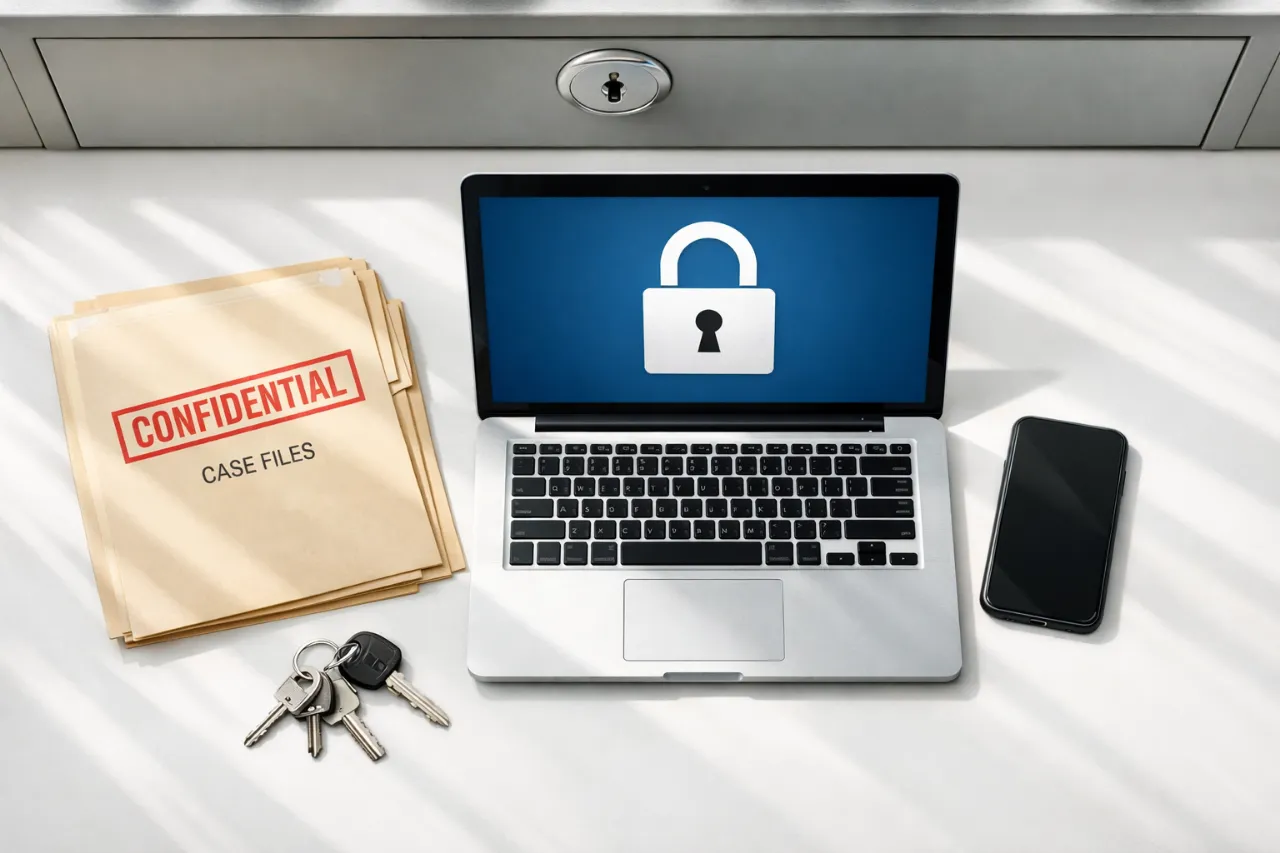
Funeral homes hold some of the most sensitive personal data of any small business. Names, dates of birth, addresses, PPS numbers, National Insurance numbers, financial details, medical cause of death, family relationships, religious beliefs - all of it collected routinely, often within hours of a death, and stored indefinitely in filing cabinets, email inboxes, and spreadsheets that haven't been audited since they were created.
Most funeral homes have never conducted a formal data audit. Many don't have a written data protection policy. Few have considered what would happen if a laptop were stolen, an email sent to the wrong address, or a former employee still had access to case files. None of this makes funeral directors negligent - it makes them typical of small businesses handling data they were never trained to manage. But the legal obligations exist regardless of whether you've read them.
What Data Funeral Homes Actually Hold
Before getting into regulations, it's worth understanding the sheer volume and sensitivity of what sits in your systems and filing cabinets.
Deceased Person's Data
- Full name, date of birth, date of death, last address
- PPS number (Ireland) or National Insurance number (UK)
- Medical cause of death and doctor/coroner details
- Religious affiliation and denomination
- Cremation or burial preferences and instructions
- Photographs used for tributes and memorial materials
Family and Next-of-Kin Data
- Names, addresses, phone numbers, email addresses
- Financial information (payment details, account numbers)
- Relationship to deceased
- Communications history (emails, letters, notes from arrangements)
Staff Data
- Employee personal details, payroll information, contracts
- Next-of-kin details for staff
- Training records and certifications
Supplier and Third-Party Data
- Contact details for clergy, florists, musicians, celebrants
- Crematorium and cemetery contacts
- Medical professionals and coroner correspondence
When you list it out, the volume is significant. A single funeral case generates data across multiple categories, much of it classified as “special category data” under GDPR - meaning it requires even greater protection. Religious beliefs and health data both fall into this category.
The Legal Framework
Funeral home data security obligations sit within the broader GDPR framework, which applies with slight variations across both the UK and Ireland.
United Kingdom
The UK operates under the UK GDPR - the retained EU regulation post-Brexit - alongside the Data Protection Act 2018. The regulator is the Information Commissioner's Office (ICO), which has the power to investigate complaints, conduct audits, and issue fines.
Every funeral home processing personal data must be registered with the ICO. The annual fee for most small organisations is £40. Failure to register is itself a breach - and the ICO does check.
Ireland
The EU GDPR applies directly in Ireland, supplemented by the Data Protection Act 2018. The regulator is the Data Protection Commission (DPC), which has become one of the most active data protection authorities in Europe.
Key Principles That Apply to Every Funeral Home
Regardless of jurisdiction, the same core principles govern how you collect, store, and use personal data:
- Lawful basis: You need a legal reason to process data. For funeral homes, this is typically “legitimate interest” (you need the data to provide the service) or, less commonly, explicit consent.
- Data minimisation: Collect only what you need. If you don't need a family member's date of birth, don't ask for it.
- Storage limitation: Don't keep data longer than necessary. More on this below.
- Security: Take “appropriate measures” to protect data. Deliberately vague - but the expectations are real.
- Individual rights: People can request access to their data, ask for corrections, or request deletion. You must be able to respond.
What “Appropriate Security” Actually Means
GDPR doesn't prescribe specific technologies. It requires “appropriate technical and organisational measures” - which means the standard scales with the sensitivity of the data. Given that funeral homes handle special category data (health, religion) alongside financial and identity information, the bar is higher than many directors realise.
Digital Files
Case data should be stored in encrypted, access-controlled systems. Not shared network drives with no password. Not email inboxes that anyone in the office can open. Not consumer cloud storage accounts (personal Dropbox, Google Drive on a free Gmail account) where the terms of service weren't designed for sensitive personal data.
EverlyPro approach
Everly Pro stores all case data with 256-bit encryption in EU data centres, with individual user logins and role-based access controls. Documents, communications, and case files are secured within the platform rather than scattered across email accounts, shared drives, and filing cabinets. It doesn't solve every GDPR obligation - you still need a data protection policy and retention schedule - but it addresses the technical security layer that most homes currently handle with a prayer and a password.
Paper Records
Physical files should be kept in locked cabinets with controlled access. Not open shelving in a shared office. Not boxes in a garage. If paper records contain cause of death, medical information, or financial details, they require the same level of protection as digital records - arguably more, since they can't be encrypted.
Consider which staff members genuinely need access to paper files and restrict accordingly. A receptionist answering phones doesn't need access to medical cause of death documentation.
Access Controls
Every staff member should have their own login credentials for any system holding case data. Shared passwords - one login for the whole office - are common in funeral homes and represent a clear security gap. When everyone uses the same credentials, you cannot audit who accessed what, when, or why. If a staff member leaves, you can't revoke their individual access without changing everyone's password.
Individual logins with appropriate permission levels (a junior staff member doesn't need the same access as the principal) are a baseline expectation, not an advanced measure.
The WhatsApp Problem
Here is the uncomfortable truth that nobody in the profession particularly wants to discuss. Case information - names, addresses, times, medical details, family instructions - is routinely shared between staff members via personal WhatsApp messages, text messages, and unencrypted email. It's fast, it's convenient, and it's how most small teams communicate.
It's also a data protection problem. Personal messaging apps store data on individual devices, often backed up to personal cloud accounts, with no organisational control over retention or access. If a staff member's phone is lost or stolen, case data goes with it. If they leave the business, those messages don't get deleted from their device.
Moving operational communications into a secure, purpose-built system - or at minimum establishing clear policies about what can and cannot be shared via personal messaging - is one of the most impactful changes a funeral home can make. It's also one of the hardest to enforce, which is why it's worth addressing directly.
Portable Devices
Laptops, tablets, and phones used for work must be encrypted and protected with passwords or biometric authentication. A laptop left in a car overnight that gets stolen is a data breach if the drive isn't encrypted - even if you get it back. Full-disk encryption is built into both Windows (BitLocker) and macOS (FileVault) and costs nothing to enable.
Data Hosting Location
Under both UK GDPR and EU GDPR, personal data should be stored in appropriate jurisdictions. For Irish funeral homes, data should remain within the EU/EEA. For UK homes, data should be stored in the UK or in countries with an adequacy decision. If your case management software stores data on servers in the United States without appropriate safeguards, that's a compliance question worth asking your provider about directly.
Retention and Deletion
How long should you keep case files? Most funeral homes keep everything, forever. Filing cabinets going back decades. Digital records from the first day the computer was switched on. It feels prudent - you might need it someday.
Under GDPR, indefinite retention without justification is a risk. You need a retention schedule: a documented policy stating how long you keep different categories of data and why.
Practical Retention Guidance
- Financial records: 6 years (UK - HMRC requirements) or 6–7 years (Ireland - Revenue requirements). Invoices, payment records, receipts.
- Case files (general): A reasonable period for handling complaints, queries, or legal claims. Many homes settle on 7–10 years post-funeral. There's no single mandated period, but “forever” isn't a defensible answer.
- Cremation records: Check your cremation authority's requirements. Some require retention of cremation forms for extended periods or indefinitely. These obligations override general retention principles.
- Employee records: 6 years after employment ends as a general guideline, though some records (pension-related) may need longer retention.
- Marketing data (e.g., mailing lists): Only with consent, and only as long as consent is valid. Review regularly.
The key principle: decide your retention periods, document them, and actually delete data when those periods expire. A written retention policy that you follow is infinitely better than no policy and a roomful of files you'll never look at again. Digital systems with archiving workflows make this significantly easier to manage than paper.
Subject Access Requests
Any living person has the right to request all personal data you hold about them. A family member could ask for every document, email, and note associated with their relative's funeral. This is called a Subject Access Request (SAR).
You have one calendar month to respond. The request can be made verbally or in writing. You cannot charge a fee unless the request is manifestly unfounded or excessive.
SARs in funeral homes are rare, but they do happen - particularly in family disputes, legal proceedings, or complaints. Having your case data organised and searchable (rather than scattered across email threads, paper files, and WhatsApp messages) is the difference between responding in a day and spending a week piecing together fragments.
Data Breaches
A data breach isn't only a hacking incident. Under GDPR, a breach is any security incident that leads to the accidental or unlawful destruction, loss, alteration, unauthorised disclosure of, or access to personal data.
Common Funeral Home Breach Scenarios
- Emailing case details to the wrong family
- A laptop or phone containing case data being lost or stolen
- A paper file left in a public area or lost in transit
- A former employee retaining access to case management systems
- Sending documents via unencrypted email when they contain sensitive information
When to Report
If a breach is likely to result in a risk to individuals' rights and freedoms, you must report it to the ICO (UK) or DPC (Ireland) within 72 hours of becoming aware. Not every breach requires reporting - but you must document all breaches internally regardless, including your assessment of risk and your decision on whether to report.
If the breach presents a high risk to the individuals affected, you must also notify those individuals directly.
What to Do Practically
- Contain the breach immediately (revoke access, retrieve documents, change passwords)
- Assess the risk to individuals affected
- Document what happened, when, and what data was involved
- Report to ICO/DPC within 72 hours if the threshold is met
- Notify affected individuals if high risk
- Review what went wrong and implement changes to prevent recurrence
Where does your software keep the data?
Hosting, encryption and whether you can export everything are listed for five funeral software systems in our UK & Ireland funeral software comparison, alongside pricing, terms and the ten capabilities that decide how a case runs.
Ten-Question Data Security Self-Assessment
Use this checklist to identify your most significant gaps. A “no” to any question indicates an area that needs attention.
| # | Question | Yes/No |
|---|---|---|
| 1 | Is all digital case data stored in an encrypted system with access controls? | |
| 2 | Does every staff member have their own individual login credentials? | |
| 3 | Do you have a written data protection policy that staff have read? | |
| 4 | Do you have a documented data retention schedule with defined periods? | |
| 5 | Are paper case files stored in locked cabinets with restricted access? | |
| 6 | Is case data ever shared via personal WhatsApp, text, or unencrypted email? | |
| 7 | Are all laptops and portable devices encrypted (BitLocker/FileVault)? | |
| 8 | Do you know where your digital case data is physically hosted (which country)? | |
| 9 | Could you respond to a Subject Access Request within one month? | |
| 10 | Do you have a process for handling and documenting data breaches? |
Most funeral homes will answer “no” to at least half of these questions. That's not a reason to panic - it's a reason to start working through them, one at a time, beginning with whichever gaps carry the highest risk. Encrypting devices costs nothing. Writing a retention policy takes an afternoon. Moving case data into a secure, purpose-built platform addresses several items simultaneously.
None of this requires a data protection consultant or a five-figure compliance budget. It requires the same practical, methodical approach that funeral directors already apply to every other part of their work - applied to the data they've been collecting all along.