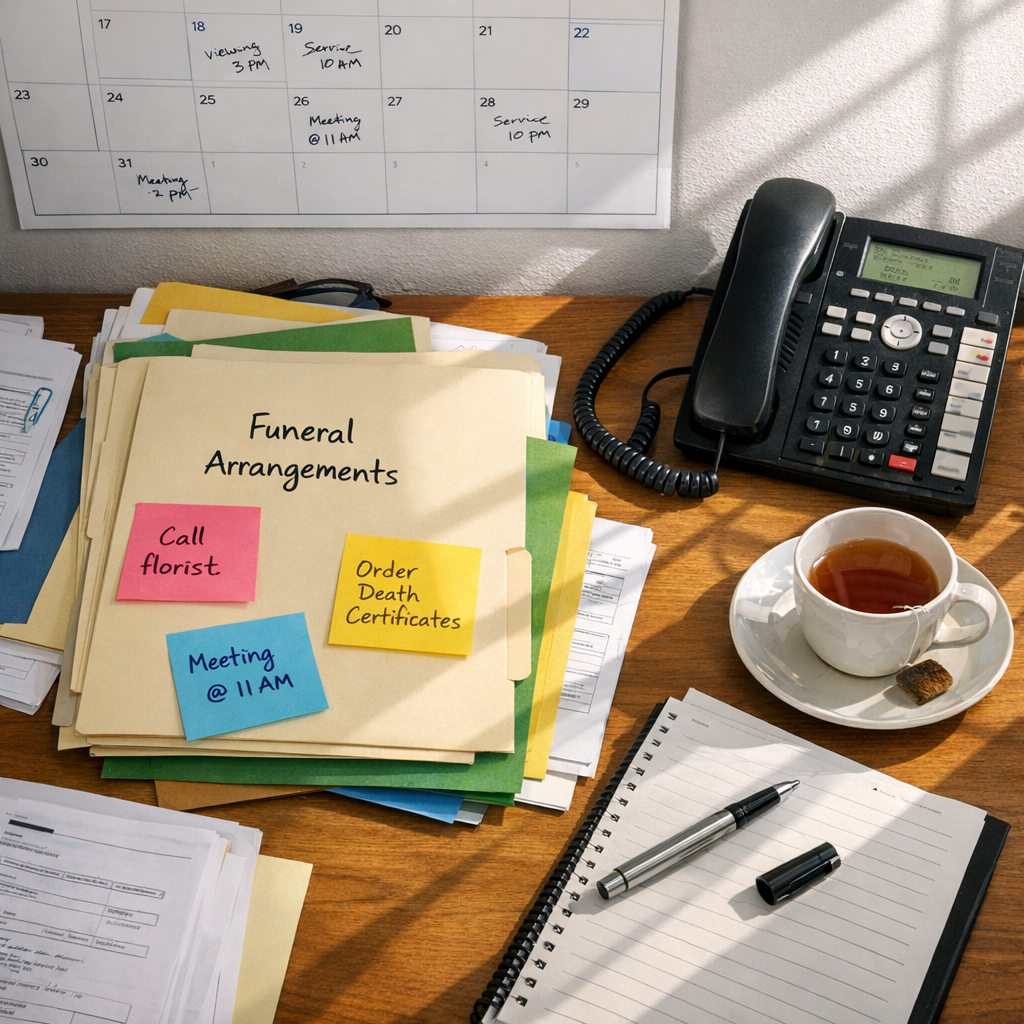
Every funeral case generates a stack of documents requiring signatures - funeral arrangement agreements, payment authorisations, burial or cremation instructions, memorial order forms, and more. Traditionally, every one of these required the family to be physically present, often across multiple visits. E-signatures eliminate that friction, and the legal ground beneath them is far more solid than most directors assume.
Legal Validity: UK
The legal framework for e-signatures in the UK rests on two pillars.
Electronic Communications Act 2000
This Act established that electronic signatures are admissible as evidence in legal proceedings and can satisfy any legal requirement for a signature. It doesn’t prescribe a specific technology or format - a typed name, a finger-drawn signature on a screen, or a click-to-sign button can all constitute a valid electronic signature, provided the signatory intended to authenticate the document.
eIDAS Regulation (Retained EU Law)
Post-Brexit, the UK retained the eIDAS framework through the European Union (Withdrawal) Act 2018. The eIDAS Regulation recognises three tiers of electronic signature:
- Simple electronic signature (SES): Any data in electronic form attached to or logically associated with other electronic data, used by the signatory to sign. This is what most e-signature platforms provide. Legally valid for the vast majority of funeral home documents.
- Advanced electronic signature (AdES): Uniquely linked to the signatory, capable of identifying them, created using data under their sole control, and linked to the signed data in a way that detects any subsequent change. Not required for standard funeral agreements.
- Qualified electronic signature (QES): Created by a qualified signature creation device and based on a qualified certificate. Carries the legal equivalent of a handwritten signature across the EU. Unnecessary for funeral service contracts.
For practical purposes: a simple electronic signature - the kind generated by any reputable e-signature platform - is legally valid for funeral arrangement contracts, payment authorisations, memorial order confirmations, and service instructions in the UK.
The Law Commission’s 2019 report on electronic execution of documents confirmed this position, concluding that existing legislation permits electronic signatures for the vast majority of legal documents, with very limited exceptions (primarily deeds requiring witnessing and certain land registration documents - neither of which applies to funeral service).
Legal Validity: Ireland
Ireland’s framework mirrors the UK’s in structure, though through EU membership rather than retained law.
Electronic Commerce Act 2000
Ireland’s Electronic Commerce Act 2000 provides that electronic signatures are not to be denied legal effect solely on the basis that they are in electronic form. Contracts formed electronically are enforceable. The Act excludes certain document categories (wills, trusts, powers of attorney, contracts for the sale of land) - none of which are standard funeral home documents.
eIDAS Regulation (EU)
As an EU member state, Ireland applies the eIDAS Regulation directly. The same three-tier structure applies. Simple electronic signatures are valid for funeral service contracts, arrangement agreements, and payment authorisations.
In practice, the legal position in Ireland is clear: e-signatures on funeral arrangement documents, service agreements, and payment authorisations are legally valid. No additional certification, witnessing, or advanced signature technology is required for standard funeral home paperwork.
Cremation Authorisation Forms: The Area That Requires Care
Cremation paperwork deserves its own section because the position is more nuanced.
In England and Wales, the cremation process involves several statutory forms. Cremation Form 1 (the application form, completed by the applicant - usually the next of kin) has historically required a wet signature. However, many cremation authorities have moved to accepting electronic signatures since 2020, when temporary pandemic-era provisions demonstrated that electronic processing worked without incident.
Medical certificates (Forms 4 and 5, formerly Cremation Forms B and C) are completed by medical practitioners, not funeral directors. Requirements for these vary and are governed by the medical practitioner’s own regulatory framework. Directors should not assume e-signatures are accepted for these forms.
The position in Northern Ireland and Scotland differs slightly in form numbering and process, but the principle is the same: check with your local crematorium before submitting cremation application forms with electronic signatures.
In Ireland, cremation authorisation requirements depend on the individual crematorium. Irish cremation legislation is less prescriptive on signature format than some directors believe, but individual crematoria may have their own policies. A quick call to your local crematorium clarifies the position in minutes.
Practical advice
Use e-signatures confidently for all your own documents - arrangement contracts, invoices, payment authorisations, service instructions. For cremation authority forms, confirm acceptance with each crematorium you work with. Many now accept them. Some still require wet signatures. This is evolving, and the direction of travel is clear.
Practical Implementation: Two Workflows
E-signatures in funeral service work through two distinct workflows, and both matter.
Remote Signing
After the arrangement meeting - or sometimes before the family visits at all - the director compiles the relevant documents into a signing packet and sends it to the family via email or SMS. The family receives a link, reviews each document on their phone, tablet, or computer, and signs electronically. Completed documents are stored automatically against the case file.
This workflow transforms turnaround times. Documents that previously waited two or three days for the family to return - or that required a second home visit - can be signed within hours. For families managing grief, work, childcare, and the hundred other demands that don’t pause for bereavement, not having to make another trip to the funeral home is a genuine kindness.
Remote signing is particularly valuable for families spread across different locations. When three siblings are arranging their father’s funeral and one lives in Manchester, one in Dublin, and one in Edinburgh, gathering physical signatures on the same document is a logistical problem. Remote signing makes it a non-issue.
In-Person Tablet Signing
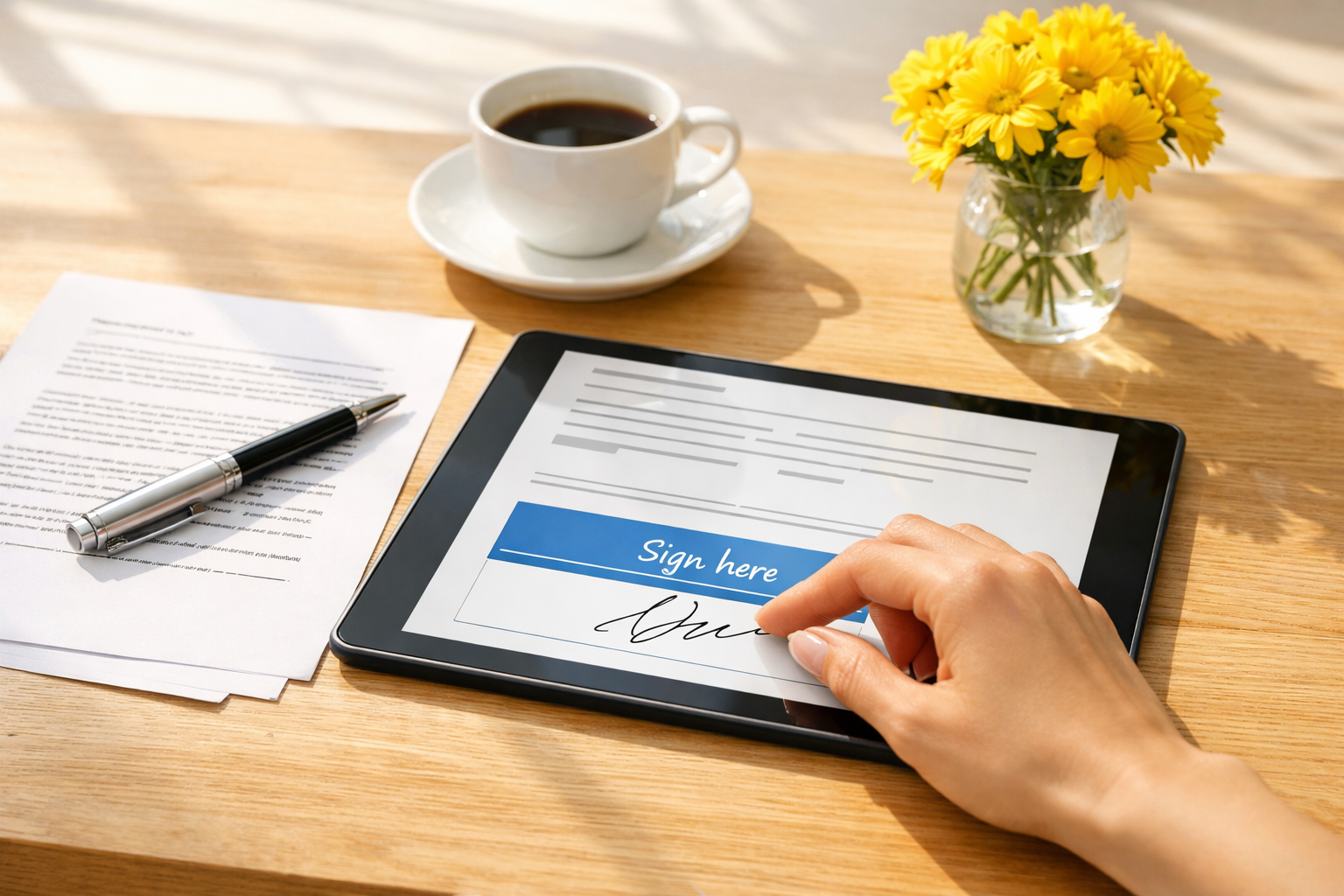
For families who are sitting across the table from you in the arrangement room, tablet-based e-signatures replace the paper shuffle. The director presents documents on a tablet, walks through each one, and the family signs on screen.
The experience is smoother than paper. No printing, no fumbling with pens, no “sign here, and here, and initial here.” Documents are complete and filed the moment the meeting ends. Nothing gets lost between the arrangement room and the filing cabinet. Nothing needs scanning.
Some directors worry this feels impersonal. In practice, the opposite tends to be true. Families spend less time on paperwork mechanics and more time in conversation. The arrangement meeting becomes about the person who died, not about chasing signatures across a stack of forms.
The Impact on Workflow and Case Management
Beyond the signing moment itself, e-signatures remove one of the most persistent bottlenecks in funeral case management. A case cannot progress until documents are signed. When signatures depend on physical presence, progress depends on scheduling. Every day a document sits unsigned is a day the case sits idle - and in a business where most services happen within a week, idle days create cascading pressure on everything downstream.
Directors who’ve made the switch consistently report the same thing: the time saved is mostly in the chasing rather than the signing itself - the phone calls to remind families, the second visits, the “we’re just waiting on your signature” conversations that consume administrative hours every week. For more on streamlining these workflows, see our post on workflow automation in funeral homes.
Everly Pro’s E-Signature Workflows
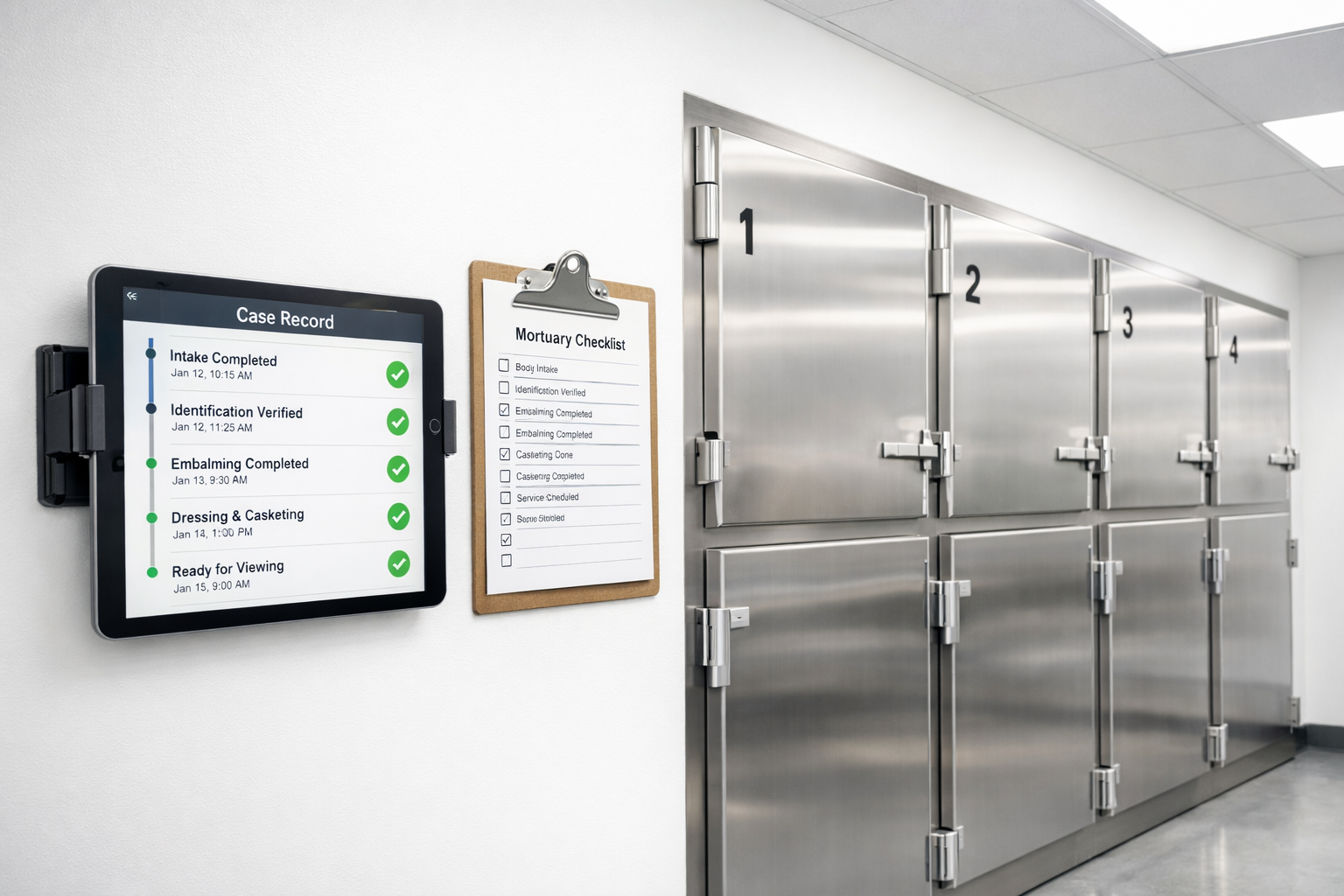
Everly Pro supports both workflows described above. Directors can compose a document packet and send it to the family via email or SMS for remote signing, or launch tablet mode for in-person signing during the arrangement meeting. Every signed document attaches automatically to the case file - no scanning, no filing, no chasing. The family receives a copy, the director has a timestamped record, and the case moves forward without waiting for paper.
Common Objections - and Honest Answers
“Families will find it impersonal”
Some might. Most won’t. Younger families in particular expect digital processes - they sign their mortgage documents electronically, their employment contracts, their GP consent forms. Being handed a physical form and a pen can feel more dated than impersonal.
Offer both options. Some families will prefer paper, especially older clients or those arranging very traditional services. Having both available is a strength, not a compromise. The key is that paper becomes a choice rather than the only path.
“I don’t trust the security”
A signed paper document in a filing cabinet is protected by a lock - and anyone with a key, or a willingness to force the drawer, can access it. E-signature platforms use encryption, timestamped audit trails, and access controls that are, by any objective measure, more secure than physical storage.
Every signed document carries a digital certificate recording who signed, when, on what device, and from what location. Try getting that level of traceability from a paper file.
“My crematorium won’t accept electronic signatures”
They might not - yet. Check with them directly. Many crematoria updated their policies during 2020–2021 and never reverted. Those that haven’t may be open to the conversation, particularly if multiple funeral homes in the area are asking.
In the meantime, use e-signatures for everything within your control. Arrangement agreements, payment authorisations, service instructions, memorial orders, accounts paperwork - all of these can go digital immediately, regardless of what the crematorium requires.
“We’ve managed fine with paper for decades”
You have. But “fine” includes hours of weekly administrative time spent printing, posting, scanning, filing, and chasing. It includes documents lost in the post, signatures delayed because the family couldn’t visit, and case files that are incomplete until someone drives across town with a form. Moving towards paperless operations is about recovering time that could be spent with families instead of filing cabinets.
Document-by-Document Reference Table
| Document Type | E-Signature Valid (UK) | E-Signature Valid (Ireland) | Notes |
|---|---|---|---|
| Funeral arrangement agreement | Yes | Yes | Standard contract - fully valid electronically |
| Payment authorisation / invoice acceptance | Yes | Yes | No legal restriction on format |
| Service instruction form | Yes | Yes | Internal document - director’s discretion |
| Memorial / headstone order form | Yes | Yes | Commercial contract - fully valid |
| Cremation application form (Form 1 / equivalent) | Check with crematorium | Check with crematorium | Many accept; some still require wet signature |
| Medical cremation certificates (Forms 4/5) | N/A - completed by medical practitioners | N/A - completed by medical practitioners | Outside funeral director’s control |
| Burial instruction form | Yes | Yes | Check with individual cemetery if their own forms are required |
| Accounts / payment plan agreement | Yes | Yes | Standard commercial agreement |
| Third-party disbursement authorisation | Yes | Yes | Director’s own document |
| Chain of custody documentation | Yes | Yes | Internal record - strongest case for digital audit trail |
Key Takeaways
- Simple electronic signatures are legally valid for funeral service documents in both the UK (Electronic Communications Act 2000, retained eIDAS) and Ireland (Electronic Commerce Act 2000, eIDAS).
- Cremation authority forms are the exception - always confirm acceptance with your local crematorium before submitting electronically.
- Remote signing via email/SMS link and in-person tablet signing are both practical workflows. Most directors benefit from offering both.
- Security of e-signatures exceeds paper-based processes by every measurable standard.
- The time saved extends far beyond the signature itself - it’s the chasing, the waiting, and the administrative friction that disappears.
Sources
- Electronic Communications Act 2000 (UK)
- eIDAS Regulation (EU) No 910/2014, retained in UK law
- Electronic Commerce Act 2000 (Ireland)
- Law Commission, “Electronic Execution of Documents” (2019)
- Law Society practice notes on electronic signatures