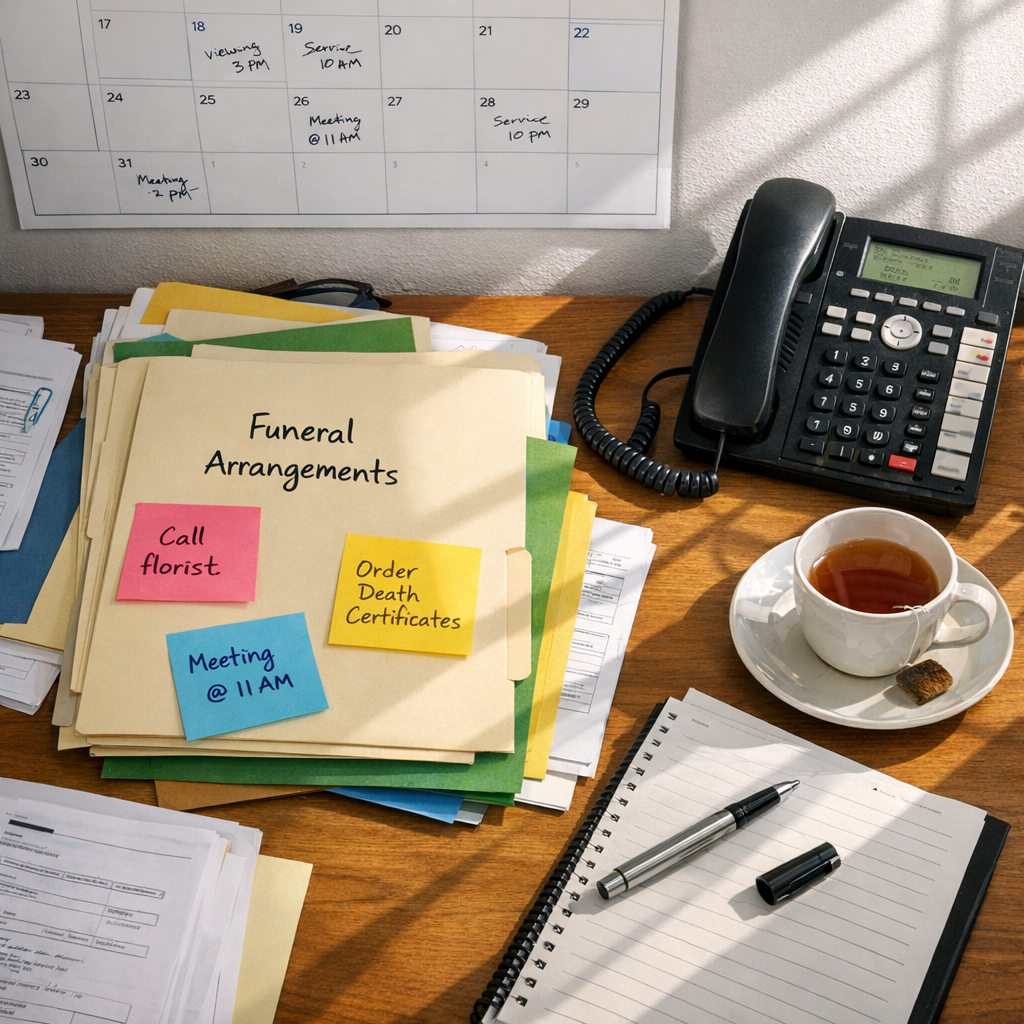
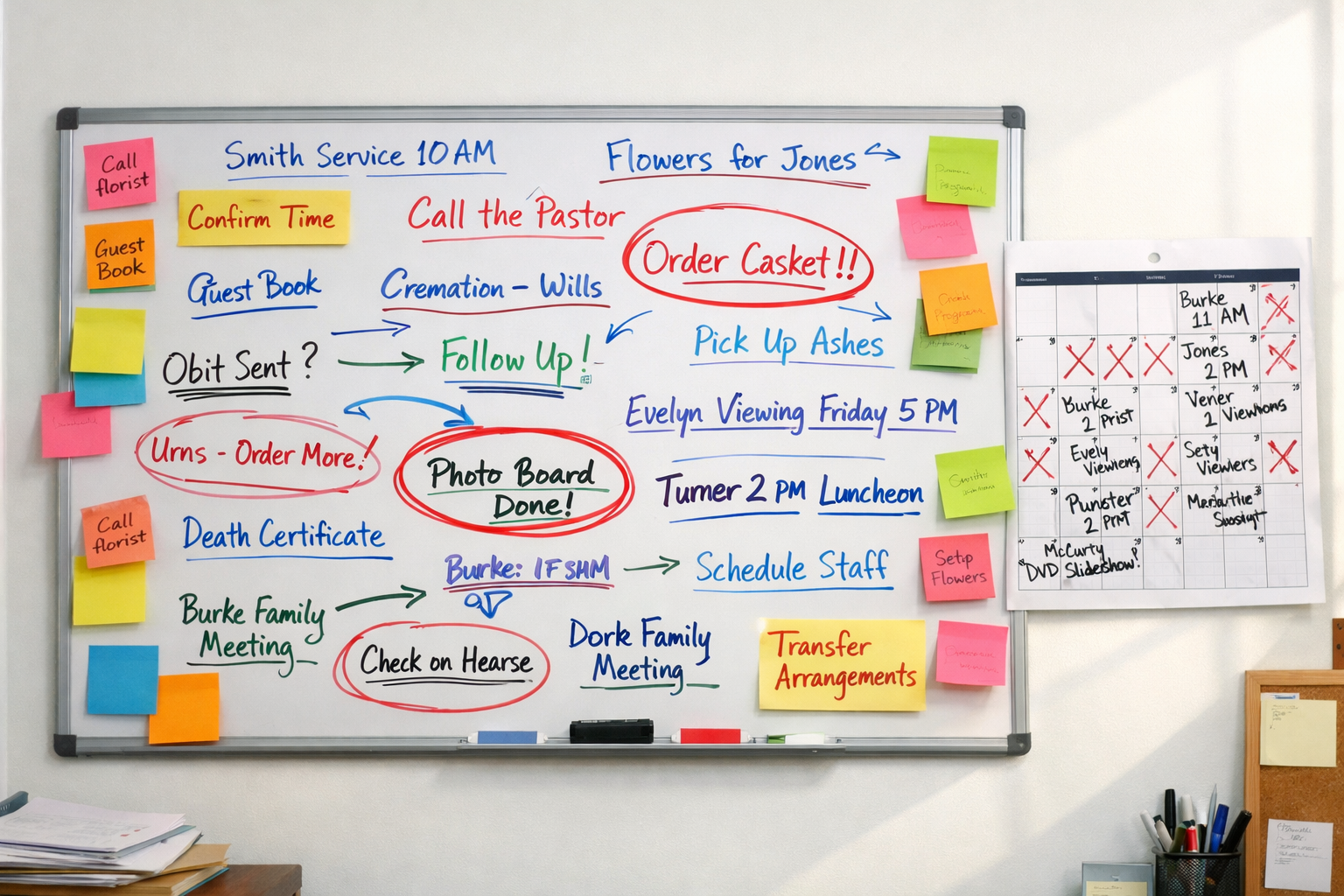
Three services this week. Two viewings. A transfer at 6am Thursday. The hearse is needed in two places at the same time on Friday. One arranger booked a service without checking the other's diary. The celebrant confirmed verbally, but nobody put it in the calendar. Then a family rings to confirm their 2pm Friday slot - and you discover there's already a service at 2pm.
This is funeral home scheduling chaos. It happens far more often than anyone in the profession admits, and it's almost never caused by incompetence. It's caused by volume, analogue systems, and multiple people making independent decisions without shared visibility.
The problem is getting worse, not better. Rising cremation rates across the UK and Ireland - approximately 65% in the UK, with direct cremations approaching 20% - mean more services are shorter, more flexibly timed, and harder to coordinate. The NAFD's operational guidance increasingly emphasises structured scheduling as a core competency, not an administrative afterthought. The IAFD Quality Standard expects funeral homes to demonstrate reliable service coordination. Yet most small-to-medium homes still run their scheduling on a patchwork of wall calendars, spreadsheets, WhatsApp messages, and memory. If this sounds familiar, the limits of these analogue tools are becoming harder to ignore.
Here are six specific scheduling failures that create operational chaos - and what fixing each one actually looks like.
1. No Single Source of Truth for the Calendar
The most common scheduling failure is the most basic: there is no one place where all events live. One arranger uses a desk diary. Another updates a shared spreadsheet. A third sends a WhatsApp to the team group. The office manager keeps a wall calendar. The owner has a system in their head.
When bookings exist in multiple places, conflicts are invisible until they collide. Nobody is making a mistake - they're all recording events. The problem is that none of them can see what the others have recorded.
The fix
Every service, viewing, transfer, and booking must go into a single shared calendar that the entire team can access and update in real time. Not a spreadsheet someone remembers to update at the end of the day. Not a wall calendar in the office that the arranger on a home visit can't see. A live, shared system that reflects reality as it stands right now.
2. Vehicle Scheduling Done by Memory
Most small-to-medium funeral homes operate with one hearse, maybe two. A limousine. A transfer vehicle. Vehicle availability is managed by whoever happens to know where the hearse is right now - which means it's managed by assumption.
When two arrangers need the hearse at overlapping times and neither checked with the other, the double-booking only surfaces the morning of the service. By then, the options are bad: borrow a vehicle from a competitor (if they'll lend one), delay a service (which means calling a family), or improvise in a way that compromises the dignity of the occasion.
The fix
Vehicle scheduling needs to be as visible as staff scheduling. Every vehicle booking - including transfers, not just services - must appear on the same timeline as everything else. If the hearse is out for a 6am transfer, it needs to be visibly blocked until it's back. If it's booked for a 10am service in one town and a 2pm service thirty miles away, the travel time between them needs to be accounted for, not assumed.
3. Staff Availability Not Tracked Centrally
The on-call rota lives in someone's head. Or on a paper schedule pinned to the office wall - one that was accurate two weeks ago. Part-time bearers whose availability changes weekly confirm by text message to whichever director asked them last. A director who was supposed to be off gets called in because nobody realised the rota was short.
Staff scheduling in funeral homes is uniquely difficult because demand is unpredictable. You cannot forecast when four families will need services in the same week. But that unpredictability makes centralised tracking more important, not less. When you don't know what's coming, you need to see clearly what you've already committed.
The fix
Every team member's availability, assignments, and on-call commitments need to be visible in one place. When an arranger is booking a new service, they should be able to see immediately which directors, bearers, and drivers are available - and which are already committed. This doesn't require complex software. It requires abandoning the fiction that someone's memory is a reliable scheduling system.
4. Chapel and Venue Conflicts
This hits hardest in homes with their own chapel or rest rooms, but it also applies to funeral homes that regularly use shared community venues, churches, or crematoria with limited slots.
Two services booked for the same chapel with inadequate turnaround time. A viewing scheduled when the room is already needed for service setup. A family arriving for a private viewing to find the room being prepared for someone else's funeral. These are routine Tuesday-afternoon occurrences when the diary isn't shared.
The fix
Every room and venue you control needs to be a scheduled resource with defined availability windows. A chapel service at 11am doesn't occupy the chapel from 11am to 12pm - it occupies it from 9:30am setup to 12:30pm turnaround. If you're booking viewings in the same space, those time blocks need to include setup, the viewing itself, and cleardown. Build the real time requirement into the schedule, not the optimistic version.
5. Celebrant, Clergy, and Third-Party Coordination Gaps
The service is in your calendar. The celebrant confirmation isn't. The organist was booked verbally but never followed up in writing. The gravediggers weren't notified of a burial time change. The florist is delivering to the wrong address because the venue changed after the order was placed.
These are coordination failures, and they happen because third-party bookings live outside the funeral home's scheduling system. The arranger confirmed the celebrant by phone and moved on to the next task. The confirmation existed as a memory, not a record. When the celebrant doesn't show, the question is always "but I thought someone confirmed them?"
The fix
Third-party confirmations need to be recorded against the event, not stored in someone's recollection. Every service should have a visible status for each external party: booked, confirmed, or unconfirmed. When the arranger can see at a glance that Friday's 2pm service has a confirmed celebrant but an unconfirmed organist, they can chase the gap before it becomes a crisis at the lectern.
6. No Lead Time or Buffer Built into the Schedule
Back-to-back services with no travel time between locations. A transfer scheduled thirty minutes before a viewing in the same premises. A hearse committed to a 10am service expected to be available for a noon service twenty miles away - with no allowance for traffic, overruns, or the simple reality that families don't always leave on schedule.
The schedule looks fine on paper until you account for physical reality. Funeral services involve vehicles moving between locations, rooms being reset, staff travelling, and families who need time. A schedule without buffers is a fiction that will collapse under its own weight by mid-morning. For a broader view of where these failures sit within the full case lifecycle, see where funeral home workflows actually break down.
The fix
Build travel time, turnaround time, and realistic buffer into every booking. A service at a crematorium forty minutes away doesn't start and end at the crematorium - it starts when the hearse leaves your premises and ends when it returns. If your scheduling system doesn't reflect that, your schedule is a wish list, not a plan.
The Operational Bridge: From Chaos to Visibility
Every one of these failures shares the same root cause: decisions made without visibility. Not bad decisions - uninformed ones. When two people can't see each other's bookings, double-bookings are inevitable. When vehicle availability lives in someone's memory, conflicts are invisible until they're emergencies.
This is where a shared resource scheduling system changes the daily reality. Everly Pro's resource timeline shows staff, vehicles, and locations in a single visual view - if the hearse is booked at 2pm Friday, anyone scheduling a second service can see the conflict before it becomes a phone call to a family. Events sync across the team calendar, so a booking made by one arranger is immediately visible to everyone else. Conflict detection flags overlaps before they're confirmed, not after they've caused damage.
A Practical Audit for Next Week
Pull up next week's schedule right now - wherever it lives. Ask yourself these questions:
- Can you see every service, viewing, transfer, and vehicle booking in one place? Not across three systems. In one view.
- Can every member of your team see it? Including the arranger on a home visit, the part-time bearer checking their shifts, the director covering the weekend?
- Are third-party confirmations recorded against each event? Or are they in someone's inbox, or worse, their memory?
- Is travel time and turnaround built into the schedule? Or does the calendar show clean, optimistic time blocks that assume everything runs to the minute?
- If you were hit by a bus tomorrow, could someone else walk in and run next week's services from your schedule alone?
If the answer to any of these is no, that's your scheduling gap. And every week it stays unfixed is another week where a conflict is coming, and some family will be on the receiving end of it when it does.
A scheduling conflict is coming. The only open question is which family will be on the receiving end of it when it does.