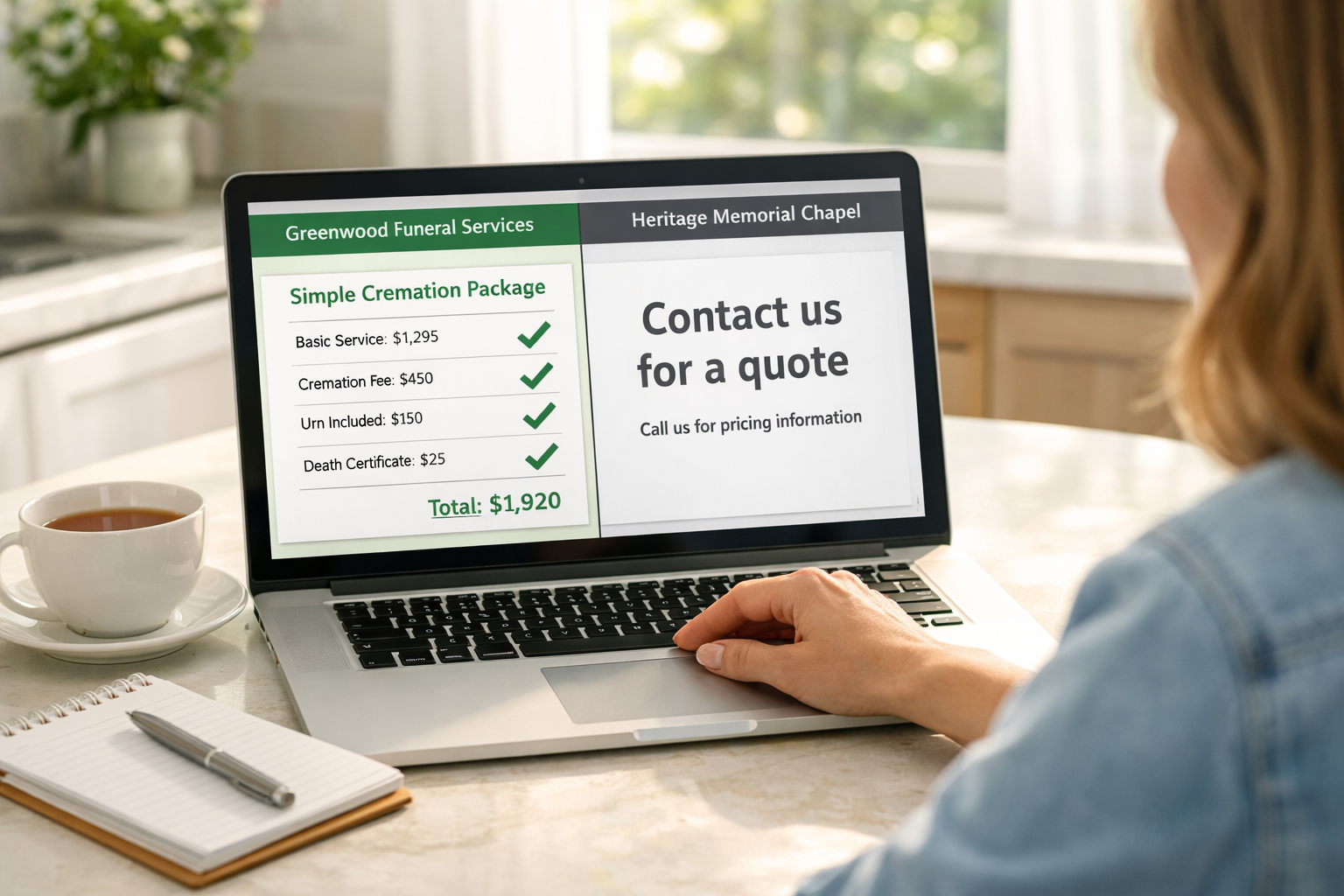

The funeral is over. The service went well - better than well. The daughter held your hand at the door and said, I don't know what we would have done without you. You believed her. Two weeks later, you check your Google Business Profile. No new review. You think about calling to ask, but it feels wrong. This family just buried their mother. You do nothing.
Three months later, you look again. Still nothing. Meanwhile, the new direct cremation provider across town has 47 five-star reviews, and they've only been open a year. (And if a negative one does land, knowing how to respond without making it worse matters just as much as earning the positive ones.)
This is the reviews problem for funeral homes. The families who would leave the best reviews are the ones you feel worst about asking.
At heart it's a human problem more than a marketing one. And it's costing independent funeral homes visibility, trust, and first calls - every single week.
Why Reviews Matter More Than Word of Mouth Now
Word of mouth built this profession for generations. It still matters. A recommendation from a neighbour or a parish priest still carries weight, particularly in smaller communities across Ireland and the UK.
But the first thing most families do before making that call is check Google. Research from BrightLocal's 2024 Consumer Review Survey found that 87% of consumers read online reviews for local businesses, and funeral homes are no exception. A funeral home with three reviews from 2021 looks dormant. A home with 30 reviews from the last twelve months looks trusted and active.
Reviews are the digital equivalent of the reputation you've spent decades building - but only if they're visible. Most directors know this. They just don't know how to ask without feeling exploitative. So they don't ask at all, and their Google listing tells a story that doesn't match the reality of what happens inside their doors.
The NAFD's own guidance acknowledges that families increasingly research funeral directors online before making contact. If your online presence doesn't reflect the quality of your care, you're invisible to the families who need you most. For a broader look at how to build that online presence, see our guide to funeral home SEO.
The Email That Doesn't Feel Like a Review Request
Back to our director. He decides to try something. Two weeks after the funeral, he sends a personal email to the daughter. Not a review request - a genuine check-in.
He asks how she's doing. Whether there's anything the family still needs. He mentions that he's available if they want to talk through any aftercare support - registrar queries, memorial options, anything at all.
At the bottom of the email, one line:
If you felt we looked after your family well, we'd be grateful if you'd share your experience on Google - it helps other families find us when they need support.
That's it. No pressure. No five-star graphic. No follow-up sequence. No "click here to leave a review" button pulsing in the middle of the email.
He sends it and moves on.
Why This Works: Timing, Tone, and Framing
Three things make this approach effective without making it crass.
The check-in is genuine and comes first. The email leads with care, not commerce. If the family never leaves a review, the email still did something useful - it reminded them that their funeral director is still there for them. That aftercare gesture alone builds the kind of loyalty that generates referrals for years.
The review request is secondary and optional. It's a single line at the end of an email that would exist without it. The family can ignore it without any awkwardness. There's no follow-up, no reminder, no "just checking if you saw my last email."
The framing is about helping other families, not about the business. "It helps other families find us when they need support" reframes the ask from do us a favour to pay it forward. For a family that felt genuinely supported, that framing resonates. They remember how lost they felt before they found you, and they want to spare someone else that uncertainty.
The timing matters. Two to three weeks after the funeral gives the family enough distance from the rawness of grief to reflect on the experience without the ask feeling premature. Compare this with the approaches that backfire: asking at the funeral itself (too soon, too intimate a moment to introduce a transactional request), sending an automated email the day after (tone-deaf), or never asking at all (leaving your reputation entirely to chance).
Key takeaway
Lead with care, not commerce. A genuine aftercare check-in with a single review line at the bottom is more effective - and more respectful - than any dedicated review request email.
What One Good Review Actually Does
The daughter leaves a review. It's detailed, heartfelt, five stars. She mentions specific things - how the director explained everything clearly, how the team were gentle with her mother, how the paperwork was handled so the family didn't have to worry about it.
That review sits on Google for years. It influences dozens of families who never meet the daughter but read her words before picking up the phone. Google's own data confirms that businesses with recent, detailed reviews rank higher in local search results and receive significantly more clicks than those with older or fewer reviews.
One genuine review from a grateful family is worth more than twenty generic "great service" reviews. The specificity is what builds trust. When a prospective family reads about how the team were gentle with her mother, they're not reading a rating - they're reading a promise.
Systematising the Ask Without Losing the Heart
The director can't write a bespoke email to every family from scratch. Or can he?
The answer is somewhere in between. With a well-written template that feels personal, timed appropriately, and triggered at the right stage of the case lifecycle, the process can be consistent without being robotic. The key is that the template provides the structure, but the director provides the judgment - deciding which families to send it to, adjusting the wording if needed, and choosing the right moment.
Everly Pro handles this specific problem. When a case is archived after completion, the system can trigger a review request using a customisable email template - personalised with the family's name and the deceased's name, sent at the interval the director chooses. Critically, the director reviews and approves each email before it sends. It's automation that keeps the human in the loop, solving the timing and consistency problem without removing the care from the process.
The goal is to automate the reminder, not the empathy, so that the ask actually happens - because left to memory and good intentions alone, it rarely does.
How EverlyPro helps
EverlyPro's case management system can trigger personalised review request emails at the interval you choose - with director approval before every send. Automation that keeps the human in the loop.
When the Review Isn't Five Stars
Not every review will be glowing. A family who felt the cost was too high. A delay with the crematorium that was outside your control but still felt like your failure. A relative who processed their grief as anger and directed it at the nearest target.
Negative reviews happen to every funeral home eventually. How you respond matters more than the review itself.
Respond promptly - within 24 to 48 hours. A negative review sitting unanswered for weeks looks worse than the review itself.
Respond with empathy, not defensiveness. "We're sorry your experience didn't meet the standard we set for ourselves" is better than "Actually, the delay was caused by the crematorium, not us."
Take the conversation offline. Offer a direct phone number or email. "We'd welcome the chance to discuss this with you directly" shows prospective families that you take concerns seriously without airing the details publicly.
Remember your audience. You're not writing your response for the person who left the review. You're writing it for every family who will read that exchange in the future. A calm, compassionate response to a harsh review tells prospective families more about your character than fifty five-star ratings ever could.
Six Months Later
Six months on, our director's Google listing has 18 reviews, mostly five stars. He hasn't done anything aggressive - just a consistent, respectful ask at the right time, sent to families he genuinely served well.
The direct cremation provider across town still has more reviews. But the director's reviews are longer, more detailed, and more personal. Families reading them can feel the difference between "Quick and professional" and a paragraph about how someone's father was treated with dignity on the worst day of the family's life.
Reviews are the afterlife of good work. The service ends, the family goes home, the chapel is reset for tomorrow. But the words a grateful family leaves on Google - those outlast the service itself. They sit there quietly, doing what word of mouth used to do, reaching families you'll never meet until the phone rings.
You just have to ask. And now you know how.
Your next step
Draft a single aftercare check-in email template. Lead with care. Add one line about reviews at the bottom. Send it to the next family you serve well - two weeks after the funeral. Then make it a habit.